
You know how two contractors can look identical on paper, then one bid turns into change orders and a stretched schedule.
That is exactly why How To Choose The Right Commercial Construction Company For Your Project matters, even if your “commercial” job is really a commercial-grade renovation in a co-op, condo, brownstone, or mixed-use building in the NYC Metropolitan Area.
I’m Alex Fedin, a licensed General Contractor in New York City, and I’ve spent 25 years planning and building renovations where permits, inspections, neighbors, and tight spaces all collide.
In this guide, I’ll show you what to verify, how to compare bids without guessing, and the red flags that usually predict cost overruns.
Key Highlights
- Match experience to your exact building type (co-op rules, landmark constraints, occupied work), and ask who will actually run your site day to day, not just who sold the job.
- Verify NYC paperwork early: confirm the contractor can pull permits through DOB NOW when needed, and for many residential renovations, confirm the contractor is properly licensed with DCWP for home improvement work.
- Budget with real market signals: keep a contingency (often 10% to 20% for renovations), and sanity-check allowances against current material and lead-time risks.
- Demand safety proof you can understand: ask for recent OSHA 300A summaries, incident trends, and what they changed after an incident, not just a generic “safety plan.”
- Lock the relationship into the contract: define change orders, a schedule of values, milestone-based payments, and retainage that fits New York’s rules for private construction contracts.
How To Choose The Right Commercial Construction Company For Your Project: Why the choice matters in NYC
In NYC, the “right contractor” is not just the lowest bid or the nicest portfolio photos.
You are choosing a team that has to manage permits, neighbors, deliveries, building rules, and a schedule that rarely has empty space for mistakes.
Strong builders protect your budget in three ways: tighter planning, cleaner documentation, and faster issue resolution when something changes behind the walls.
Skanska is a good example of what large-firm systems can look like at scale. In Skanska USA’s published quick facts, it reports 2025 U.S. revenue of $8.7 billion and notes an ENR Top 400 ranking by revenue of 10th for 2024.
Mortenson also positions itself as a top-25 builder and developer nationally, and that kind of scale usually comes with repeatable processes for scheduling, procurement, and quality control.
If a contractor cannot explain their process for permits, changes, and closeout in plain English, the “surprises” will show up in your budget.
For a homeowner, the practical takeaway is simple: you want professional project controls, even on a smaller renovation.
Ask to see a sample weekly report, a sample change order form, and how they track submittals, inspections, and punch list items.
Watch a short overview on choosing a construction partner
Key factors to consider when selecting a commercial construction company
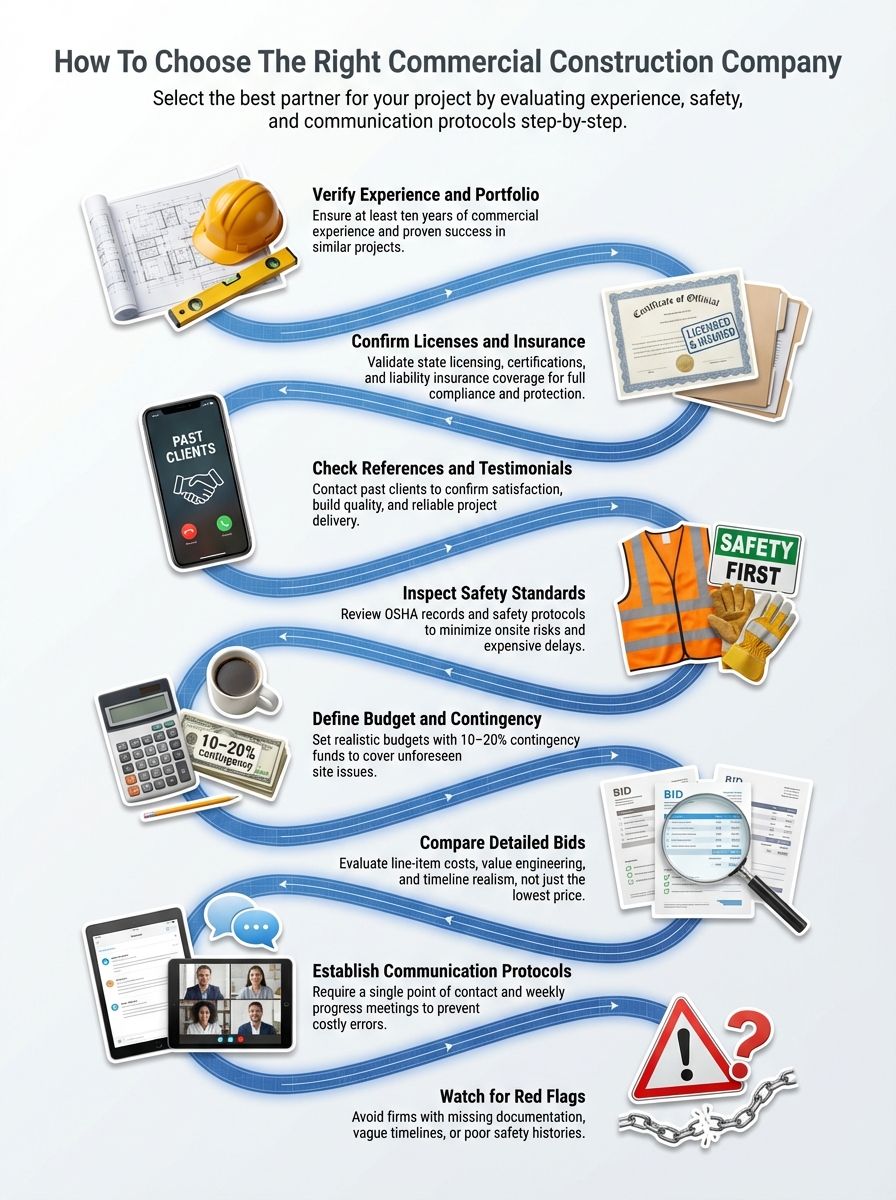
Start with the basics: relevant experience, clean credentials, a portfolio that matches your building type, and references you can actually call.
Then go one level deeper, because NYC renovations succeed or fail in the details: permits, logistics, safety, and change control.
If you want a fast way to compare firms, compare how they deliver the work, not just what they promise.
| Delivery approach | Best fit for NYC homeowners | What to watch |
|---|---|---|
| Design-bid-build | You already have drawings, and you want clean bid comparisons. | Gaps between design and construction can create change orders if drawings are light. |
| Design-build | You want one team accountable for design decisions and buildability. | Demand clear scope definitions early so “design decisions” do not become budget creep. |
| CM at Risk (CMAR) or GMP-style | Phased planning with early procurement, useful when lead times are a risk. | Verify what is included in the “guarantee” and what is treated as an allowance. |
Use that table as your lens while you review every proposal and every interview answer.
Watch: how to compare contractor bids and proposals
How much industry experience should a construction company have?
Ten years of experience is a solid baseline, but in NYC I care more about relevant experience than a long timeline.
A contractor who has completed occupied apartment renovations, co-op alterations, and tight-access deliveries will usually outperform a contractor with decades of experience in wide-open suburban sites.
HomeRenovation4U, for example, describes 20+ years in business serving New York City, New Jersey, and Pennsylvania, which matters because a “good plan” has to survive local inspections and real-world site conditions.
If you’re evaluating larger commercial builders (like Mortenson or Skanska), treat them as benchmarks for systems and project controls, then confirm whether they are the right fit and available for your project size and location.
- Ask for three comparable projects: same building type, similar scope, and similar constraints (occupied work, limited hours, board approvals).
- Ask who will be your superintendent and who will be your project manager, and request a short resume for both.
- Ask for a real schedule sample (not a marketing timeline), including inspections and long-lead items.
- Ask how they handle subcontractor coordination in NYC (elevators, deliveries, staging, noise rules).
- Confirm how they control changes: what triggers a change order, and how fast you get pricing.
What does client feedback reveal about a company’s reputation?
Client feedback tells you how a contractor behaves when the plan meets reality.
Look for patterns in three areas: schedule honesty, change-order fairness, and how they communicate in stressful moments.
On Mortenson’s site, Joe Dieker (Cornell College) describes Mortenson as building confidence and helping deliver an excellent campus. That kind of comment matters because it points to planning and follow-through, not just finishes.
Lloyd Construction publishes testimonials that get more specific. Jordan Huisken (First State Bank Southwest) describes the process as seamless, and Ryan Brown (American Bank & Trust) says the finished building exceeded expectations.
Dick Molseed (Avera Addiction Care Center) also calls out quality and communication, which are two signals I pay attention to on any renovation.
- Ask each reference, “What was the first problem, and how did they fix it?”
- Ask, “How close were they to the original schedule, and why?”
- Ask, “How many change orders happened, and what caused them?”
- Ask, “Would you hire them again, without hesitation?”
Which licenses and certifications are required for commercial construction?
NYC has layers of licensing, registration, and permit rules, and the mix depends on your building type and scope.
At a minimum, you want a contractor who can pull the permits that apply to your job, and who uses properly licensed trades for regulated work like plumbing, electrical, and fire suppression.
NYC DOB notes that licensed contractors must register first to use the online permit processing system, and that permit applications are filed online for renovation permits through DOB systems.
For many residential renovations in NYC, you also need to think about DCWP. The City states you need a DCWP Home Improvement Contractor license to do home improvement work on a residential building, and DCWP highlights enforcement against unlicensed contractors.
- Ask for proof of general liability, workers’ compensation, and disability coverage that is current.
- Ask who will file and track DOB items in DOB NOW, and how you will see status updates.
- Ask whether your scope triggers special inspections, and which Special Inspection Agency will sign off (TR forms and related inspections).
- If your building is pre-1978, ask about EPA lead-safe practices and whether the firm is certified for Renovation, Repair and Painting (RRP) work where it applies.
- Confirm the contractor can coordinate licensed trades for MEP work, and that those trades will pull their own permits if required.
Paperwork is not busywork in NYC. If the contractor cannot show clean, current documentation, you should assume schedule risk.
What range of services should a construction company offer?
You do not need a contractor that offers all possible services.
You need a contractor that offers what your scope demands, and can prove they have a repeatable process for it.
For many NYC homeowners, that means pre-construction planning, permit strategy, demolition and protection, licensed trades, finish carpentry, and tight closeout documentation.
Lloyd Construction, for example, lists delivery methods like construction management and collaborative design/build, which can be useful when you need phased planning and faster procurement.
HomeRenovation4U focuses on renovation scopes homeowners actually live with, including kitchens, bathrooms, basements, and interior remodels, which often require disciplined sequencing to keep dust, noise, and downtime under control.
- Pre-construction: scope definition, feasibility, and a permit plan.
- Cost estimation: a clear schedule of values and realistic allowances.
- Project management: a real schedule, weekly reporting, and daily site protection.
- Licensed trades: plumbing, electrical, HVAC, and fire protection as needed.
- Quality assurance: mockups for key details and punch list discipline.
- Closeout: warranties, manuals, and permit sign-offs where required.
How do safety and compliance affect company selection?
Safety is not a slogan. It is a predictor of schedule stability.
When a jobsite is disorderly, injuries and rework become more likely, and both show up as cost.
Skanska’s Green Sticker Program is one example of how big firms formalize jobsite support, including mental health awareness, so workers have a visible signal for who is trained to talk and connect people to help.
On your project, you do not need the same program name, but you do need the same mindset: clear rules, consistent enforcement, and fast reporting when something goes wrong.
- Ask for the last three years of OSHA 300A summaries, and ask what changed year to year.
- Ask how they train crews on site protection in occupied buildings (dust control, housekeeping, and access rules).
- Ask what a “stop work” looks like on their sites, and who has authority to call it.
- Ask how they manage hazards unique to NYC, like sidewalk sheds, street closures, and staging limits.
- Ask how they document corrective actions after an incident or near-miss.
Defining your commercial construction project requirements
A contractor can only price what you define.
If your scope is vague, your bid comparison will be guesswork, and that is where budgets break.
Start by writing down your must-haves, your constraints (hours, neighbors, building rules), and what “done” means, including inspections and approvals.
Watch: how to define project scope before bidding
How do you set a realistic budget for your project?
In NYC, renovation budgets fail for two reasons: unknown conditions and unrealistic allowances.
Protect yourself by building a budget that has a plan for both.
Mortenson’s Construction Cost Index page for Q4 2025 notes a national increase of 7.35% compared to a year earlier, and it highlights ongoing pressure from metals pricing, embedded tariffs, and persistent electrical and power-distribution lead times.
- Set a budget range, then decide what you will cut if bids land at the top of that range.
- Carry a contingency (often 10% to 20% in renovations) and keep it separate from finish upgrades.
- Demand line-item detail: labor, material, permits, insurance, protection, and supervision.
- Ask for a clear list of allowances, including what is included and what is excluded.
- Plan for long-lead items early (electrical gear, custom millwork, specialty tile), and align deposits to procurement milestones.
- Use milestone-based payments tied to verifiable progress, not calendar dates.
What is involved in planning your construction timeline?
A timeline is a tool, not a promise.
In my experience, the best timelines are built around inspections, procurement lead times, and access constraints, not just “weeks per room.”
- Build your schedule around permits and inspections, including buffer time for DOB and building-required inspections.
- Require a three-week lookahead plan, updated weekly, so you see problems before they become delays.
- Ask the contractor to identify critical path items (materials, trades, approvals) and how they will protect them.
- Confirm how the contractor schedules deliveries and staging in your building, including elevator reservations and loading rules.
- Plan “quiet work” vs “loud work” blocks if your building has hour restrictions.
- Do not accept a timeline that has no space for punch list and closeout.
How do you specify your construction needs effectively?
Clear specs reduce change orders. They also make bids comparable.
You do not need a hundred-page document to start. You need a clean scope, clear constraints, and written decisions on finishes that drive cost.
- Describe the scope in plain language, then add dimensions where they matter (kitchen linear feet, bathroom layout, ceiling heights).
- List your must-haves and your “nice-to-haves,” so value engineering is not a fight.
- Call out building constraints: work hours, elevator rules, protection requirements, and debris hauling paths.
- Specify critical systems impacts: electrical upgrades, plumbing reroutes, HVAC changes, and sprinkler or fire alarm impacts if applicable.
- Define finish standards with a short selections list (tile, fixtures, flooring, paint level, trim profile).
- Set your change-order rule: “No work proceeds without written approval with price and time impact.”
How can you research commercial construction companies effectively?
Good research is not endless Googling. It is verification.
Your goal is to confirm the contractor can legally work, has relevant experience, and has a track record of finishing cleanly.
What are the best online search methods to find construction companies?
Start with official systems, then use reviews as a secondary filter.
NYC DOB provides tools for checking contractor and permit activity, and DOB explains that DOB NOW is the portal used to do business with the department online.
- Search DOB records for permit filing history tied to the company name, and confirm work types match your scope.
- Check whether the contractor’s insurance status is visible through DOB systems, since DOB notes insurance must be active and current for permit issuance.
- Confirm DCWP licensing for residential home improvement work, and avoid contractors with a history of enforcement actions.
- Use reviews to spot patterns, then verify them by calling references.
- Look for recent projects, not just a gallery of older work.
How do you gather reliable recommendations?
Recommendations matter most when they come from someone with the same constraints you have.
In NYC that usually means the same building type, similar neighbor sensitivity, and similar permit needs.
- Ask your managing agent or superintendent which contractors consistently follow building rules.
- Ask for references that are one to three years old, so you can judge durability and follow-through.
- Ask whether the contractor was clean on change orders, and whether pricing stayed consistent with the original proposal.
- Ask who showed up for walk-throughs, and whether the company stayed responsive after final payment.
- Ask if the contractor coordinated trades well, or if the owner had to play project manager.
How should you analyze company portfolios and past projects?
Portfolios should prove three things: the contractor can build it, can manage it, and can close it out.
For specialized work, look for projects where constraints were similar to yours, not just projects that look impressive.
Skanska’s OHSU Vista Pavilion press release is a good example of the kind of detail you want to see in a serious portfolio story: it describes a 14-story, 530,000-square-foot hospital expansion completed in December 2025 and scheduled to open to patients in April 2026, with logistics that required prefabrication and just-in-time deliveries.
- Ask for before-and-after photos plus one “in-progress” photo set that shows protection and staging.
- Ask for scope clarity: what was included, what was excluded, and what changed.
- Ask how they handled inspections and sign-offs, and who owned the closeout process.
- Confirm the project had a similar occupancy condition (occupied, partially occupied, or vacant).
- Ask for the client contact, then ask that client about schedule reality.
How do you evaluate bids and proposals from construction companies?
A good proposal reads like a plan, not a guess.
If you cannot tell what is included, you cannot compare bids, and you cannot control changes.
What should you look for in cost estimates?
Cost estimates should help you spot risk early.
In NYC, the biggest “budget shocks” usually come from missing scope, vague allowances, and unplanned logistics.
- Scope match: does the estimate clearly include protection, demolition, debris hauling, and supervision?
- Allowances: are fixtures, tile, cabinets, and appliances defined with realistic numbers?
- Permits and inspections: does the bid state who files, who pays fees, and who schedules inspections?
- Site logistics: does it include staging, delivery plans, and building-required protection?
- Schedule of values: can you see what each phase costs, so progress payments match progress?
- Exclusions: are exclusions listed clearly, so you can price them before signing?
Why is considering value alongside price important?
Price tells you what you pay today. Value tells you what you keep after the work is done.
A higher bid can be the safer bid if it includes stronger protection, tighter supervision, and better closeout.
Skanska often emphasizes safety and long-term community investment in its project messaging, and Mortenson emphasizes customer success and community impact, which is another way of saying they try to protect outcomes beyond the ribbon cutting.
- Pay for clarity: detailed scope reduces change-order exposure.
- Pay for supervision: a strong superintendent prevents rework.
- Pay for procurement planning: long-lead planning protects the schedule.
- Pay for quality control: mockups and punch list discipline save time at the end.
- Pay for closeout: warranties and sign-offs protect resale value.
What contract details must you examine carefully?
Your contract should prevent the most common NYC renovation disputes: scope confusion, change-order chaos, and payment fights.
New York has also tightened retainage rules for many private construction contracts. New York State’s Senate Bill S5655 was signed on December 19, 2025, voiding contract provisions that require retainage exceeding 5% for qualifying private construction contracts.
- Scope and specs: attach the full scope, drawings, and finish selections, and reference them clearly.
- Change orders: require written pricing and time impact approval before work proceeds.
- Payment schedule: tie payments to milestones, and hold a reasonable retainage that complies with New York rules.
- Insurance and licensing: list required coverages and who pulls which permits.
- Subcontractors: require a subcontractor list for key trades and require lien waivers where appropriate.
- Closeout: define final walk-through, punch list standards, warranties, and what “substantial completion” means on your job.
Why is communication and collaboration crucial in construction projects?
Communication is not a soft skill on a renovation. It is a control system.
If you do not have a consistent reporting rhythm, small issues become expensive issues.
How can you create effective communication channels?
Set communication rules before demo starts, then keep them simple.
- Name a single point of contact for you, and a single point of contact for the contractor.
- Hold a weekly site meeting with a short agenda: schedule, selections, open issues, and safety.
- Require a written weekly update with photos, completed items, and next-week plan.
- Maintain an open-issues log (who owns it, due date, and status).
- Use one change-order channel so approvals do not get lost in texts.
- Agree on an escalation path for urgent decisions and after-hours emergencies.
What are ways to promote transparency throughout the project?
Transparency means you always know three things: where the schedule stands, where the money stands, and what decisions are waiting on you.
- Use a shared schedule, updated weekly, including inspections and long-lead deliveries.
- Track budget vs approved changes in one running summary.
- Require photos that show behind-the-wall work (plumbing, electrical, waterproofing) before it is closed.
- Use a folder system for submittals, product approvals, and warranty documents.
- Request safety documentation, including incident reporting and corrective actions, and ask what they do to support jobsite wellbeing.
- Do a formal mid-project walk to catch scope drift early.
Expertise required for specialized commercial construction projects
Some NYC homeowner renovations become “specialized” the moment you touch regulated systems, complex occupancy conditions, or building-wide constraints.
When that happens, you want a contractor who can prove they have done similar work safely and cleanly.
What should you know about building healthcare and medical facilities?
Healthcare work is a strict example of why process matters: infection control, phased work, and constant coordination.
Skanska’s Vista Pavilion announcement describes prefabrication and just-in-time deliveries to keep an active hospital environment operating, plus sustainability measures like diverting about 90% of construction waste from landfills.
If your NYC project involves a medical tenant buildout or work in an occupied, sensitive environment, borrow the same expectations.
- Ask how they isolate work areas (dust control, negative air where appropriate, and protection plans).
- Ask for a plan to maintain safe access and egress for occupants.
- Ask how they schedule loud work and shutdowns to reduce disruption.
- Ask who manages inspections and documentation so the space can open on time.
What are the challenges in constructing data centers and tech buildings?
Data center construction is about power, cooling, lead times, and testing.
You may not be building a data center, but NYC renovations often include tech-heavy scopes like electrical service upgrades, building-wide Wi-Fi, AV systems, or server rooms for a business below you.
- Ask what equipment has the longest lead time, and when they plan to order it.
- Ask how they coordinate shutdowns with the building and utilities.
- Ask what testing is included (startup, balancing, commissioning where applicable).
- Ask how they protect finished areas while heavy equipment is moved in and out.
How do you approach developing retail and commercial spaces?
Retail and commercial spaces succeed when the contractor understands finishes, durability, and fast turnarounds.
Lloyd Construction lists retail-related projects and describes collaborative delivery, which matters in tenant work where schedules are tight and decisions move fast.
If your renovation includes a storefront, a lobby upgrade, or mixed-use work, focus on details that protect long-term wear.
- Confirm floor and wall assemblies meet durability needs for traffic.
- Ask how they coordinate inspections so you avoid last-minute delays to opening.
- Ask how they plan deliveries and debris removal so the building stays clean.
- Ask for mockups of key finish transitions before they install everything.
What are the warning signs when choosing a construction company?
Most bad projects give warnings early.
If you learn to spot them, you can avoid the contractor selection mistakes that cause budget blowups and unfinished punch lists.
Why is missing documentation a red flag?
Missing documentation means you cannot verify what you are buying.
In NYC, it also means you may be the one holding the risk if permits, insurance, or licensing are not in order.
DCWP has publicly warned New Yorkers about contractors operating without a required home improvement license, and it has highlighted enforcement actions tied to unlicensed activity.
- If they will not show insurance certificates, assume you will be chasing problems later.
- If they cannot explain who pulls permits, assume the job may stall.
- If they “do not do paperwork,” assume you will not get clean closeout.
- If they refuse written change orders, assume the final bill will surprise you.
How to identify unrealistic commitments and timelines?
Unrealistic timelines sound great in a sales meeting, then collapse in the field.
A real schedule names tasks, dependencies, inspections, and long-lead items.
Skanska’s Vista Pavilion release is a reminder that serious builders track milestones and constraints closely, even on complex projects, and they will explain the “how,” not just the date.
- Watch for promises with no written schedule, no procurement plan, and no inspection plan.
- Watch for bids that are missing protection and supervision line items, then claiming a fast finish.
- Watch for “we start tomorrow” pressure before you have a complete scope and contract.
- Watch for vague allowances that make the schedule look shorter than reality.
What indicates a substandard safety record?
Safety problems show up as clutter, confusion, and shortcuts.
They also show up in documentation, if you ask for it.
OSHA provides public inspection and citation data through its establishment search, and it notes the database is updated daily, which makes it a practical verification tool when you are vetting a contractor.
- Ask for recent OSHA 300A summaries, and do not accept “we do not share that.”
- Check for a pattern of repeat issues: PPE, housekeeping, fall protection, and training gaps.
- Ask what corrective action they took after the last incident or near-miss.
- Walk an active site if possible, and look for clean staging and clear walkways.
Final Wordz
How To Choose The Right Commercial Construction Company For Your Project comes down to verification, not vibes.
Choose a contractor with relevant NYC experience, clean credentials, clear bids, and a written plan for safety, schedule, and change orders.
Keep communication tight, tie payments to milestones, and you give your renovation the best chance to finish cleanly and on time.
FAQs
1. How do I judge a commercial construction company’s experience and portfolio?
Look for past projects like your project, review their portfolio for scope and outcomes, and note sector experience. Ask for references, visit finished sites, and confirm safety records and permits.
2. What licenses, insurance, and safety checks should I require from a commercial construction company?
Ask for current licenses, liability insurance, and worker compensation proof, and check state records for standing. Require evidence of safety programs, and verifiable references.
3. How should I compare bids, to protect my budget and timeline?
Compare the full scope, materials, exclusions, and schedule, not just the bottom line. Choose the company that shows clear services, a realistic timeline, and a strong contract that guards your budget.
4. How can I evaluate communication, project management, and post-construction support?
Pick a commercial construction company that assigns a single project manager, gives regular written updates, and answers questions fast. Make sure they coordinate trade partners, handle permits, and provide warranty or post-completion support.