

You can usually tell in the first two meetings whether a commercial general contractor will protect your schedule and budget, or quietly create chaos.
In NYC, the margin for error is thin.
I’m Alex Fedin, a licensed General Contractor and founder of HomeRenovation4U, and since 2000 I’ve helped homeowners across the NYC Metropolitan Area plan and run renovations with tighter scopes, cleaner paperwork, and fewer surprises.
In this guide, I’ll show you exactly what to verify, what to ask, and how to compare contract options like a pro.
Key Points
- Verify licenses, certificates of insurance, bonding, EMR, and loss run reports before hiring a commercial general contractor.
- Prioritize local NYC experience, contractors who plan preconstruction well can reduce total costs by 5–10% by catching scope gaps early and ordering long-lead items before they stall the job.
- Confirm the contractor is properly registered for your job type, and ask for proof of minimum coverage levels required to pull permits (including general liability, workers’ compensation, and disability coverage).
- Choose an appropriate contract: fixed price, cost-plus, guaranteed maximum price (GMP), or time-and-materials (T&M), and make sure your change order rules are written, not verbal.
- Expect typical timelines: small 2–6 months, mid-size 6–12 months, office build-outs 6–12 months, large projects 12–24+ months, then add time for approvals, long-lead materials, and closeout sign-offs.
- Require clear scopes, line-item cost breakdowns, PMIS access, and regular updates to reduce delays, change orders, and surprise costs.
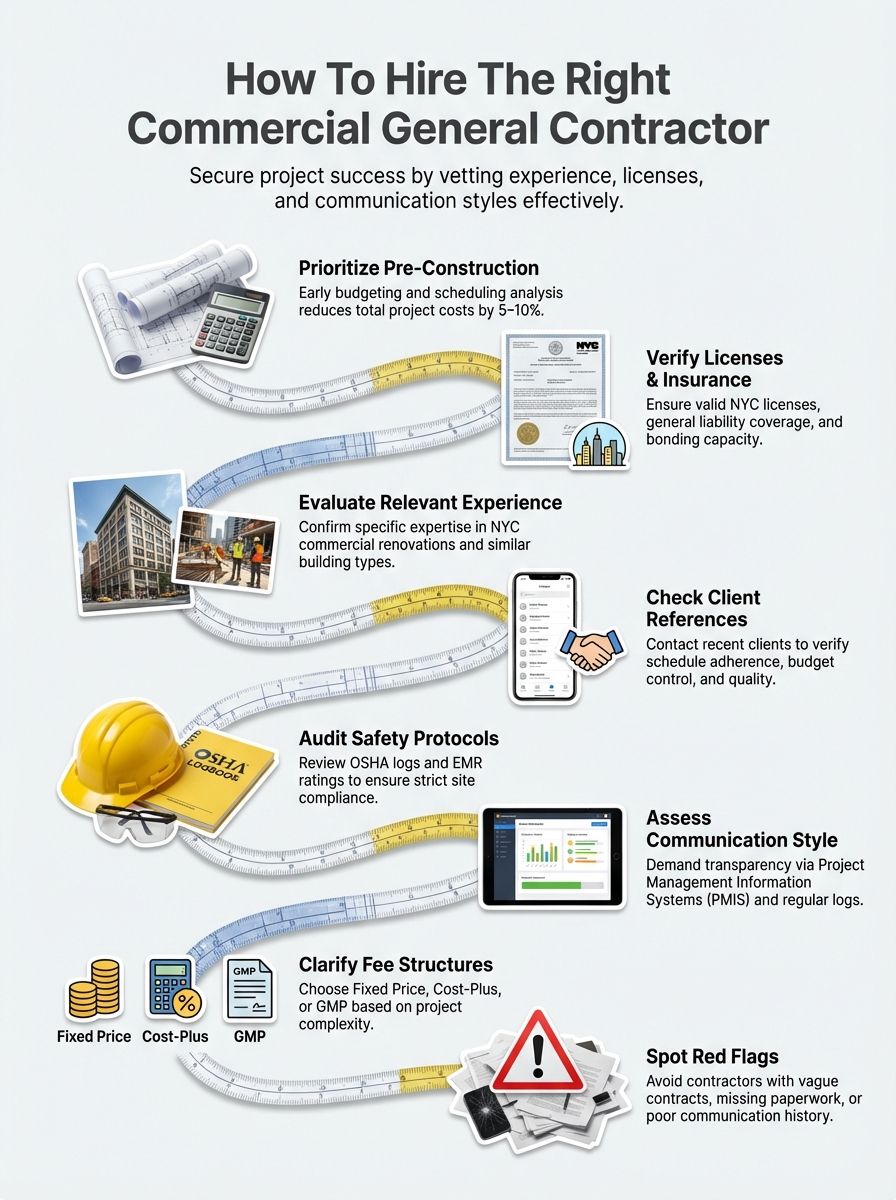
Understanding a Commercial General Contractor
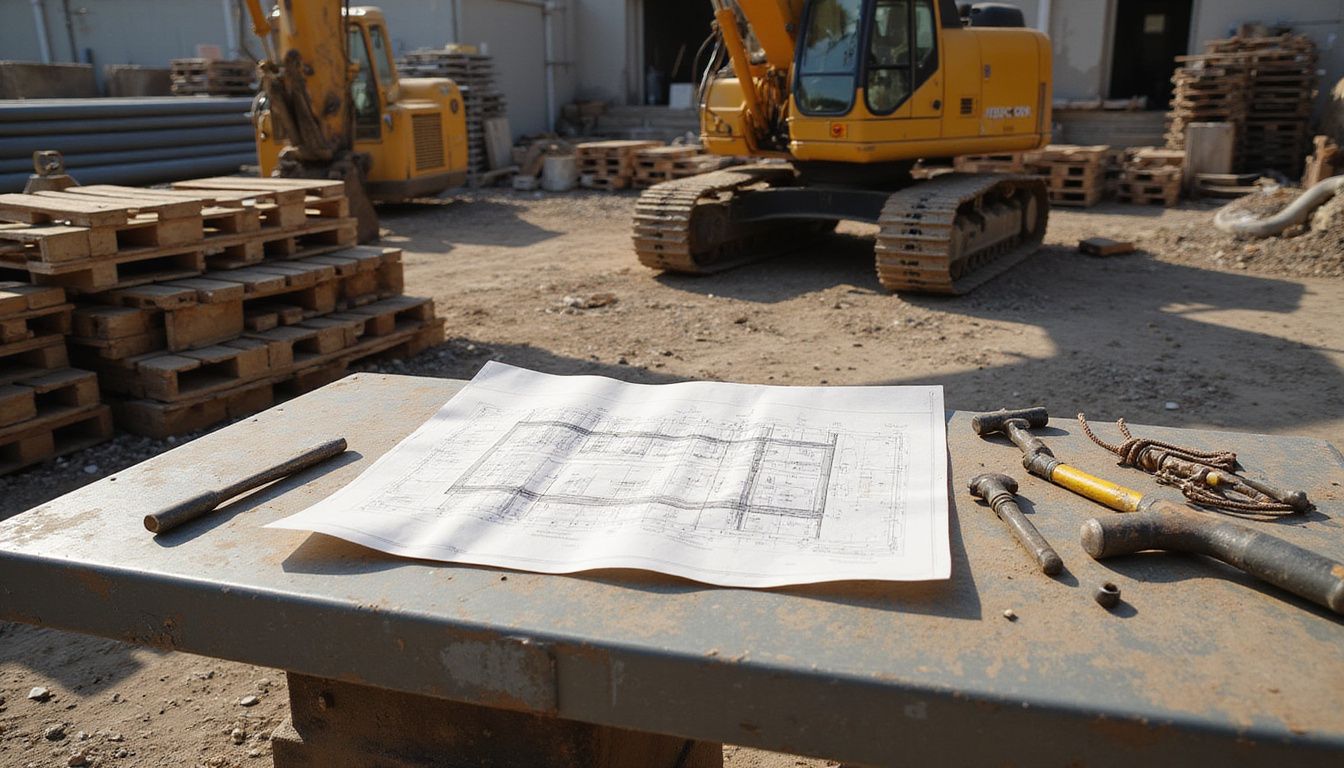
A commercial general contractor coordinates trades, manages schedules, and drives the paperwork that keeps a job moving through inspections and sign-offs.
In NYC, that paperwork is not optional. The NYC Department of Buildings requires contractors who supervise construction or demolition work to register, and it ties permit activity to active insurance on file. This is the backbone of real risk control for your renovation.
Video: A quick overview of what a general contractor does
What is a Commercial General Contractor and What Do They Do?
Commercial general contractors manage scheduling, budgeting, and subcontractor coordination for renovation and new construction projects in NYC.
They oversee the full build process, from early planning through closeout, and they coordinate architects, engineers, and trade partners so the work stays buildable, inspectable, and on time.
In practice, the best contractors run two tracks at once: the field work and the documentation.
- Field control: sequencing trades, enforcing site rules, controlling quality, and solving clashes between structural, electrical, plumbing, and HVAC work.
- Paper control: RFIs, submittals, change orders, daily logs, and inspection coordination so you have a clean record when questions come up.
- System control: many teams use a project management information system (PMIS) such as Procore or Autodesk Build, so you can see logs, photos, punch lists, RFIs, and schedule updates without chasing texts and email threads.
If you want a simple litmus test, ask how they track daily site activity. A serious commercial general contractor can show you a repeatable daily log routine and a punch list process that closes items fast.
How Do Commercial and Residential General Contractors Differ?
A commercial general contractor usually handles bigger scopes, tighter safety expectations, and more coordination than a typical residential crew.
Commercial work often involves higher occupancy classifications, fire and life safety requirements, accessibility obligations, and a heavier inspection rhythm, which makes schedule management less forgiving.
Office build-outs commonly run 6 to 12 months, while large projects can span 12 to 24 months or more.
Here are two NYC-specific differences you should ask about during interviews.
- Site safety training: under Local Law 196, many job sites that require specific site safety roles also require workers to have a total of 40 hours of safety training. Ask the contractor how they verify training compliance for their crews and subs before anyone steps onto your site.
- Closeout expectations: commercial projects often rise or fall on sign-offs, letters of completion, or certificates tied to legal occupancy and use. Your contractor should be able to explain how they plan to get from final inspection to final documentation without dragging your finish date.
Why Hiring the Right Contractor Matters
Hiring the right commercial general contractor saves time, cuts costs, and keeps your project on schedule.
A skilled contractor enforces quality standards, reduces rework, and protects your budget with clear documentation instead of wishful thinking.
Video: Why contractor selection affects cost and schedule
How Does the Right Contractor Improve Project Efficiency?
A skilled commercial general contractor keeps projects on schedule, on budget, and within scope because they force decisions early.
They spot conflicts before they hit the field, coordinate trades so work does not get torn out and rebuilt, and they keep approvals and inspections from turning into surprise downtime.
One practical difference you can measure is how they manage preconstruction.
- They confirm what is included, what is excluded, and what is an allowance before pricing goes final.
- They identify long-lead items (like custom millwork, specialty glass, electrical gear, or packaged HVAC) and build procurement time into the schedule.
- They set a communication cadence so you are not guessing, weekly owner updates plus a written log is a solid baseline for NYC jobs.
Local experience matters because NYC is a logistics city. If a contractor understands deliveries, building rules, staging, and trade availability, you see it in fewer stalled days.
How Can You Avoid Cost Overruns When Hiring a Contractor?
Cost overruns rarely come from one big mistake. They usually come from small gaps that compound: missing scope, unclear allowances, and loose change order rules.
Use value engineering to boost function, cut waste, and keep quality high, but only if it’s documented and approved before it hits the field.
- Demand a line-item scope and cost breakdown: if the bid lumps everything into a few vague numbers, you cannot compare contractors or control change orders.
- Ask for proof of active insurance and claims history: request certificates of insurance and loss run reports, then look for patterns, not just one-off issues.
- Control allowances: require a written allowance schedule (amount, what it includes, what it excludes, and the selection deadline). Late selections are a quiet schedule killer.
- Lock a change order process: no work proceeds without a written change order that states scope, cost, and time impact.
If your project needs project-specific liability coverage based on building height or scope, build that into your bid review. Insurance requirements can change the contractor’s pricing and the time it takes to start.
Why Is Maintaining Quality Standards Important?
Quality is not a finish issue. It is a control issue.
When a contractor runs consistent inspections, tracks punch lists, and holds subs to written standards, you cut rework, reduce delays, and protect the long-term durability of the renovation.
Safety is part of quality, and it has paperwork you can verify. OSHA rules require many employers to post an OSHA Form 300A summary by February 1 and keep it posted through April 30 each year, and those records must be retained for five years. If a contractor cannot explain their recordkeeping approach, treat it as a warning sign.
- Ask for the contractor’s safety manual and a real jobsite inspection routine, not a generic PDF.
- Review EMR and loss runs together, EMR is a snapshot, loss runs show the story behind the number.
- Confirm workers’ compensation and general liability coverage match your building and lender requirements.
Homeowners in the NYC Metropolitan Area should treat quality controls the same way they treat budgets, as a system you can audit.
Key Responsibilities of a Commercial General Contractor
A commercial general contractor leads pre-construction planning, secures permits, and builds the project schedule to keep work on track.
They manage subcontractors, enforce quality and safety standards, and handle closeout tasks like inspections and final documentation.
Video: General contractor responsibilities from start to finish
What Is Involved in Pre-Construction Planning and Bidding?
Preconstruction is where you win the job, or pay for it later.
Instead of focusing only on the bottom-line number, evaluate how the contractor builds the number.
- Budgeting and schedule realism: contractors should connect the estimate to an actual sequence of work, long-lead ordering, and building access constraints, not a generic timeline.
- Design and trade coordination: the contractor should coordinate architectural, structural, and MEP scope early to reduce field conflicts and change orders.
- Code awareness: NYC work is regulated under the 2022 NYC Construction Codes today, and the NYC Existing Building Code was enacted in January 2026 with an effective date in July 2027. Ask which code pathway applies to your scope, and how they plan for changes if your project spans that transition.
- Permit strategy: confirm who files what, and which licensed trades are required for your scope. A contractor who hand-waves permits is not protecting your schedule.
- Special inspections planning: on jobs that require it, the Registered Design Professional identifies responsible Special Inspection Agencies. Your contractor should know how this impacts sequencing and sign-offs.
- Bid clarity: demand clear inclusions, exclusions, allowances, unit prices (if used), and a written alternates list so you can compare bids fairly.
One more NYC reality: permits have a maximum duration of two years from issuance, and insurance lapses can trigger permit issues. That is why I push homeowners to ask for an insurance renewal plan on any project that might run long.
How Does a Contractor Oversee Project Execution?
Execution is where organization shows up, or fails loudly.
On my NYC projects, I focus on three controls: daily field leadership, weekly cost checks, and a clean paper trail.
- I run on-site construction daily and coordinate subcontractors so crews stay productive and the sequence stays intact.
- My project managers maintain daily logs with progress notes, manpower, deliveries, and job conditions, so we can resolve disputes and inspection questions with facts.
- We compare actual costs to budget weekly, flag overruns early, and adjust procurement to protect the schedule.
- We run safety meetings and enforce PPE and site rules, because injuries create downtime and paperwork that can stall a job.
- We secure long-lead items early, then track submittals and approvals so materials arrive when the schedule needs them.
- We provide regular owner updates with photos, a look-ahead schedule, and open items, so you can make decisions before they turn into delays.
- We use a PMIS to track RFIs, submittals, and punch list items, so nothing gets lost in email and text chains.
- We manage closeout throughout the job, collecting warranties, manuals, and sign-off requirements before the final week.
What Happens During Post-Construction Closeout?
Closeout is not just a final walk-through. It is the proof that your project is complete, compliant, and ready for legal use.
The NYC Department of Buildings states that you cannot legally occupy a building until a Certificate of Occupancy (or a Temporary Certificate of Occupancy) is issued when one is required, and it ties a CO to completed paperwork, sign-offs, and resolved violations.
| Closeout item | What you should ask for | Why it protects you |
|---|---|---|
| Final punch list | Written list with responsible party and due date for each item | Prevents unfinished details from getting ignored after final payment |
| Inspection sign-offs | Confirmation of final inspections and required trade sign-offs | Reduces the risk of failed completion or delayed occupancy |
| Certificate of Occupancy or completion documentation | Status of CO, TCO, Letter of Completion, or other required proof for your scope | Protects resale, refinancing, and legal occupancy |
| Warranties and manuals | Warranty letters, product manuals, and maintenance requirements | Makes repairs and claims easier later |
| Lien releases | Final lien releases from contractor and key subs (as applicable) | Reduces the chance of payment disputes showing up after you move on |
Closeout goes smoother when your contractor builds the checklist early, then updates it as the job progresses.
Qualifications to Look for in a Contractor
Hire a commercial general contractor with valid registration and licensing for your scope, strong insurance and bonding, relevant certifications, a consistent track record, and a clear safety plan.
Then verify it in writing, before you sign.
What Licensing and Certifications Should a Contractor Have?
Start with local eligibility to pull permits and run the job.
- NYC registration status: ask for the contractor’s NYC Department of Buildings registration or tracking information that matches the company name on your proposal.
- Right license for the work type: many scopes require licensed trades (like plumbing and electrical) even if you hire one general contractor to coordinate them.
- Home Improvement licensing where applicable: for certain renovations in residential properties and apartment units, a Home Improvement Contractor license can also apply, so confirm which licenses your specific scope triggers.
- Team credentials that match your scope: ask for resumes of the superintendent or construction manager who will actually run your job, and confirm similar project sizes and building types.
I worked on a Manhattan renovation where the contractor provided registration paperwork, key personnel resumes, and a Duns & Bradstreet number for business verification. That level of organization made approvals and onboarding much faster.
Why Are Insurance and Bonding Important?
Insurance and bonding are your financial seatbelts. If they are missing or sloppy, you are exposed.
At a minimum, verify these items match the contractor’s legal name and the work you are hiring them to do.
- General liability: NYC permitting and registration often requires at least $1,000,000 per occurrence, and some projects require higher, project-specific limits based on scope and site conditions.
- Workers’ compensation and disability: do not accept vague proof. NYC DOB insurance guidelines list specific accepted forms, and they also note that workers’ comp and disability should not be bundled onto a general liability certificate.
- Loss runs: ask for loss run reports directly from the insurance carrier and review frequency trends, not just the claim total.
- Bonding (when appropriate): for larger jobs, co-op or condo board work, or any project with strict completion risk, ask for evidence of bonding capacity and the bond type you will require (performance, payment, or both).
I asked for loss run reports on a recent NYC renovation and found two minor claims. That did not automatically disqualify the contractor, but it did help me set tighter safety expectations and documentation requirements.
Tips for Hiring the Right Commercial General Contractor
Vet past projects, confirm registration and insurance, check references, and ask specific questions that force clear answers.
These steps help you hire the right commercial general contractor for your NYC renovation, not just the best salesperson.
How to Evaluate a Contractor’s Experience with Similar Projects?
Before you compare price, compare fit.
- Ask for 3 to 5 completed projects that match your building type and constraints (co-op, condo, mixed-use, retail, office, townhouse), and focus on what was hard about each job.
- Confirm they regularly build in the NYC Metropolitan Area and can explain how they handle deliveries, staging, elevator protection, and building rules.
- Request a sample schedule from a recent job and ask what they do when inspections, long-lead materials, or access restrictions threaten milestones.
- Ask who will be your day-to-day lead on site, and confirm that person has run similar scopes, not just smaller residential work.
- Require proof they can pull permits and keep insurance active for the full project duration, especially on renovations likely to run longer than expected.
If the contractor cannot show you real examples, assume the learning curve will happen on your project.
How Can You Check References and Past Projects?
I review references for every commercial general contractor I consider, and I ask questions that uncover patterns in schedule control and change orders.
- Ask for recent references tied to comparable scopes, then ask those owners how many change orders occurred and what caused them.
- Request a walk-through of a completed job if possible, and look at transitions, alignment, doors, trim, tile, and punch list details.
- Ask whether the contractor finished closeout cleanly, including warranties, manuals, and sign-offs.
- Verify recency: older projects alone do not prove current staffing, current trade relationships, or current code familiarity.
If you hear the same complaint from multiple references, treat it as a forecast.
Next, I will explain common fee structures you should expect from a commercial general contractor.
What Should You Look for in Communication Style and Transparency?
Communication style is a jobsite control system.
If the contractor cannot communicate clearly before the contract is signed, it rarely improves once the work starts.
- Response expectations: agree on response times for RFIs, budget questions, and urgent site issues, and put it in writing.
- Single point of contact: confirm who owns decisions day to day, and who covers when that person is out.
- Update rhythm: require a weekly owner update with a look-ahead schedule, open items, and budget status.
- PMIS access: request access to the PMIS dashboard, and require that change orders, photos, punch lists, and daily logs live there.
- Clear scopes: insist on a detailed scope of work and a line-item cost breakdown so you can spot missing items before they become change orders.
My pro-tip: ask the contractor to show you a real weekly update from a finished project (with private info removed). It tells you more than a polished proposal ever will.
How Do You Verify Safety Protocols and Compliance?
Safety verification should be written, current, and specific to NYC.
- Request the contractor’s current safety manual and hazard communication plan, then look for jobsite inspection routines and enforcement, not just policies.
- Ask to review OSHA recordkeeping practices, including the OSHA Form 300A annual summary posting window (February 1 through April 30) and their approach to retaining records for five years.
- For sites covered by Local Law 196 requirements, ask how they verify Site Safety Training cards and training hours for their workers and subcontractors before mobilization.
- Request loss runs and discuss corrective actions taken after any claim trends, this is where you find out if safety is real or performative.
If a contractor dodges safety questions, that is enough reason to keep interviewing.
Fee Structures of General Contractors
Fee structure decides who carries cost risk, how change orders are handled, and how transparent your billing will be.
Ask your commercial general contractor to explain their fee model in plain English, then compare it side by side.
| Contract type | Best for | Owner risk | What you must demand in writing |
|---|---|---|---|
| Fixed price (stipulated sum) | Clear scope, few unknowns | Lower risk of overruns, higher risk of change order pricing | Detailed scope, exclusions, allowances, and a strict change order process |
| Cost-plus with GMP | Complex scopes where you still want a cap | Moderate risk, capped if the GMP is real and well-defined | Open-book rules, what counts as cost, fee structure, and a clear savings clause |
| Cost-plus (no GMP) | High-unknown conditions, early starts | Higher risk if controls are weak | Invoice backup requirements, fee caps, and a not-to-exceed option if possible |
| Time and materials (T&M) | Small scopes, emergency work | Highest risk if you do not cap it | Hourly rates, markup rules, daily logs, and a hard cap or stop-work threshold |
If you want standardized language, many owners and contractors use AIA contract documents as a reference point, including agreements for stipulated sum and cost-plus with a guaranteed maximum price.
What Are Fixed Price Contracts?
A fixed price contract sets a predetermined amount for all work, regardless of actual costs.
This model works best when your drawings are complete, your finishes are selected, and your scope is not likely to change midstream.
- Owner advantage: clearer budget planning and easier lender coordination.
- Owner risk: change orders can become expensive if your scope is not tight.
- Best move: require a detailed inclusions list and a written exclusions list, so you can see what the price is really buying.
How Do Cost-Plus Agreements Work?
Cost-plus reimburses the contractor for actual costs, plus a fee (a lump sum or a percentage), so the final price moves with the real spend.
I used a cost-plus deal on a 2019 Brooklyn gut renovation, and I required invoice-level backup on every trade and material purchase.
- Owner advantage: flexibility when you find hidden conditions in older buildings.
- Owner risk: without strong controls, spending can drift.
- Best move: set documentation rules, review cadence, and a not-to-exceed cap if your scope has any definable edges.
What Is a Guaranteed Maximum Price (GMP) Contract?
A GMP sets a ceiling on the project price, and it makes the commercial general contractor responsible for overruns above that cap (as long as the scope assumptions are honored).
This structure is popular for larger renovations because it blends flexibility with a hard limit, if you keep the allowance schedule and scope assumptions tight.
- Owner advantage: budget certainty with room for controlled change.
- Owner risk: a sloppy GMP (too many assumptions, too many allowances) behaves like cost-plus in disguise.
- Best move: require open-book accounting and a written savings clause, so everyone has the right incentives.
How Do Time and Materials (T&M) Contracts Function?
Time and Materials pays for actual labor hours and materials, plus a markup.
It can be the right tool for emergencies or very small scopes where pricing every detail up front costs more time than it saves.
As a commercial general contractor, I ran a 2023 condo emergency plumbing repair under T&M, and I logged every hour and part, so the owner could audit each charge.
- Owner advantage: fast start and flexibility.
- Owner risk: cost uncertainty if you do not cap it.
- Best move: set a written cap and require daily logs, receipts, and a stop-work approval threshold.
Up next, watch for common red flags to avoid costly mistakes.
Red Flags to Watch Out For
Watch for missing paperwork and vague contracts when hiring a commercial general contractor.
Poor communication and sketchy timelines often signal deeper issues, so vet references and insurance thoroughly.
What Does Lack of Proper Documentation Indicate?
Missing documentation is not a small problem in NYC. It is a predictor of delays, disputes, and failed sign-offs.
- No clear scope or line items: you cannot control change orders or compare bids.
- Cannot prove registration, insurance, or bonding: you may not be able to pull permits, and your risk exposure rises fast.
- No safety documentation: missing safety manual, unclear training compliance, or weak incident tracking signals real operational risk.
- No system for logs and updates: if they cannot show how they track daily activity, expect confusion during inspections and closeout.
If they cannot produce documents quickly during bidding, assume they will be slower when the job gets stressful.
Why Is Poor Communication a Warning Sign?
Slow or inconsistent response times early often signal disorganization.
I hired a commercial general contractor in Brooklyn who took days to answer simple questions, and that delay led to missed deliveries and a $4,200 change order.
When communication breaks down, you see it in three places first: unanswered RFIs, unclear scope decisions, and change orders that show up after the work is already done.
- They avoid direct answers about what is included in the proposal.
- They cannot name your day-to-day point of contact.
- They resist sharing schedules, logs, or PMIS access.
If you see those signs, keep interviewing.
How to Identify Unclear Project Timelines or Budgets?
Vague schedules create expensive surprises because you cannot see problems early.
Ask for a milestone schedule with inspection touchpoints, procurement windows, and a closeout plan.
- Timeline red flag: no milestones, no sequencing logic, or no plan for long-lead items.
- Budget red flag: allowances that are too low to be realistic, or a bid that does not match your spec level.
- Process red flag: they cannot explain how change orders affect both cost and time.
My last NYC renovation showed how unexplained shifts hide problems, the contractor could not explain mid-project changes and missed two key milestones.
Benefits of Hiring an Experienced Contractor
An experienced commercial general contractor speeds up schedules and cuts costly delays.
They bring proven teams and value engineering that saves money and protects quality.
How Does an Experienced Contractor Streamline Project Management?
Experienced contractors run repeatable routines: preconstruction checklists, daily logs, weekly budget reviews, and predictable owner updates.
That structure keeps decisions from piling up and turning into delays.
- They coordinate architects, engineers, and trade partners so the field stays productive.
- They run disciplined closeout so occupancy and sign-offs do not drag on.
- They keep documentation clean, which matters when questions come up from building management, inspectors, or lenders.
When a contractor can show you their process, you stop relying on promises.
Why Is Access to Skilled Subcontractors Valuable?
In NYC, trade availability can make or break your schedule.
A commercial general contractor with strong subcontractor relationships can mobilize faster, get more reliable bids, and keep quality consistent across trades.
- Reliable subs reduce rework because they understand the standard expected and the inspection rhythm.
- Better trade coverage reduces schedule gaps between phases.
- Consistent supervision keeps site safety and building rules from becoming daily friction.
This is one reason I always ask contractors to name their core subs for your trade mix, then explain how long they have worked together.
What Is Value Engineering Expertise and Why Does It Matter?
Value engineering helps you get more function for less cost, without cutting quality.
Done right, it is a documented decision process that protects your design intent while improving buildability, lead times, and long-term maintenance.
- Materials: swap to an equivalent product with shorter lead time or better warranty coverage.
- Sequencing: reorder tasks so trades stop waiting on each other.
- Scope clarity: eliminate duplicate work between trades that creates change orders later.
My experience is simple: the earlier you bring value engineering into preconstruction, the less it feels like a downgrade and the more it feels like smart planning.
Next, read the Conclusion for final takeaways.
Wrapping Up
Choose a commercial general contractor who can prove local NYC experience, show clean documentation, and communicate in a steady rhythm.
Verify registration, insurance, safety practices, and recent references before you sign.
Then lock a clear scope, a clear fee structure, and a written change order process, so your commercial general contractor can deliver quality work without budget surprises.
FAQs
1. What does a commercial general contractor do?
A commercial general contractor plans the build, hires and leads trade teams, manages budgets and schedules, and enforces quality and safety standards.
2. How do I choose the right commercial general contractor for my project?
Check licenses, insurance, and recent project results, ask for references and a clear, written estimate. Pick a commercial general contractor who uses modern tools to track time and cost, and who shows a strong record of finishing work well.
3. What should I ask in interviews with a commercial general contractor?
Ask about the timeline, how they vet subcontractors, their safety plan, and how they handle change orders. Request client contacts and samples of similar projects, so you can confirm their team work and results.
4. How do I verify a commercial general contractor’s credibility?
Confirm licenses and insurance, review finished projects, and call past clients, check financial references and safety records, and look for warranties or guarantees on the work.