
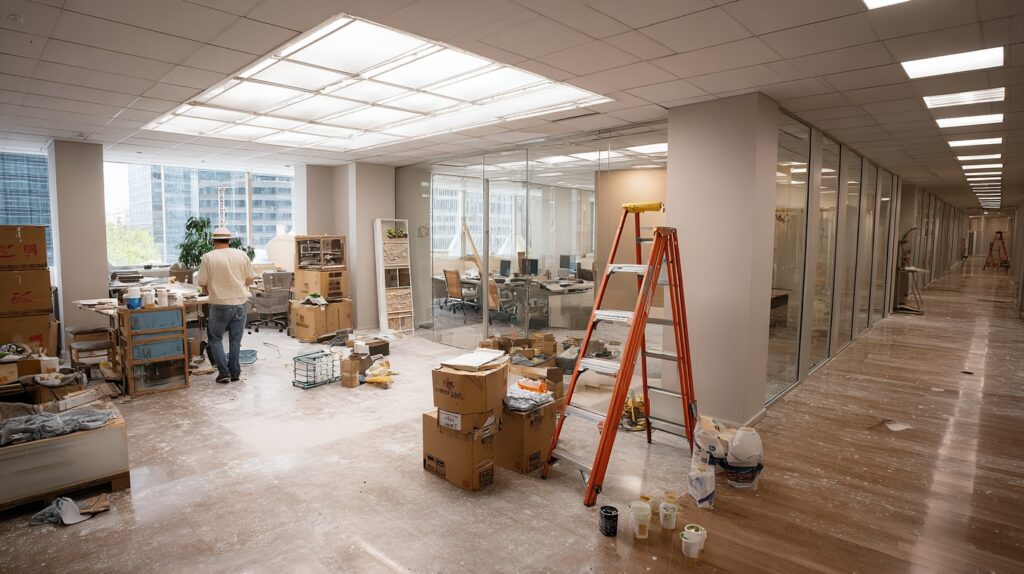
You know how office renovations in the NY tri-state area rarely fail because of design ideas, they fail because the budget gets guessed instead of built.
This Commercial Office Renovation Cost Guide And Design Tips For 2026 is meant to fix that gap with real NYC pricing logic, code-driven cost triggers, and a planning approach that keeps your business running.
I’m Alex Fedin, a licensed General Contractor in New York City, and I’ve been building and renovating here since 2000.
Below, I’ll break down cost per square foot, the cost drivers most owners miss, area-by-area budgets, and the design and sustainability upgrades that usually pay back in fewer headaches later.
Key Points
- In NYC (2026), commercial office renovation costs range roughly $20–$150+ per sq. ft. for light refreshes and selective upgrades, but a full office fit out commonly budgets much higher once you include mechanical, electrical, permits, and compliance needs.
- For construction-only fit out pricing, Cushman & Wakefield’s 2025 U.S. cost guide lists New York City at $212.59 per sq. ft., which is a useful reality check if you are planning a true build-out, not just paint and floors.
- If your building is covered by Local Law 97, NYC Department of Buildings materials explain that emissions penalties are calculated by multiplying the exceedance by $268, so energy upgrades can protect you from a yearly bill, not a one-time problem.
- Expect architect/contractor fees of 20–25% of budget; flooring $2–$15/sq ft, wall construction $12–$180/sq ft, electrical/lighting $150–$300 per unit, then add contingency to cover the surprises NYC buildings like to hide.
- Do not treat asbestos as a paperwork detail. NYC Department of Environmental Protection requires notification at least 7 days before abatement, and you should confirm survey and filings early so you do not stall your start date.
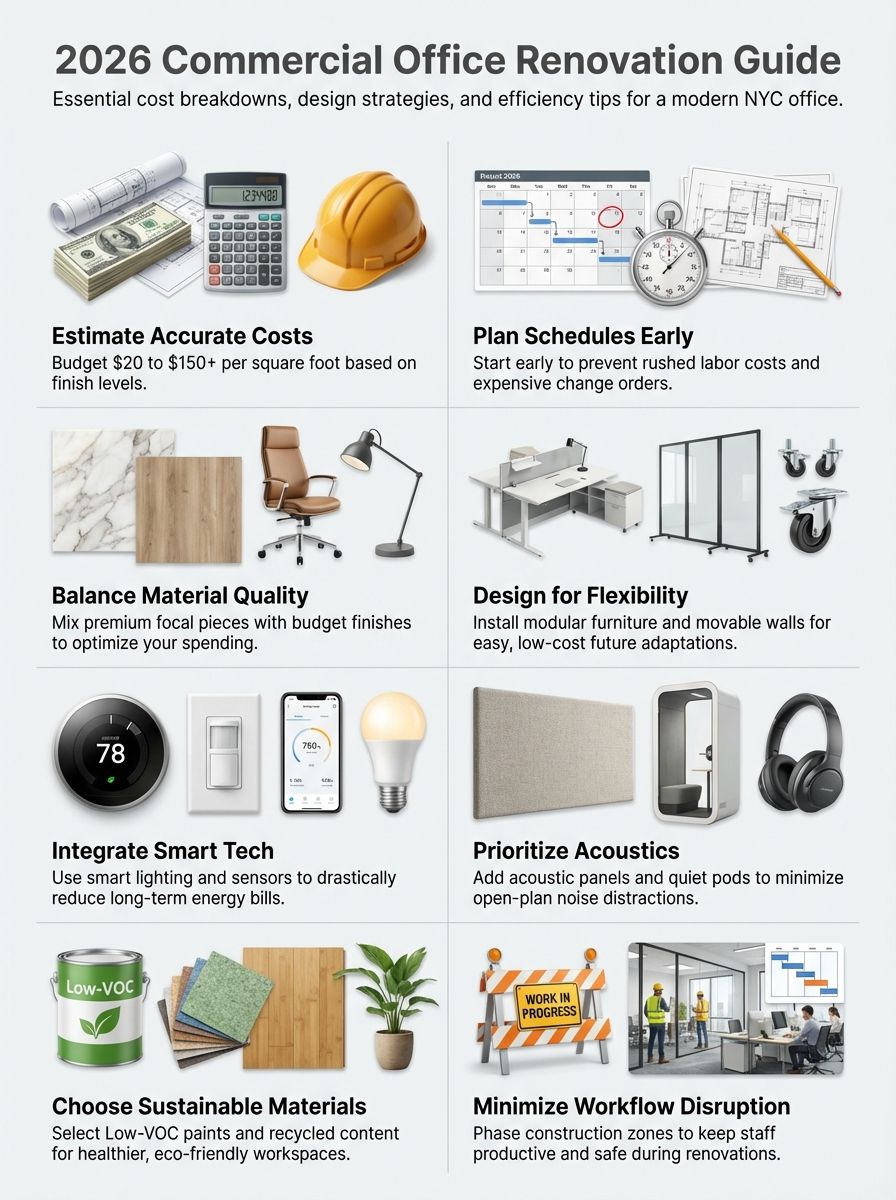
Commercial Office Renovation Cost Guide And Design Tips For 2026: NYC Costs Overview
NYC office renovation pricing swings because the work is tied to building conditions, permits, logistics, and how far you push finishes and systems.
The cleanest way to budget is to separate refresh work (paint, floor finishes, basic lighting swaps) from a fit out (multiple trades, new layouts, MEP changes, code sign-offs).
What is the average renovation cost per square foot in 2026?
For a true office fit out in New York City, a recent benchmark comes from Cushman & Wakefield’s 2025 U.S. Office Fit Out Cost Guide, which lists NYC at $212.59 per sq. ft. for construction-only fit out costs.
That number is not meant to scare you. It is meant to keep you from budgeting a full build-out like it is a cosmetic update.
| Scope (NYC metro) | What it typically includes | Planning range (per sq. ft.) |
|---|---|---|
| Light refresh | Paint, selective flooring, fixture swaps, minor repairs | $20–$50 |
| Basic renovation | Refresh plus limited partitions, targeted electrical, small HVAC adjustments | $50–$150+ |
| Full office fit out (construction-only benchmark) | Multiple trades, new layout, MEP coordination, code-driven work | About $212.59 (recent market benchmark) |
| High specification fit out | Premium MEP, high-end AV, elevated finishes, strong sustainability scope | Can exceed $500 (high-spec global benchmark) |
If you are planning a high-spec space, Turner & Townsend’s 2025 global fit-out data put New York among the most expensive high-spec markets, at about $5,677 per square meter, which works out to roughly $525–$530 per sq. ft. at that spec level.
- Use $20–$50 when you are truly refreshing what exists.
- Use $150+ when you are touching multiple trades and changing the layout.
- Use the $212.59 benchmark as a check against under-scoping a real fit out.
- Keep a contingency, NYC buildings reward humility.
Itemized costs still shape the final total, so plan carefully. Flooring runs $2 to $15 per square foot, wall construction goes from $12 to $180 per square foot, and electrical and lighting work averages $150 to $300 per unit.
Hire an architect or contractor, who will usually charge 20 to 25 percent of the total budget, and factor in building code compliance, space planning, and property improvement for realistic estimates.
What factors affect commercial office renovation costs?
Older buildings raise renovation expenses because hidden conditions (moisture damage, undersized power, tired ductwork) force scope changes after demolition.
If your building is pre-1987, treat asbestos due diligence as part of the budget, not an afterthought. NYC Department of Buildings guidance explains that an asbestos assessment may be required before permit, and NYC Department of Environmental Protection requires filings when asbestos-containing material will be disturbed.
- Compliance triggers: ADA restroom clearances, egress, fire alarm and sprinkler tie-ins, and Local Law 97 planning for covered buildings.
- Logistics: elevator bookings, material staging, and after-hours rules can inflate labor costs.
- Building systems: base-building HVAC limits can force expensive upgrades if you add more rooms or higher occupancy zones.
- Paperwork speed: NYC DOB Professional Certification can reduce permit wait time by eliminating plan examination when a PE or RA certifies compliance.
Know the scope, plan the budget, and negotiate lease terms before you fall in love with finishes.
Tenant versus owner status affects who pays for property improvements, lease negotiations can shift major costs to landlords.
Larger square footage raises total cost, but economies of scale can lower price per square foot.
Short planning time raises risk, rushed schedules push up labor and material costs. Next we will examine how square footage and layout impact renovation costs.
Key Cost Considerations
Key cost considerations determine your renovation costs, affecting cost per square foot, labor expenses, and material choices.
To keep budgeting realistic in NYC, plan for the hidden line items: compliance filings, waste hauling, and the building’s rules on hours and deliveries.
Watch a quick video on office renovation budgeting
How does square footage and layout impact renovation costs?
Larger square footage raises the total renovation price, yet bigger jobs often gain economies of scale, which can lower the cost per square foot.
Layout is the real cost lever. The more rooms you add, the more you multiply doors, power runs, data drops, diffusers, returns, and life safety coordination.
A practical planning detail: mechanical design often follows recognized ventilation standards like ANSI/ASHRAE 62.1, so when you shift from open plan to many enclosed offices, you can force more ductwork, controls, and balancing work.
- Open plan: fewer partitions, fewer doors, simpler distribution.
- Hybrid layout: more conference rooms and focus rooms, higher MEP coordination.
- High privacy layout: more walls and doors, more acoustic detailing, more electrical distribution complexity.
Flexible space design, with modular furniture and movable walls, lets owners adapt without a full rebuild, and that reduces future renovation expense.
Converting a storage area into a collaboration zone or private office alters scope, and that change will increase materials and labor costs, so next we will cover what renovation schedules and timelines affect the budget.
What renovation schedules and timelines affect the budget?
Longer planning periods often cut total project costs because you reduce change orders and you can sequence trades cleanly.
In NYC, timelines also depend on filings. For example, NYC DEP requires asbestos abatement projects to be filed at least 7 days before the start date, so late discoveries can push your schedule even if your contractor is ready.
- Best budget control: finalize your layout before you start ordering custom items.
- Best disruption control: phase demolition and noisy work, then move into finishes.
- Best approval speed: consider DOB Professional Certification when your design team qualifies, since DOB states it reduces wait time by eliminating plan examination.
Plan the schedule early, lock decisions, and protect your timeline from last-minute scope changes.
Phased renovation lets you work in stages, and limits tenant disruption.
Scheduling noisy work off-hours can raise labor costs and extend the project length, so price it before you commit.
Next, examine how material and finish quality influence cost.
How do material and finish quality influence cost?
Material and finish quality drive a large share of your renovation cost.
Premium flooring, like hardwood or bamboo, runs about $10 to $15 per sq. ft. Budget flooring, such as vinyl tiles or concrete, can cost $2 to $7 per sq. ft. Premium glass walls can reach $180 per sq. ft., which raises the price fast.
One action step that saves rework: write material standards that cover both performance and indoor air. The U.S. EPA notes that low-VOC and zero-VOC paints vary in composition, so you should specify for durability and emissions, not marketing labels.
- For paints and coatings: target low-VOC systems and keep ventilation and isolation in your scope.
- For flooring and adhesives: consider products with FloorScore certification, which the Resilient Floor Covering Institute describes as independent VOC emissions compliance under California Section 01350.
- For furniture and casework materials: UL states GREENGUARD Gold sets stricter low-emitting criteria for sensitive environments, which can help if your office includes wellness rooms or client-facing healthcare use.
Choose a mix of high-impact upgrades with budget finishes to stretch your budget.
Sustainable materials, like recycled content, low-VOC products, FSC-certified wood, or reclaimed wood, can add upfront cost but lower long-term waste and comfort risks.
Next, the cost breakdown by office areas outlines typical expenses for reception, workspaces, kitchens, and bathrooms.
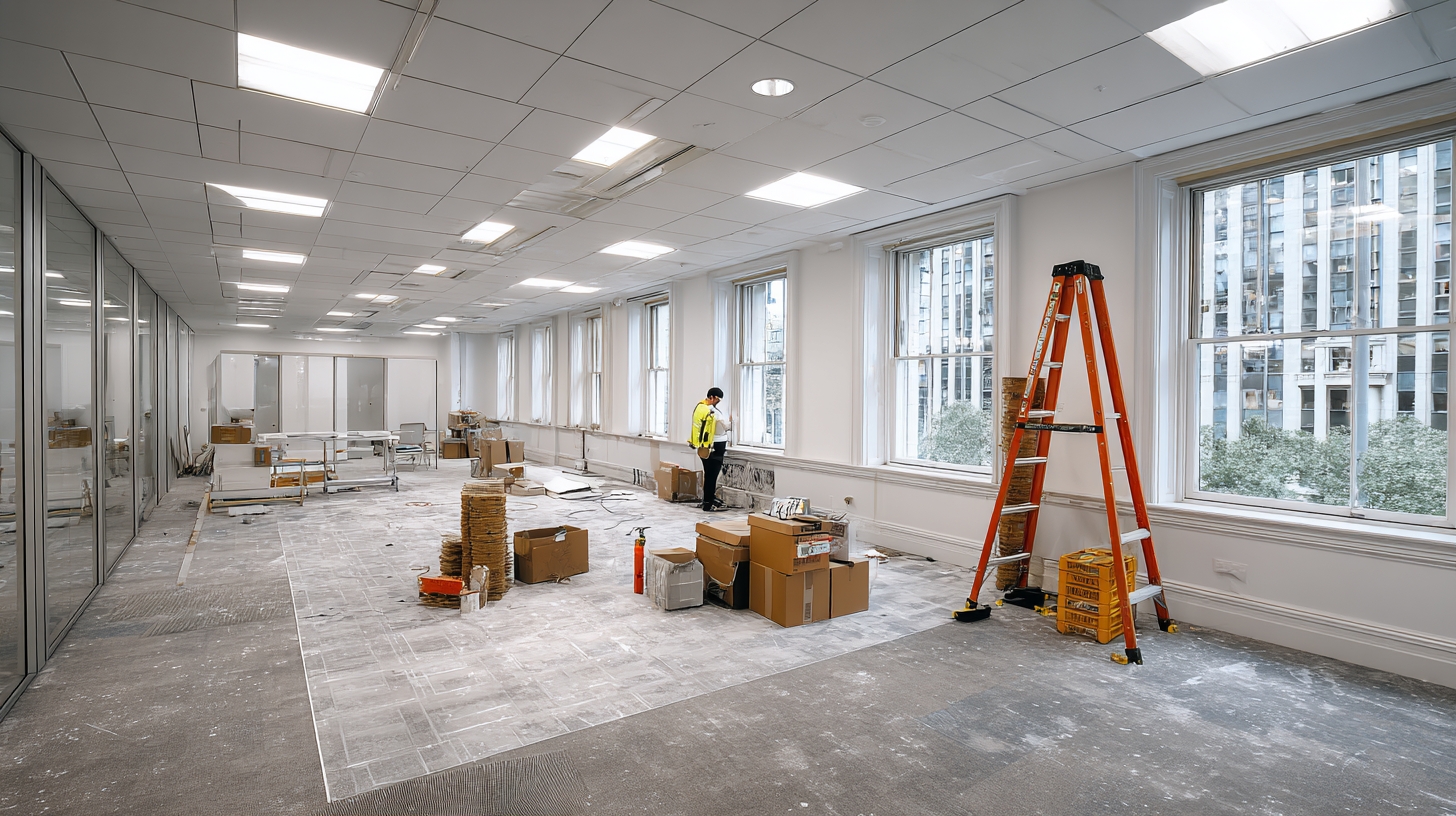
Cost Breakdown by Office Areas
This section breaks down Renovation Costs by area, showing typical Cost Per Square Foot for lobbies, workspaces, kitchens, and bathrooms.
Use these figures to plan your Office Renovation budget, then adjust based on your building’s rules, your lease, and how much MEP work your layout forces.
See an example walkthrough of office build-out planning
| Area | What drives cost | Budget tip |
|---|---|---|
| Reception / lobby | Lighting design, millwork, finishes, branding features, access control | Pick a clear finish level early to avoid expensive mockup changes |
| Workspaces | Power and data density, acoustics, furniture, HVAC distribution | Design for change, use modular planning grids |
| Kitchen / breakroom | Plumbing points, electrical loads, ventilation, durability | Spend on surfaces and fixtures that take abuse, save on decorative tile |
| Bathrooms | Plumbing, ventilation, waterproofing, ADA clearances, tile labor | Confirm clearances before framing, changes later cost the most |
How much does renovating the reception and lobby typically cost?
Expect basic reception and lobby renovations in NYC to start around $75 to $150 per sq. ft., premium finishes and custom features often push costs above $150 per sq. ft.
In my experience, reception budgets rise fastest when you add custom millwork, stone, feature lighting, and higher-end access control.
- Plan for vertical logistics: elevator and loading rules can change labor pricing.
- Plan for life safety tie-ins: if you move walls or ceilings, you may trigger fire alarm, sprinkler, and egress coordination.
- Plan for durability: reception finishes take the most visible wear, so pick cleanable materials.
What are the costs for workspaces and open areas?
Costs for workspaces and open areas vary with layout, furniture choices, acoustic treatment, and technology integration.
One practical way to control this category is to decide your power and data density early. Late changes to furniture plans often force expensive electrical revisions.
Energy controls can also reduce operating costs. A Lawrence Berkeley National Laboratory study (published in 2001) found open office areas using occupant sensors saved about 9.0% to 14.6% lighting energy, which supports using sensors even when the savings feel small per fixture.
- Keep flexibility: use modular furniture and plan for future moves without re-running conduit.
- Budget for acoustics: open rooms need ceilings, panels, and soft finishes to control noise.
- Budget for hybrid work: video calls in open plan spaces need better sound control than most owners expect.
You can cut furniture costs by refurbishing existing pieces or rearranging items.
Technology, such as integrated power and smart office systems, increases upfront expense, and it affects the wiring and layout plan.
How much should you budget for office kitchens and breakrooms?
Plan on budgeting between $6,000 and $31,200 for office kitchen and breakroom remodeling, depending on size and appliance quality.
Small makeovers sit near $6,000, while full remodels with high-end appliances can reach $31,200.
- Choose durable surfaces: breakrooms get heavy daily use, so pick countertop and flooring materials that resist staining and heat.
- Use ENERGY STAR appliances where it fits: you usually see the best value on fridges, dishwashers, and commercial-style microwaves that run all day.
- Reduce install labor: keep plumbing points close to existing risers when you can.
Factor in budgeting for maintenance and appliance warranties, they lower lifecycle costs.
What expenses are involved in bathroom renovations?
Expect total bathroom renovation costs around $18,000 to $24,200 for a standard remodel in the NYC area, with added showers costing another $6,000 to $8,400.
Typical line items include demolition, new plumbing, ventilation upgrades, fixtures, tile, and premium finishes that last and clean easily, plus labor and permit fees.
Do not guess ADA clearances. The 2010 ADA Standards require a turning space of 60 inches diameter minimum (or a 60 inch by 60 inch T-shaped space), and that single detail can change the room size, the door swing, and the plumbing wall layout.
- Confirm the layout first: frame after you verify clearances, not before.
- Spend on ventilation: bathrooms fail early when moisture control is weak.
- Pick cleanable materials: it reduces long-term maintenance and protects your investment.
Design Tips for a Functional Office Space
Use flexible layouts and modular furniture to allow quick Workspace Transformation, and pick durable Construction Materials for high-traffic areas.
Plan shared zones and quiet pods, to balance collaboration and privacy during your office renovation.
Watch a short video on practical office layout ideas
How can flexible layouts and modular furniture improve your office?
Modular planning lets you adapt without tearing the space apart every time your team changes.
If you own a small commercial space, like an office condo or mixed-use building with a ground-floor suite, flexibility is often the simplest way to protect resale value.
- Demountable partitions: systems from brands like DIRTT can support reconfiguration with less demolition.
- Modular workstations: lines from Steelcase are built for moves, adds, and changes.
- Future-proof power: plan floor boxes and wall power so furniture can shift without rewiring.
Height-adjustable desks and movable partitions support different work styles, and they improve office ergonomics for everyone.
Rearranging existing furniture can create openplan design and boost collaboration, and mobile seating plus portable equipment make areas multipurpose.
What are shared zones and quiet pods, and why use them?
Shared zones are the collaboration areas that keep people out of conference rooms for quick work.
Quiet pods are small enclosed spaces for calls, focus, or decompression, and they help open plans feel livable.
- Shared zones work best near natural light and near power, so they stay used.
- Quiet pods work best when you plan ventilation and power early, not as an afterthought.
- Wellness rooms should be located away from reception and breakrooms to avoid noise spikes.
How do acoustics and privacy solutions enhance office design?
Acoustics is where an office either feels professional or feels exhausting.
The easiest way to make better decisions is to understand the target ratings for privacy and absorption.
For sound blocking, WELL resources explain STC performance in plain language: STC 40 is the onset of privacy, STC 45 means loud speech is barely audible, and STC 50 means loud speech is not audible.
- For conference rooms: ask your designer what wall assembly hits STC 45+.
- For open areas: use high-absorption ceilings and soft finishes, stone wool ceiling panels can reach NRC values as high as 0.95 in some product lines.
- For glass partitions: budget for seals and door hardware, gaps defeat expensive materials.
Glass or movable partitions enable space division while keeping the office layout bright.
Quiet rooms give private spots for focused work or important calls. Using eco-friendly acoustic materials supports environmental sustainability and pairs well with green project goals.
Incorporating Technology in Office Design
Choose smart office systems and energy-efficient lighting to cut Renovation Costs over time, and make your fit out more efficient.
Plan essential office technologies early to prevent surprise Construction Expenses.
What smart office systems should be considered?
Start with systems that reduce waste and improve comfort: lighting controls, HVAC controls, and air quality monitoring.
If your building is subject to energy reporting, tie your renovation to measurement. NYC Department of Buildings explains Local Law 84 benchmarking is submitted through the U.S. EPA’s ENERGY STAR Portfolio Manager by May 1 each year.
- Lighting controls: occupancy sensors and daylight sensors in offices, conference rooms, and restrooms.
- Smart HVAC controls: zone scheduling and demand-based ventilation where your system supports it.
- Room booking: simple scheduling prevents wasted meeting rooms and helps hybrid teams.
How can energy-efficient lighting and appliances save costs?
LED fixtures and smart controls cut utility bills and reduce maintenance calls.
On the incentive side, Con Edison has promoted LED upgrades as a way to reduce energy costs by up to 90%, and their Instant Lighting Incentive Program listed a program sunset date of December 31, 2025, so for 2026 you should confirm what rebates are active before you finalize specs.
- Fast ROI zones: restrooms, storage rooms, conference rooms, and private offices.
- Open office reality check: occupant sensing saves less than people expect during core hours, but it saves after-hours and weekends.
- Appliance discipline: pick ENERGY STAR where it fits and plug everything else into controllable circuits.
What are essential office technologies to include?
Essential tech is the stuff that prevents rework later: structured cabling, AV readiness, and security planning.
- Conference rooms: video conferencing, mics that match your room size, and wall backing for displays.
- Power everywhere: floor and wall power planned for the furniture layout you actually want.
- Access control: door hardware and wiring planned early so you do not open finished walls later.
Smart sensors for energy management and environmental monitoring can cut utility use, and they support better maintenance decisions.
Next, plan eco-friendly materials and waste management to pair with these systems.
Sustainable Renovation Practices
Choose eco-friendly renovation materials, set a waste management plan, and add energy-efficient systems to cut operating costs and lower Commercial Office Renovation Costs.
In NYC, sustainability also ties directly to compliance, especially for larger buildings covered by Local Law 97.
Which eco-friendly materials are best for renovations?
Pick sustainability upgrades that improve indoor air, durability, and maintenance, those are the wins you feel every day.
- Low-emitting materials: UL explains GREENGUARD and GREENGUARD Gold are based on low chemical emissions testing, which can help when you want healthier indoor air.
- Low-emitting flooring: RFCI describes FloorScore as independent certification of VOC emissions compliance under California Section 01350.
- Responsible wood: the Forest Stewardship Council (FSC) provides chain-of-custody certification that verifies responsible sourcing through the supply chain.
- Low-VOC paint systems: the U.S. EPA notes water-based acrylic latex paints are generally lower in VOCs than solvent-based paints.
Use durable, repairable materials to extend lifespan and support waste reduction.
What are effective waste management strategies during renovation?
Waste planning saves money because dumpsters, labor, and hauling time add up fast in NYC.
NYC Department of Sanitation guidance notes that professional construction projects must arrange debris removal through a private service, and NYC ties commercial and construction debris hauling to licensed and registered carting through the Business Integrity Commission.
- Write a separation plan: wood, metal, clean drywall, and mixed debris should not all land in one pile if you want reuse options.
- Use approved hauling: BIC maintains requirements for licensed and registered haulers, including companies that register specifically for construction and demolition debris.
- Reuse where it makes sense: DSNY lists options like donateNYC Exchange, Big Reuse, and Habitat for Humanity NYC ReStore for salvage and donation.
Plan disposal routes for demolition debris, and set targets for material reuse, upcycling, and refurbishment with your team.
How can energy-efficient upgrades reduce operating costs?
Energy upgrades are not just a green add-on in NYC, they can be risk management for certain buildings.
NYC Department of Buildings explains that most buildings over 25,000 square feet must meet Local Law 97 emissions limits, and DOB materials describe penalties as the exceedance multiplied by $268.
- Start with measurement: Local Law 84 benchmarking uses ENERGY STAR Portfolio Manager, and benchmarking makes your upgrade priorities obvious.
- Target controls first: sensors and scheduling often reduce waste with less disruption than major equipment swaps.
- Use incentives wisely: NYSERDA highlights programs like FlexTech to support energy studies, and it also points businesses to utility rebates for lighting and controls.
Minimizing Disruption During Renovation
Block work into short, timed phases to keep staff working and control Construction Expenses.
Use clear signage and off-hours crews to protect productivity during Office Renovation and speed Workspace Transformation.
How to plan phased renovations to minimize disruption?
Use phased renovation scheduling to limit work to one zone at a time, this keeps most of the office functional.
- Isolate dust: temporary barriers and negative air planning keep the finished areas clean.
- Protect egress: keep exits and corridors clear, treat it as non-negotiable.
- Sequence smart: demolition, then rough-ins, then inspections, then finishes.
- Communicate weekly: staff work better when they know what noise is coming.
Hire a contractor who can coordinate noise control, temporary workspaces, and daily cleanup.
Use strict safety checks to meet construction rules and reduce liability.
What options exist for temporary workspaces during renovations?
Temporary remote work arrangements help affected employees keep working during construction.
Hot-desking in unaffected areas can keep teams onsite if you control reservations and power needs.
- Short-term coworking: useful for high-noise phases like demolition and core drilling.
- Team rotation: split schedules to reduce crowding and simplify cleaning.
- Temporary conference rooms: set up one reliable meeting space so calls do not collapse during construction.
Work with your contractor and renovation management team to map schedules, assign temporary setups, and set clear booking rules.
Steps to Plan a Successful Renovation
Set clear project goals, define the scope, and match them to your budget for office renovation.
Work closely with contractors and architects, track construction expenses, and update cost per square foot estimates as the fit out moves forward.
How to set clear project goals for an office renovation?
Define the type of renovation needed, such as a facelift, expansion, or reconfiguration, before you plan any work.
Then tie goals to measurable decisions like headcount, meeting room count, storage needs, and technology requirements.
- Space planning: decide what needs to be enclosed, then price the mechanical and electrical impact.
- Wellness: plan for indoor air, acoustics, and lighting comfort, not just finishes.
- Sustainability: if your building is covered by Local Law 97, put energy upgrades into the early scope, not the wish list.
How to collaborate effectively with contractors and architects?
Get three detailed quotes that show both total cost and cost per square foot, then compare scope line by line.
NYC permitting moves faster when your drawings are complete and coordinated across trades.
- Use qualified professionals: DOB explains the Professional Certification program lets a PE or RA certify compliance and reduce permit wait time by eliminating plan examination.
- Confirm trade licensing: NYC DOB notes that many work types require specialized licensed contractors, like a Licensed Master Plumber for certain plumbing work.
- Control changes: write every scope tweak as a signed change order with pricing and time impact.
Ask architects to share drawings with contractors, and ask contractors to flag code or cost issues fast.
How to create a realistic budget and timeline?
Set a budget that covers square footage, finish quality, and at least one contingency fund.
For NYC fit outs, a 10% to 15% contingency is common for older buildings and multi-trade scopes, especially when you have limited access to above-ceiling conditions before demolition.
- Budget categories: hard construction, soft costs, FF&E, technology, moving, contingency.
- Permit-driven scheduling: build filing and inspections into your timeline, not just construction days.
- Asbestos timing: if asbestos may be present, plan survey and DEP filing early since DEP requires at least 7 days notice before abatement work.
Track costs by line item and update the budget weekly during the construction phase.
Final Words
This Commercial Office Renovation Cost Guide And Design Tips For 2026 helps you plan budgets and pick materials that match goals.
Use cost per square foot benchmarks as a reality check, then refine your Cost Estimation with a scope that reflects NYC permits, building systems, and compliance triggers.
Choose sustainable Renovation Materials, smart office systems, and flexible layouts to support Workspace Transformation, and protect long-term operating costs.
FAQs
1. How much does a commercial office renovation cost in 2026?
Average costs vary, expect about $40 to $200 per square foot, based on scope, finishes, and building condition. Use a commercial office renovation cost guide to set a budget, add a 10 to 20 percent contingency for surprises.
2. What design tips improve worker comfort and appeal?
Use an open layout with quiet zones, add natural light, and create flexible meeting areas. Pick durable materials, energy-saving lights, and sound-absorbing panels to cut upkeep and boost comfort.
3. How do I plan a budget and timeline for a renovation?
Start with a clear cost guide, list must-haves and nice-to-haves, and get three bids from licensed contractors. Include time for permits and inspections, expect 4 to 12 weeks for modest work, longer for full builds, and phase work to limit business downtime.
4. Which upgrades give the best return on investment?
Invest in heating and cooling systems, energy-saving lights, durable flooring, modern restrooms, and improved network cabling. These upgrades lower operating costs, improve user experience, and raise property value.
References
- https://www.cushmanwakefield.com/en/united-states/insights/office-fit-out-cost-guide
- https://descco.com/integrating-smart-tech-in-office-renovations/
- https://bryanconstruction.com/sustainable-renovation-practices-for-commercial-facilities/ (2024-10-23)
- https://www.sciencedirect.com/science/article/pii/S2772912525002295