
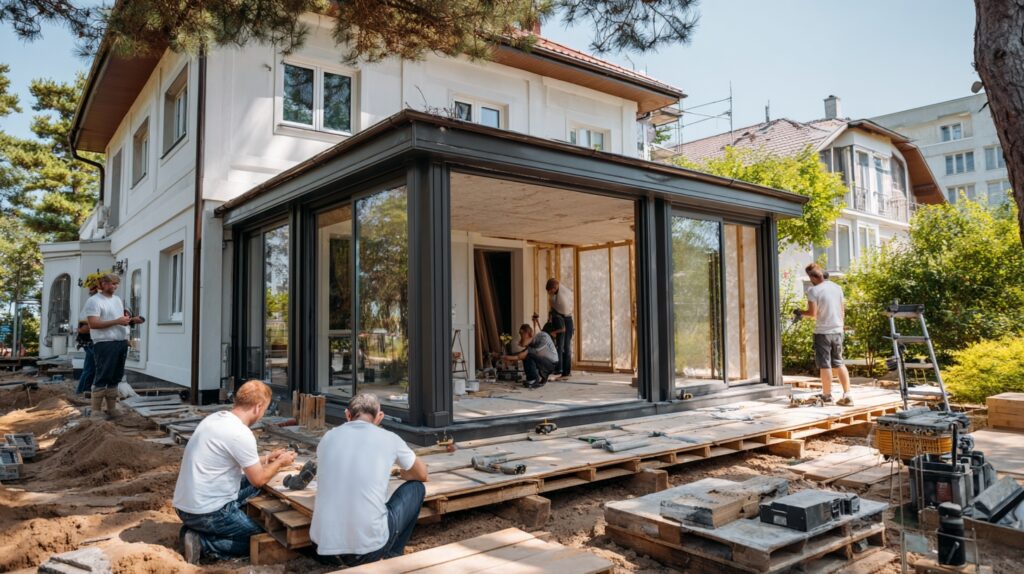
Ever have that moment when you look around and realize your house still works, but your life has completely outgrown it? That’s exactly where good home addition plans can change everything.
Especially in the NYC metropolitan area, moving often means diving into a hyper-competitive market. A 2023 Housing and Vacancy Survey update from NYC Housing Preservation and Development reported the city’s net rental vacancy rate was just 1.41%. Staying put and expanding is often the smarter, more controllable choice.
I’m going to walk you through the practical side of house addition blueprints, room addition plans, and home addition floor plans, with a focus on NYC’s real-world permit needs, cost ranges, and the design choices that protect your home’s value.
We’ll look at how to budget for fewer surprises, choose a contractor you can trust, and figure out which addition floor plans are best for tight city lots. Let’s get into it.
Key Points
- NYC costs are a wide spectrum. Depending on the scope of work and the quality of finishes, you can expect to see costs for a standard-grade addition in New York City somewhere between $200 and $600 per square foot, and that’s before any high-end upgrades.
- Plan for the real cost of permits. NYC permit filing fees aren’t just a minor expense. The NYC Department of Buildings (DOB) calculates fees based on the total project cost. For alterations, this often means a base fee for the first few thousand dollars of work, plus an additional fee for each thousand dollars thereafter.
- Conversions can offer a strong return. National data consistently shows that turning existing space into living area pays off. The 2025 Remodeling Impact Report noted an estimated cost recovery of 71% for a basement conversion and 67% for an attic conversion.
- Basement and attic legality is specific. For some basement apartment projects under NYC rules, guidelines specify targets like a 7 feet 6 inches clear ceiling height in habitable rooms and at least one window with 6 square feet of openable area for ventilation.
- Protect your payments. NYC consumer guidance is clear: you should pay no more than 25% of the project cost upfront. After that, payments should be tied to specific project milestones once you can verify the work has been completed.
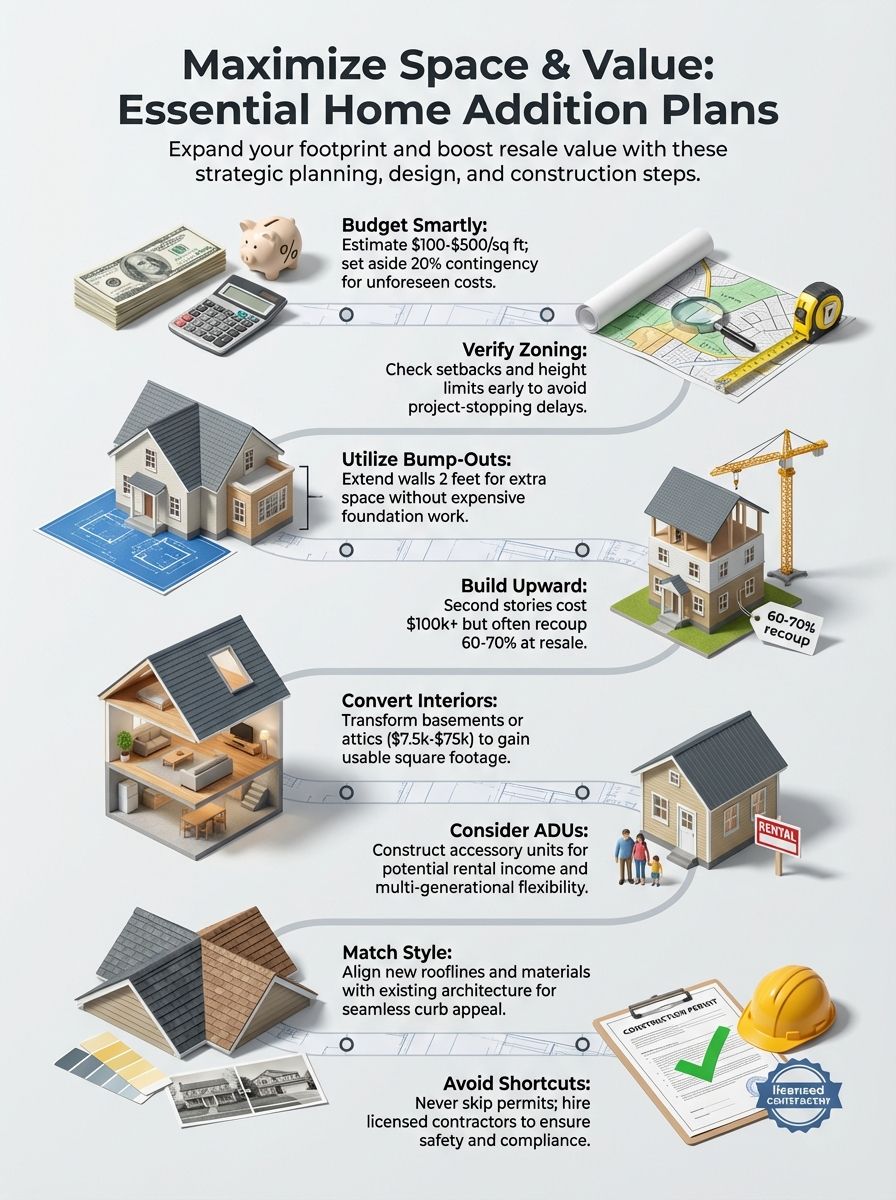
Planning Your Home Addition Plans

Great house addition plans begin with a simple but important realization. You’re not just “adding space,” you’re fundamentally changing the way your home functions every single day.
In NYC, that plan also has to navigate a maze of permits, inspections, close neighbors, and zoning limits. If you make the right decisions early on, the rest of the process becomes much smoother.
Watch a short video on planning an addition
What are your needs and goals for a home addition?
Always start with your needs, not a specific room. You want to create a list of priorities that you can refer back to when you have to make decisions about costs and trade-offs.
I am Alex Fedin, a licensed General Contractor in New York City. I’ve spent the last 25 years turning architectural drawings into real, functional homes. My architecture training at Kharkiv National University of Architecture & Construction helps me see where a plan might look good on paper but will ultimately fail in a real-world application.
In my experience with NYC metro homes, the most common goals are adding an extra bedroom, creating a home office with a door, getting more storage, or designing a better kitchen layout. According to a 2026 trend report, multifunctional spaces and dedicated home offices remain top priorities for homeowners.
Before you even think about drawing a wall, decide what is a “must-have” and what is a “nice-to-have.” This single choice will guide every good set of house add on plans.
- Daily function goal: What will you do in this new space that you can’t do now? Think about specific activities like taking work calls without interruption, managing laundry flow, or comfortably hosting guests.
- Resale goal: Are you trying to increase your home’s bedroom or bathroom count to be more competitive in your local market, or are you focused on creating better entertaining space?
- Disruption tolerance: Can your family handle months of construction noise, dust, and blocked-off rooms, or do you need a less invasive option?
- Future-proofing: Could a main-level bedroom, a wider doorway, or relocating the laundry room help you stay in your home longer as you age?
How do you set a realistic budget and timeline for additions?
In NYC, your budget’s success often depends on two areas people tend to underestimate: permits and “hidden” systems work. This includes things like electric service upgrades, plumbing reroutes, and structural reinforcement.
For initial planning, many local guides suggest that standard additions cost in the low-to-mid hundreds per square foot, with premium work costing more. Use this as a starting point, then focus on pricing the major drivers: foundation work, steel or LVL beams, stairs, kitchens, bathrooms, and HVAC systems.
Permits are not a simple flat fee. The NYC DOB’s fee schedule shows that alteration fees are calculated based on the job’s cost, so the more expensive the project, the higher the permit fee will be. You can track the status of your filings and schedule inspections through the city’s online portal, DOB NOW.
| Budget line item | What to plan for | Why it matters in NYC |
|---|---|---|
| Design + engineering | Measured survey, drawings, structural design | Most additions require a Registered Architect or Professional Engineer to file plans, and detailed structural designs reduce the chance of objections from the DOB. |
| Permits + inspections | Filing fees, sign-offs, special inspections | Plan review and inspection steps can add weeks to your timeline if the paperwork is incomplete or inaccurate. |
| Systems upgrades | Electrical, plumbing, HVAC capacity, venting routes | Older NYC housing stock often requires significant upgrades to safely support the new loads of an addition. |
| Contingency | 10% to 20% | Discovering hidden issues behind plaster, brick, and old framing is common in renovation projects. |
If you’re financing the project, make sure to arrange it independently. NYC consumer guidance clearly states that home improvement contractors are not permitted to arrange or offer financing for a home improvement loan.
One more dose of reality: the 2025 Remodeling Impact Report found that 54% of consumers used a home equity loan or line of credit for their remodeling project. This is a common approach, but it only works if your plan and contract are clear enough to satisfy a lender and your household’s cash flow.
What zoning laws and building codes should you know?
Check local rules early, and talk with your neighbors.
NYC zoning rules can put a stop to your expansion plans by limiting floor area, yard size, height, and lot coverage. Even if your contractor can physically build the addition, zoning regulations might not allow it.
For many residential districts, rear yards and setbacks are common constraints. The city’s Zoning Resolution includes requirements for rear yard depths, which are often 30 feet in many districts, with special provisions that depend on the lot type and building form. You can use the Department of City Planning’s ZoLa (Zoning and Land Use application) map online to see the specific zoning for your property.
If your property is a landmark or located in a historic district, you should budget for extra time. The Landmarks Preservation Commission (LPC) notes that obtaining a Certificate of Appropriateness can take about three months for work that requires a full Commission review, and their fees are based on the cost of the project.
On the building code side of things, the numbers are what matter. For example, NYC code language about ceiling heights and basement conditions can determine whether a space can legally be considered habitable.
- Start with feasibility: Confirm your lot coverage, yard, and height constraints before you invest in full home addition floor plans.
- Identify extra approvals early: Determine if you need landmarks review, co-op or condo board approval, or have to address shared-wall conditions with attached buildings.
- Design to pass inspection: Make sure that egress, smoke and carbon monoxide alarms, structural details, and energy code items are included in your drawings.
Popular Home Addition Ideas
There is no single “best” type of addition. The right choice is the one that fits your lot, your home’s structure, and what buyers are looking for in your neighborhood.
Here are the most common addition plans that NYC homeowners request, along with what I look for before we commit to a design.
Watch a video with home addition ideas
| Addition type | Best for | NYC watch-outs |
|---|---|---|
| Bump-out (small extension) | Fixing tight kitchens, baths, and dining areas | Structural support details and exterior wall tie-ins need to be designed properly. |
| Second-story addition | Gaining significant square footage without losing yard space | Zoning height limits, structural reinforcement, and a longer permit process. |
| Over-garage addition | Adding a suite or office with minimal impact on your yard | The existing garage structure may not be strong enough to support the new loads. |
| Sunroom or enclosed porch | Creating a light-filled space with a smaller scope of work | Glazing, insulation, and HVAC decisions will define the room’s comfort and cost. |
What is a room addition (bump-out) and when is it useful?

A bump-out is the surgical option for home additions. It adds a small amount of depth to an existing room, often just two or three feet, to fix a layout that is almost perfect.
In NYC rowhouses and older homes, that small extension can be just enough space to fit a larger shower, a pantry wall, or a more functional kitchen aisle. The cost for these micro-additions can range from $4,000 to $30,000.
Here’s a key detail most homeowners miss: a cantilevered bump-out, which is supported by the floor joists rather than a new foundation, still requires real structural design. You may avoid a full foundation, but you can’t avoid designing for load paths, insulation, and weatherproofing.
- Great use cases: Creating a kitchen banquette, expanding a powder room, adding a closet, or widening a stair landing.
- Common pitfall: Treating it like a simple framing project and then discovering you need to upgrade beams or wall supports.
- Pro tip: If you are already opening up walls, plan your electrical and plumbing changes at the same time to reduce the number of change orders.
How does a second-story addition increase space and value?
A second-story addition is a major project. It can transform a cramped home into a multi-bedroom layout that can compete with larger properties in your area.
In the NYC metro area, I always treat this as a structural project first and a design project second. We confirm the foundation, framing, and load capacity, then we design the floor plan around what the structure can safely support.
The cost per square foot for building up is often higher than building out, with prices ranging from $200 to over $500 per square foot. A full second-story addition can easily cost between $200,000 and $750,000 or more in the NYC area, and the timeline is longer due to the more complex permitting and structural work required.
- Timeline reality: Plan for design, filings, and approvals before any demolition begins. Construction will go much faster once all the paperwork is in order.
- Comfort reality: The new square footage will likely require an upgrade to your HVAC system, not just an extension of your existing ducts.
- Resale reality: Buyers will notice a well-placed staircase, good ceiling heights, and natural light more than they will fancy trim.
What are the benefits of an over-garage addition?
An over-garage addition can often give you 400 to 600 square feet of extra space without taking up any of your backyard. This is a significant advantage in NYC neighborhoods where outdoor space is already at a premium.
It’s a great option for a primary suite, a quiet home office, or a guest space, especially when the garage footprint is already within the zoning envelope. Costs typically range from $60,000 to over $200,000, depending on the finishes and whether a bathroom or kitchen is included.
One practical word of caution: many garages were built to hold cars, not to support living spaces above. We often need to reinforce bearing points, check spans, and confirm fire separation details before we commit to house addition plans that rely on the existing garage structure.
- Fast win: You can often avoid the cost and hassle of new foundation excavation.
- Common hidden cost: Structural reinforcement and upgraded insulation in the garage ceiling are often necessary.
- Design tip: Make sure to add sound control in the floor assembly, for example with a product like Rockwool Safe’n’Sound insulation, if the garage will still be in use.
When should you consider a sunroom or enclosed porch?
You should choose a sunroom when you want to add daylight and a flexible extra room without the cost of a full build-out.
The financial decision is straightforward: a three-season room costs less but won’t feel like true living space in the winter. A four-season room costs more because the insulation, high-performance glazing, and HVAC system turn it into a real room. A three-season room might cost between $15,000 and $25,000, while a four-season room is more likely to be in the $20,000 to $60,000 range.
- Best use: A reading space, a plant room, an informal dining area, or a play space.
- Design move that pays off: Plan for shading early on. The summer sun in NYC can quickly overheat rooms with a lot of glass.
- Comfort check: If you want to use the room year-round, you need to plan for proper heating and cooling, not just a space heater.
Transforming Existing Spaces
If you’re on a tight lot, converting existing space often makes more sense than expanding. You are upgrading square footage you already own without affecting setbacks or lot coverage.
From an ROI perspective, conversions also perform well in national remodeling data. The 2025 Remodeling Impact Report lists an estimated 71% cost recovery for a basement conversion to living area and 67% for an attic conversion.
Watch a video on converting existing space
How can you convert a garage into livable space?
A garage conversion can be one of the cleanest ways to add a room, but only if the zoning, parking rules, and legal egress requirements can be met.
You should start by checking the requirements with the NYC Department of Buildings. You’ll want to confirm your filing path early, since conversions can change the use and egress of the space, and sometimes require a Certificate of Occupancy update.
Here is the process I follow to keep these projects predictable and on track.
- Step 1, inspect structure: Check the condition of the slab, framing, roof, and for any water intrusion. If you see cracks or sagging, bring in a structural engineer.
- Step 2, confirm feasibility: Verify zoning constraints, parking trade-offs, and whether the conversion will trigger any egress upgrades.
- Step 3, plan utilities: Budget for electrical, plumbing, and HVAC systems. Garages often lack the necessary infrastructure for a living space.
- Step 4, design for comfort: Insulation, air sealing, ventilation, and window placement will determine whether the room feels like a true part of the home.
- Step 5, file and permit: Get all necessary approvals before work begins, then schedule inspections as you reach project milestones.
- Step 6, safety systems: Install the required smoke and carbon monoxide alarms and confirm all fire separation details.
- Step 7, finishes with restraint: Choose durable flooring and wall systems that can handle moisture and dirt.
- Step 8, document everything: Keep all permits, sign-offs, warranties, and change orders for future buyers and lenders.
- Step 9, legalization plan: If you plan to rent out the space, confirm the legal path for rental use and any required sign-offs.
- Step 10, avoid payment risk: Pay by milestones, not promises, and maintain a clean paper trail.
The cost of a conversion can still vary widely. Many NYC homeowners find that garage conversions can range from a few thousand dollars for basic work to tens of thousands for full systems and finishes, especially if plumbing is involved.
What are the steps to finish a basement?
Basements can add valuable space, but NYC has strict rules that differentiate between storage, rec rooms, and legal habitable space. This is where homeowners often get into trouble.
NYC guidance for certain basement apartment work specifies measurable targets like minimum clear ceiling height and window ventilation requirements. For instance, NYC DOB project requirements related to Local Law 49 of 2019 list a clear ceiling height of 7 feet 6 inches in habitable rooms (with some exceptions for projections) and at least one window with 6 square feet of openable area for natural ventilation in each habitable room.
Use this checklist to keep your basement project on the right track.
- Water first: Fix any leaks, control humidity, and address grading or drainage issues before you frame a single wall.
- Measure legality: Confirm the ceiling height, stairs, and window conditions before you start calling the space “living area.” The 2022 NYC Building Code requires a minimum ceiling height of 7 feet in basements of one and two-family dwellings.
- Plan egress: If you want to add a bedroom, you may need to install code-compliant egress solutions.
- Design utilities: Map out the electrical, plumbing, and HVAC routes so you don’t lose headroom or access to important systems.
- Choose the right materials: Use moisture-tolerant materials. Basements are tough on the wrong kind of drywall and flooring. Opt for something like luxury vinyl plank (LVP) flooring and mold-resistant drywall.
- Permit and inspect: File your permits early and schedule inspections for rough-ins, not at the end of the project.
- Sound control: Add insulation and other resilient details if you want the space to be quiet and feel finished.
- Lighting plan: Basements need layered lighting, not just a single overhead fixture.
- Finish for resale: Match the trim, doors, and paint colors to the rest of your home to create a seamless feel.
- Keep records: Save all sign-offs and warranties. Buyers in NYC ask for them more often than you might think.
How do you convert an attic into usable living space?
Attics can be converted into a great bedroom, office, or bonus room, but only if the headroom, stairs, and insulation are planned like a real build and not just a storage upgrade.
For code compliance in NYC, ceiling height is a major factor. While the general code for habitable rooms often calls for an 8-foot ceiling, the 2025 Residential Code of New York State allows for a ceiling height of 6 feet 8 inches when creating a habitable attic in an existing building.
Here is a practical sequence of steps to keep your attic conversion from stalling out.
- Structure check: Confirm the floor capacity and roof framing, then design any necessary reinforcement upfront.
- Headroom plan: Measure where you can comfortably stand and place the room’s main functions there, not in the sloped areas.
- Stair strategy: Design a code-compliant staircase, not a pull-down ladder, and make sure to protect the circulation space below.
- Insulation and ventilation: Get the roof assembly right to avoid ice dams, moisture problems, and overheating in the summer.
- Windows and daylight: Plan for skylights or dormers to bring in light and create usable wall space. High-quality brands like Velux are a good investment.
- HVAC reality: Confirm your heating and cooling capacity. Attics are the most challenging rooms to keep comfortable.
- Electrical layout: Place outlets and lighting where the furniture will actually go.
- Budget with permits: Include design, filings, and a contingency fund for any hidden framing issues.
Specialized Additions for Functionality
Some additions are all about lifestyle, while others are about flexibility. In NYC, the most valuable specialized projects are usually the ones that manage to do both.
What is an Accessory Dwelling Unit (ADU) and its advantages?
An accessory dwelling unit, or ADU, is a smaller, secondary home located on the same lot as your main home. It can be internal (like an attic conversion), attached, or in some cases, detached, depending on zoning and flood-related restrictions.
In NYC, the rules for ADUs have recently changed. The city adopted DOB rules for “ancillary dwelling units” in one and two-family dwellings, with an effective date of September 30, 2025. This has opened up a legal path for some homeowners, but eligibility depends on location, zoning, and other constraints.
Why are homeowners so interested in ADUs? Flexibility. You can plan for multigenerational living, a caregiver suite, or potential long-term rental income, all while keeping your main home intact.
- Design for privacy: A separate entry, sound control, and clear mechanical zones will make the unit feel like a real home.
- Plan for approvals: Confirm whether your lot, district, and building type qualify before you invest in drawings.
- Budget honestly: Kitchens and baths are expensive. A “tiny” unit can still require full systems and come with a big price tag.
When are modular or prefab additions a good choice?
Modular and prefab additions can reduce the amount of time construction is happening on-site, which is a big deal when you’re trying to live in your home during the project.
The most important factor is compliance. New York State explains that modular buildings must be built and installed according to the Uniform Code and State Energy Code, and they must have an Insignia of Approval issued through the state program.
- Good fit: Simple room additions, rear additions, or ADU shells, especially when site access is tight.
- Watch-out: Foundations, utility connections, and zoning reviews still happen on-site, so prefab doesn’t eliminate the need for permits.
- Buyer benefit: Factory-built components can be very consistent in quality when the manufacturer and installer are experienced.
How can expanding a mudroom improve your home?
In NYC, a mudroom is not a suburban luxury. It’s a damage-control zone for rain, snow, salt, strollers, bikes, and pet gear. A 2026 report on home upgrades noted that improved entry-way “drop zones” with built-in storage are appealing to families and can earn a roughly 50% ROI.
If you have the space near an entry, a small mudroom addition can protect your floors, reduce clutter, and make the rest of your house feel bigger.
- Build in storage: Closed cabinets for a calmer look, hooks at kid height, and a bench you’ll actually use.
- Choose tough finishes: Porcelain tile or durable LVP flooring, washable paint, and a floor drain if your conditions allow.
- Add a “dirty” circuit: A dedicated spot for wet umbrellas, mop storage, and a charging shelf for your devices.
What upgrades can enhance your laundry room?
An efficient laundry room is one of the best ways to buy back some of your time. A tight, noisy setup can make your whole home feel more difficult to manage.
Start with the layout, then focus on energy performance, and finally, storage.
- Space strategy: Stacked units, an L-shaped counter, and a rod for hang-drying items can reduce daily friction.
- Leak prevention: Add a pan, a shutoff, and a leak detector, like the Flo by Moen, especially in basements and on upper floors.
- Dryer decision: If you’re considering a heat pump dryer, NYSERDA has announced incentives for income-eligible households that include up to $840 for the appliance purchase and installation, plus additional incentives for wiring and panel upgrades if needed.
- Ventilation: Properly managing moisture will protect your finishes and your indoor air quality.
Design and Style Considerations
In NYC neighborhoods, buyers value cohesion. The addition should look and feel like it belongs, both inside and out. In fact, design trends for 2026 are shifting toward timeless designs with intentional, collected details rather than spaces that feel brand new.
How do you match the addition to your existing home style?
Start with the exterior. Match the roof pitch, the rhythm of the windows, and the materials so that the addition looks like it was part of the original design.
Then, match the inside. Align the floor levels, keep the hallways logical, and avoid creating awkward ceiling drops where the old structure meets the new.
- Exterior continuity: Repeat trim sizes, window proportions, and siding or masonry patterns.
- Interior flow: Keep sight lines clean and make sure you’re not blocking natural light in the original rooms.
- Neighborhood fit: A design that respects the style of the block is less likely to face resistance during the review process.
What are the best materials to choose for durability and value?
In NYC, durability is value. Repairs are expensive, and buyers can spot shortcuts.
I’ve seen the best long-term results when homeowners invest in the “shell” of the addition first: roofing, flashing, windows, insulation, and moisture control. The finishes are important, but failures in the building envelope will show up quickly.
| Where to spend | What to choose | Why it pays back |
|---|---|---|
| Windows | High-quality, properly flashed units from brands like Andersen or Marvin. | Better comfort, sound control, and fewer water issues down the road. |
| Exterior cladding | Moisture-resistant systems with correct detailing, like James Hardie fiber cement siding. | Lower maintenance requirements and better curb appeal. |
| Flooring | Durable hardwood or quality engineered options. | Better wear resistance, buyer appeal, and easier to refinish. |
| Bathrooms | Waterproofing and ventilation should be the top priorities. | Prevents mold and protects the underlying structure from damage. |
How can you incorporate energy-efficient features in additions?
Energy efficiency is one of the few upgrades you can feel in two ways: first in comfort, and then in your operating costs.
Start with air sealing and insulation, then make sure to size your mechanical systems correctly. Oversized systems cycle poorly, while undersized systems will struggle during NYC’s heat waves and cold snaps.
Install ENERGY STAR appliances and choose high-performance windows when your budget allows. A smart thermostat, like a Google Nest or Ecobee, is another great way to manage energy use.
One time-sensitive note: as of the latest IRS guidance, the federal Energy Efficient Home Improvement Credit was scheduled to expire at the end of 2025. If you completed work in 2025, ask your tax advisor what documentation you need. If your project starts in 2026, confirm if any extension or replacement incentive has been put in place before you rely on it.
- Comfort win: Continuous insulation and good air sealing will reduce drafts in small additions.
- Equipment win: Heat pumps and smart thermostats work very well when they are properly sized for the space.
- Noise win: Better windows and insulation will also reduce street noise, which buyers love.
Maximizing Return on Investment (ROI)
ROI isn’t just a percentage. In NYC, the best ROI often comes from making your home easier to live in and easier to appraise against better comparable properties.
That said, you should still use numbers to guide your decisions. In the 2025 Remodeling Impact Report, the estimated cost recovery was 71% for a basement conversion to living area, 67% for an attic conversion, and 56% for adding a new bathroom. Other 2026 reports suggest a minor kitchen remodel can recoup nearly 96% of its cost.
How do home additions increase your property’s value?
Additions increase your property’s value when they improve the things that buyers in your neighborhood are looking for: bedroom count, bathroom count, and usable square footage with a good flow.
Appraisers and buyers also care about whether the work is legal and permitted. Clean sign-offs and consistent documentation will reduce friction during a sale.
- Value driver: Adding a bathroom or creating a true bedroom can move your home into a higher buyer bracket.
- Proof driver: Permits, sign-offs, and warranties make buyers feel safer about paying a premium price.
- Design driver: A layout that feels natural can be more valuable than a larger layout that feels awkward.
In what ways do additions enhance living space and functionality?
Function is where you will feel the benefits of your addition first. Good addition floor plans can reduce daily friction, especially in tighter NYC homes.
Try to think in “routes,” not just rooms. Where do you drop your bags, take calls, store shoes, fold laundry, and handle guests?
- Remote work: A small office with good sound control can be more functional than a huge open den.
- Storage: Well-placed closets can make the home feel larger without actually adding square footage. According to 2026 trend reports, homeowners are realizing how transformative well-designed storage can be.
- Light: Borrowed light and well-placed windows can change the feel of the original parts of your home, too.
What long-term benefits should you consider for future needs?
Plan for the next decade, not just the next season.
Durable materials, good insulation, and clean mechanical design will reduce your maintenance costs and keep your home comfortable in more extreme weather conditions.
In my experience, the most overlooked step is planning the “boring” details early on. Things like storage depth, outlet locations, lighting layers, and access panels for plumbing and HVAC are what make a home easier to live in and maintain over the long run.
Common Mistakes to Avoid
In NYC, mistakes are more costly because they compound. A missed permit can trigger delays, fines, and expensive rework.
Why is it important not to ignore permit requirements?
Permits protect you in three ways: they ensure safety, protect your resale value, and reduce your enforcement risk.
On the enforcement side, NYC law lists civil penalties for failing to comply with a stop-work order. This can include a $6,000 fine for an initial violation and $12,000 for subsequent violations, as stated in the current NYC Administrative Code.
When it comes to resale, unpermitted work raises red flags for buyers, appraisers, and lenders. It can lead to lower offers or force you to go through the process of retroactive legalization.
- Do this early: Confirm the filing category, the plan examiner’s needs, and the inspection steps before any work begins.
- Do this during the job: Schedule inspections as you complete the rough-ins, not after everything has been covered up.
- Do this at the end: Collect all sign-offs and keep a simple project folder for future buyers.
How can underestimating costs or timelines affect your project?
Underestimating your costs leads to change orders. Change orders lead to delays. And delays lead to stress and sometimes, bad decisions.
In NYC, permitting, plan review objections, and inspection scheduling can add significant time to a project, even when the construction itself is straightforward. You can use the DOB NOW portal to track filings, resolve objections, and schedule inspections, instead of relying on phone calls and guesswork.
- Budget buffer: Keep a contingency fund of 10% to 20% for any surprises.
- Schedule buffer: Add extra time for approvals, lead times for materials, and utility coordination.
- Decision discipline: Lock in your selections for things like tile, fixtures, and windows early to avoid weeks of delays.
What are the risks of hiring unqualified professionals?
Hiring the wrong person is the fastest way to ruin a project. Poor workmanship can lead to code violations, water problems, and expensive do-overs.
For any work in NYC, you need to confirm licensing and have a clear paper trail. NYC requires many home improvement contractors to hold a Home Improvement Contractor license from the Department of Consumer and Worker Protection (DCWP). You can use the DCWP’s online lookup tool to verify a contractor’s license status. NYC guidance also says you should pay no more than 25% of the project cost upfront.
- Contract first: Always demand a written contract that includes the scope of work, start and end dates, materials, and a payment schedule.
- Insurance proof: Ask for certificates of insurance, not just a verbal promise.
- Milestone payments: Tie your payments to passed inspections and completed work.
- Low bid warning: Unusually low bids often hide exclusions for things like permits, debris removal, or finish allowances.
Last Thoughts
Home addition plans are most successful when you treat them like a complete strategy, not just a way to get a bigger footprint.
You should budget with the real NYC permit and inspection steps in mind, and create a design that matches both your home and your neighborhood.
When you choose smart house addition plans and the right team, you’ll gain valuable space now and protect your home’s value for the future.
FAQs
1. What are the best home addition plans to maximize space and home value?
Good home addition plans add usable square footage and aim to maximize both space and home value. To appeal to buyers and lower your long-term costs, you should pick simple layouts, create flexible living spaces, and use energy-efficient materials.
2. How much do home addition plans cost, and will they raise my home’s market value?
Costs can vary widely based on the size of the addition, the materials you choose, and local fees, so you should always get multiple estimates. Well-planned, modest additions that use quality design and durable finishes can often add more market value than their cost.
3. Do I need permits and expert help for home additions?
Yes, most additions require building permits and must meet local building codes. You should hire a licensed contractor and a designer to ensure the work is done safely, is compliant with all regulations, and protects your investment.
4. Which addition gives the best return on investment?
Extra living space, an improved kitchen, and an updated bathroom often provide strong returns. You should focus on energy-efficient upgrades, a clear flow, and durable finishes to maximize your home’s resale appeal. Work with a professional to match the plan to your neighborhood and your budget.