
You know how a renovation can look straightforward on paper, then turn into weeks of back-and-forth once demo starts. That gap is exactly why How To Choose The Right Commercial Remodeling Contractors For Your Project matters so much in the NYC metro area.
The wrong contractor choice is what usually creates the pain: delays, change-order surprises, messy sites, and permit headaches that ripple into tenants, staff, and neighbors.
I’m Alex Fedin, a licensed General Contractor and founder of HomeRenovation4U in New York City.
This guide gives you a practical way to vet commercial remodeling contractors, compare bids, verify licensing and insurance, and lock in a timeline that holds up in real NYC conditions.
Key Takeaways
- Verify the right license for the right space: NYC residential work can require a DCWP Home Improvement Contractor license, while many commercial-only scopes do not. Ask what your filing requires before you sign anything.
- Confirm insurance with the right proof: request workers’ compensation and NY disability/Paid Family Leave proof on the official forms (not generic ACORD pages), and call the insurer to confirm the policy is active (per the New York State Workers’ Compensation Board).
- Compare at least three written bids: the fastest way to spot missing scope is to line up bids side-by-side with the same inclusions list, schedule assumptions, and allowance amounts (BBB recommends getting at least three quotes).
- Use a contract that controls change orders: require a line-item scope, a milestone payment schedule, and a written change-order process so “small extras” do not quietly become your budget.
- Choose a team that can run NYC paperwork: ask who is handling permits, special inspections (if required), and job status tracking with the NYC Department of Buildings, because that admin work is where timelines often slip.
Why Is It Important to Choose the Right Commercial Remodeling Contractor?
The contractor you pick controls more than craftsmanship. They set the pace of your schedule, the quality of your subcontractors, and whether your project stays clean, safe, and compliant.
In NYC, a “good build” also means clean paperwork. If permits, inspections, and sign-offs fall behind, the work can be done and you still cannot close out the job cleanly.
NYC consumer guidance also puts guardrails around how you pay. DCWP advises you to pay no more than 25% upfront and to never pay in cash, which is a simple way to reduce the risk of getting stuck mid-project.
- Budget protection: clear scope and change-order rules limit surprise costs.
- Time protection: realistic sequencing keeps trades from stepping on each other.
- Risk protection: verified insurance and permits reduce liability exposure.
- Tenant and neighbor protection: clean sites and predictable hours cut friction.
Ethics and safety matter as much as skill. NARI members follow a Code of Ethics, and larger builders like Skanska publicly tie safety culture to training programs like its “Green Sticker” mental health initiative, which signals trained listeners on site (as described in Skanska’s program materials).
Choose a contractor who can prove compliance, communicate clearly, and document everything in writing.
Key Qualities of Qualified Commercial Remodeling Contractors
Qualified commercial remodeling contractors bring a mix of field skill and management skill. In NYC, that means you want someone who can run crews and also run approvals, inspections, and documentation.
If you only evaluate “how nice the portfolio looks,” you miss the things that prevent delays: planning, coordination, and financial stability.
| Quality to look for | What to ask for | Why it helps you |
|---|---|---|
| Project management system | Weekly schedule, meeting notes, and a change-order workflow | Fewer surprises, faster decisions |
| Financial stability | A contractor qualification statement (many owners use AIA A305-style disclosures) | Reduces the risk of abandoned jobs and unpaid subs |
| Permitting competence | Who files, who tracks job status, and who closes permits | Prevents “work is done but not signed off” problems |
| Credentials and training | NARI certifications (for example CRPM for project management) | Signals standardized knowledge in planning, cost, risk, and QA |
What Experience Should Contractors Have with Commercial Projects?
Look for experience that matches your building type and your constraints. A retail fit-out has different sequencing than a mixed-use lobby renovation or a medical office refresh.
Ask for examples where they coordinated multiple trades under tight conditions, especially if your building has strict work hours, elevator rules, or noise limits.
Also ask who will handle any required special inspections. NYC’s rules allow special inspectors to be disqualified for cause, and they must maintain inspection records for years, so you want a contractor who treats inspections like a core deliverable, not an afterthought.
- Ask for similar NYC projects: “Show me a job with the same building type and similar access limits.”
- Ask who runs the site daily: superintendent name, not just the sales rep.
- Ask how they sequence trades: rough-ins first, then inspections, then close-up.
- Ask how they document decisions: meeting notes, photos, and written directives.
Big builders like Skanska highlight the scale of coordination on projects like Kaye in Seattle, a 31-story multifamily tower that began construction in winter 2023 and targeted completion in 2025. The point for you is not the location, it’s the discipline: clear supervision, planned milestones, and documented quality checks.
How to Evaluate a Contractor’s Portfolio of Completed Work
A strong portfolio is more than pretty “after” shots. You want proof of scope, constraints, and how the contractor handled the messy middle of the job.
In NYC, I also like to see evidence that the contractor closes out properly, permits signed off, punch list finished, and a clean handoff plan.
- Look for before-and-after sets: they show real problem-solving, not just staging.
- Check the “boring details”: waterproofing, transitions, trim, and door reveals.
- Ask for a job number and closeout proof: owners can track job status using NYC Department of Buildings tools like BIS and the DOB NOW public portal (per NYC DOB guidance on finding building data and job status updates).
- Request one active-site visit: with permission, see cleanliness, protection, and supervision.
| Portfolio item | What “good” looks like | Red flag |
|---|---|---|
| Similar scope | Same building type and similar constraints | Only unrelated project photos |
| Detail photos | Close-ups of finishes, not just wide shots | Only staged glamour angles |
| Closeout proof | Final inspections, sign-offs, warranty handoff | “We don’t keep that paperwork” |
What Licenses and Certifications Are Required?
Licensing in NYC depends on what you are renovating and where. This is where many owners get misled, because “commercial” and “residential” rules can change within the same building.
If your project is a residential unit, co-op, condo, or a 1 to 4 family home filing, NYC requires the contractor to provide a Home Improvement Contractor license number for many Alteration filings. The NYC Department of Buildings notes that the HIC license requirement applies to Alteration 1, 2, and 3 permits for those residential scenarios.
For commercial-only work, an HIC license may not be required, but you still need the right permits and the right licensed trades for plumbing, electrical, fire protection, and other regulated scopes.
- Ask for the license number that matches your permit filing: do not accept “we’re licensed” without specifics.
- Request insurance proof that agencies accept: New York State requires specific workers’ comp and disability/PFL certificates for permits and licenses, and it states that ACORD forms are not acceptable proof.
- Confirm coverage by phone: call the insurer, confirm active dates, limits, and named insured.
Pro tip from my own NYC process since 2000: get paperwork before you schedule a start date. It is cheaper to wait a week upfront than to pause mid-project.
How Can Client Feedback Reflect a Contractor’s Reputation?
Reviews help you see patterns you cannot spot in a walkthrough, responsiveness, schedule discipline, cleanliness, and how the team acts when something goes wrong.
On the data side, Modernize reported in its 2025 homeowner insights that nearly 7 in 10 homeowners research contractors online, which is a strong reminder that you should look past testimonials and scan for consistency across platforms.
- Read the “medium” reviews: 3-star reviews often reveal the real workflow problems.
- Ask for references you can call: and ask about changes, not just finishes.
- Check complaint history: DCWP encourages NYC homeowners to review complaint history and understand contract rights before work begins.
Awards can help you shortlist, but they should not be the whole decision. The NARI Remodeler of the Year recognition is useful as a signal that a firm has been judged on completed work, yet you still need to confirm fit for your building, your schedule, and your communication style.
Next, I’ll walk you through a step-by-step approach to contractor selection that works well for NYC projects.
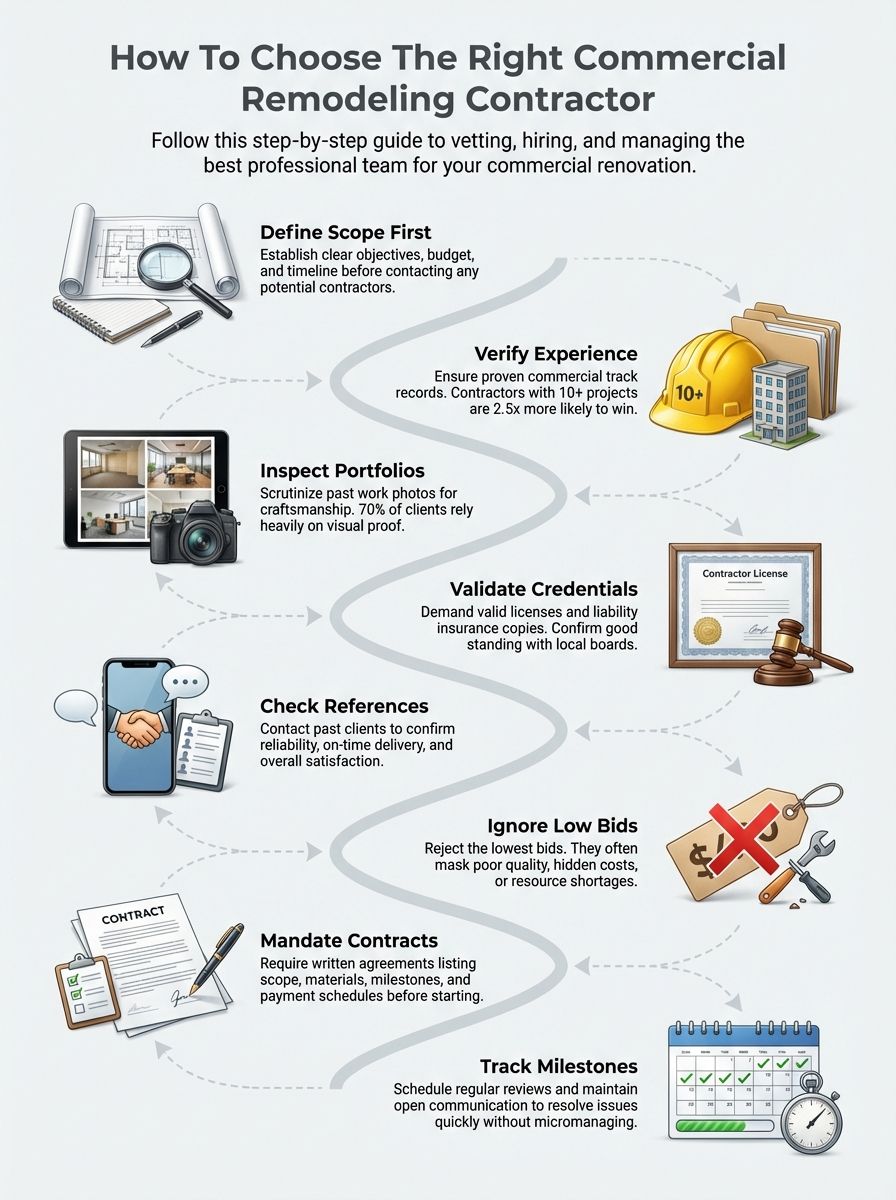
How To Choose The Right Commercial Remodeling Contractors For Your Project
Start by making your scope and constraints clear. Then you can compare bids on equal ground and avoid “apples to oranges” pricing.
From there, validate credentials, confirm insurance, check reviews, and require a written plan for communication and change orders.
How Do You Define Your Project Scope and Objectives?
Your scope is the job’s decision filter. If you define it well, you will spot weak bids fast.
Write your scope in plain language first, then let your contractor and designer translate it into drawings and specifications.
- Space and use: what rooms or areas, and who uses them daily.
- Constraints: building work hours, elevator access, noise rules, deliveries.
- Must-haves: items you will not compromise on (durability, ADA access, airflow).
- Nice-to-haves: upgrades you will do only if budget allows.
If you are in a co-op or condo, get your building’s alteration agreement early. Sweeten notes that NYC buildings commonly require higher insurance limits, often $1 to $2 million, and some require up to $5 million, which can narrow your contractor options.
How Should You Establish Your Budget and Timeline?
Budget and timeline work together. A budget without sequencing leads to rushed decisions, and a timeline without a budget leads to constant scope trimming.
Use your bid package to force clarity: specify allowances, clarify what is included, and require a written change-order process.
- Deposits: DCWP advises NYC homeowners to pay no more than 25% upfront for home improvement work.
- Milestones: tie payments to completed work you can verify on site.
- Permits and closeout: build time into your plan for filings, inspections, and sign-off.
- Contingencies: carry a separate line item for unknowns, especially in older buildings.
If you want a practical benchmark for high-end finish expectations, look at NARI’s published RotY cost categories. For example, NARI lists award categories like Residential Kitchen $150,000 to $200,000 and Residential Bath $40,000 to $70,000, which helps you sanity-check whether a bid is “in the ballpark” for the level of finish you want.
If you read my blog post from 1/22/2026, you’ll see the same theme: your best cost control tool is a scope you can actually enforce.
What Are the Best Ways to Research and Evaluate Contractors?
Do your research in a sequence that protects your time. First eliminate contractors who cannot legally do the work, then compare workmanship and process.
- Shortlist: pick 3 to 5 contractors who do your type of project in NYC.
- Verify: confirm licenses that apply to your scope and building type.
- Interview: ask who your daily point of contact will be and how changes are approved.
- Bid apples-to-apples: require the same scope sheet and allowance list for everyone.
For deeper due diligence, owners can review building history, filings, and job status through NYC Department of Buildings tools like BIS and the DOB NOW public portal, which NYC DOB describes as the official way to review permits, violations, and job history.
Why Is It Important to Review References and Previous Work?
References tell you how the contractor behaves under pressure. That matters as much as the finished tile line.
When I review references, I listen for specifics: what went wrong, how fast they responded, and how cleanly they documented changes.
- Ask about change orders: were they fair and written before work started?
- Ask about schedule: did they give weekly updates and stick to milestones?
- Ask about closeout: did they finish punch list and deliver warranties?
If you want an objective “quality bar,” use published award work as a reference point. NARI’s RotY winners and cost categories can help you describe your target finish level in clear terms, instead of vague phrases like “high end.”
How Do You Confirm Contractor Credentials and Insurance?
Credential checks should be a repeatable routine, not a one-time gut check.
Ask for documents, verify the numbers, and keep copies in your project file.
- License: confirm the license type that applies to your job (DOB registration, DCWP HIC, and licensed trades as needed).
- Workers’ compensation: request the official certificate form and confirm it is current (the NYS Workers’ Compensation Board lists specific acceptable proof forms and notes that ACORD forms are not acceptable).
- Disability and Paid Family Leave: request the NY disability/PFL certificate (Form DB-120.1 is commonly used) when a permit, license, or contract requires it.
- General liability: request a certificate, confirm limits, and confirm additional insured language if your building requires it.
What Critical Questions Should You Ask Before Hiring a Contractor?
Your questions should force clarity. If a contractor cannot answer in writing, they are not ready to run your job.
How Much Experience Do You Have with Projects Like Mine?
Ask for two things: a similar NYC project example, and the names of the people who will actually run your job.
If the salesperson cannot introduce you to the superintendent or project manager, expect communication gaps later.
- “What is the closest match project you’ve done in NYC?”
- “Who is the day-to-day lead, and how many projects are they running?”
- “Which subcontractors do you use for plumbing, electrical, and fire protection?”
- “What is your closeout process for permits and inspections?”
Can You Provide a Detailed Timeline and Budget Estimate?
A serious contractor can produce a written schedule and a line-item estimate. You are looking for assumptions, not just totals.
Sweeten notes that many contractors take about 1 to 2 weeks to prepare an estimate after a site visit, because they need subcontractor pricing and scope confirmations.
- Timeline: phases, inspection points, and long-lead materials.
- Budget: line items, allowances, and what is excluded.
- Payments: milestone schedule, not big front-loaded deposits.
- Changes: written change orders approved before extra work starts.
How Do You Manage Unforeseen Issues During a Project?
Unforeseen issues are normal in NYC. The difference is whether your contractor has a calm, written process.
Listen for specifics: how they document field conditions, who prices the fix, and how fast you get a decision-ready proposal.
When a contractor says, “We’ll figure it out as we go,” ask them to show you the form they use to document it.
What Common Mistakes Should You Avoid When Hiring Contractors?
Most renovation mistakes are predictable. You can avoid them by insisting on documentation and by verifying credentials before you pay.
Why Is Choosing Solely Based on Cost a Bad Idea?
The lowest bid often wins by leaving things out. In NYC, “left out” can mean permits, protection, evening cleanup, or the finish level you assumed was included.
BBB’s homeowner guidance is simple for a reason: get multiple quotes, compare scope, and do not pay the full cost upfront.
- Low bid risk: missing scope becomes change orders.
- Low staffing risk: schedule slips when the crew gets pulled elsewhere.
- Low documentation risk: disputes become “he said, she said.”
What Happens If You Neglect to Check Credentials and Reviews?
If you skip verification, you can end up with unlicensed work, expired insurance, or a contractor who cannot pull permits for the scope you are doing.
DCWP has repeatedly warned NYC homeowners about unlicensed home improvement contractors, and it has public enforcement actions that show this is not a rare edge case.
- Liability exposure: accidents and damage get messy fast without valid coverage.
- Permit exposure: work can be stopped or delayed until filings are corrected.
- Quality exposure: poor supervision leads to rework and tenant disruption.
Why Is Having a Detailed Contract Essential?
A detailed contract is your “project operating system.” It sets the rules before emotions, schedules, and surprises kick in.
DCWP states that contractors must give you a written contract that you both sign, including key dates, materials, charges, and a Notice of Cancellation.
- Scope: what is included, what is excluded, and what “complete” means.
- Schedule: start date, milestones, and closeout requirements.
- Payment: milestone payments tied to progress you can verify.
- Change orders: pricing and approvals in writing before extra work starts.
What Are the Benefits of Choosing the Right Commercial Remodeling Contractor?
The right commercial remodeling contractor saves you time, limits risk, and improves final quality. It also protects your investment by making sure the job can be signed off cleanly.
How Does the Right Contractor Improve Project Efficiency?
Efficiency comes from planning, coordination, and fast decisions, not from rushing. A good contractor keeps trades sequenced and keeps materials arriving before crews are standing around.
They also reduce rework by catching problems early, during rough-ins and inspections, not after finishes are installed.
- Clear sequencing: fewer trade conflicts and fewer callbacks.
- Jobsite standards: protection, cleanup, and controlled deliveries.
- Decision cadence: weekly checkpoints keep you moving without daily micromanagement.
Why Does Quality of Work Matter?
Quality is what you live with after the contractor leaves. In NYC, quality also affects noise, maintenance, and how long you can go before the next repair cycle.
If you want an external quality reference point, NARI’s RotY program publishes winners and cost categories, which helps you see what “excellent finish work” looks like at different budget levels.
How Do Contractors Ensure Compliance with Local Building Codes?
Good contractors treat compliance as a process: permit filing, inspections, corrections, and sign-off.
NYC Department of Buildings tools allow owners to review filings and track job status, which means you can confirm that the project is moving through official steps and not just “moving on site.”
- Permits: filed for the correct scope and work types.
- Inspections: scheduled at the right phases.
- Closeout: sign-off and completion documents organized for your records.
How Can You Manage Your Commercial Remodeling Project Effectively?
You do not need to run the job daily to manage it well. You need a simple rhythm: clear communication, scheduled checkpoints, and written decisions.
Why Is Clear and Regular Communication Important?
Communication prevents small misunderstandings from becoming expensive rework. It also keeps you in control of changes that affect cost and timing.
Large builders like Skanska talk openly about jobsite culture and communication, including programs like its Green Sticker initiative that signals trained support for mental health conversations. The practical takeaway for homeowners is simple: choose teams that make it easy to speak up early.
- Weekly check-in: schedule, decisions, and upcoming inspections.
- Photo updates: quick proof of progress and hidden conditions.
- Written change approvals: no verbal “go ahead” on extras.
How Do You Oversee Progress Without Micromanaging?
Set checkpoints tied to milestones. Then evaluate work against the scope, the drawings, and the contract.
If you do one thing consistently, do this: keep decisions written and dated, even if it is a short email summary after a call.
- Confirm the plan weekly: what finishes, what trades, what inspections.
- Walk the site at milestones: rough-in complete, pre-close, punch list.
- Hold payments to milestones: pay for verified progress, not promises.
How Should You Prepare for Potential Setbacks?
Setbacks happen. Your job is to make sure they do not become chaos.
Ask every bidder for a simple written plan: who approves changes, how pricing is documented, and how schedule impacts are reported.
- Decision makers: name the people who can approve changes fast.
- Documentation: photos, field notes, and written proposals.
- Contingency planning: a clear process for unknown conditions.
Last Words
How To Choose The Right Commercial Remodeling Contractors For Your Project comes down to one thing: you hire the team that can prove scope control, compliance, and communication, not just good photos.
Define scope, set a realistic budget, verify licensing and insurance, and compare at least three written bids before you commit.
If you want local NYC guidance from a contractor who values detail and craftsmanship, HomeRenovation4U offers licensed expertise and over 25 years of renovation experience. Reach out to discuss your project goals and constraints.
FAQs
1. How do I vet commercial remodeling contractors for my project?
Check licenses, insurance, and work samples, ask for past client contacts and recent project photos. Verify approvals, official inspections, clear communication, and fit with your budget and timeline.
2. What questions should I ask before hiring a contractor?
Ask about experience with commercial remodeling projects, who will manage the job, and how they handle permits. Request written estimates and a payment schedule, and ask for proof of insurance.
3. How do I compare bids and stay within budget?
Compare detailed, itemized estimates, check what each bid covers, and prefer clear timelines and milestones to avoid change orders.
4. Will the contractor handle permits and inspections, and who pays?
You usually need permits for commercial remodeling, and official inspections will follow. Good contractors will obtain approvals, coordinate inspectors, and keep you updated, call our office if you want help finding a vetted commercial remodeling contractor.