
Commercial renovation estimates in NYC need more than a quick price per square foot. One bid may look reasonable because it only includes visible construction. Another may look higher because it includes permits, mechanical work, electrical upgrades, furniture, technology, after-hours labor, building protection, inspections, and contingency. Those are not the same estimate.
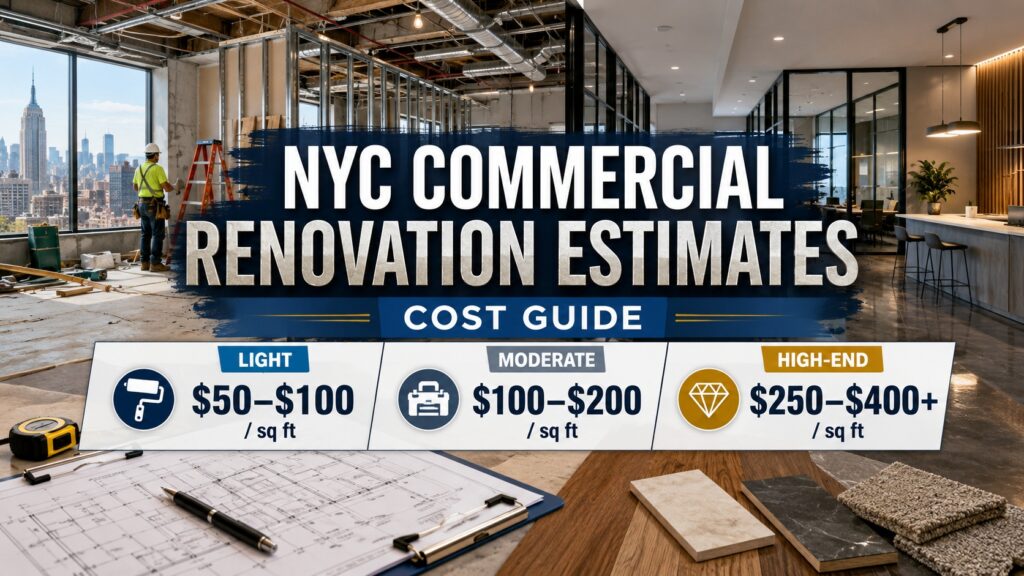
For early planning, light commercial renovation work in New York City often starts around $50 to $100 per square foot. Moderate renovations commonly land around $100 to $200 per square foot. High-end, specialty, restaurant, medical, or system-heavy commercial build-outs can reach $250 to $400+ per square foot.
Current NYC office fit-out benchmarks show why the full scope matters. A construction-only office build-out can sit around $212.59 per square foot, while an all-in example can reach about $330.92 per square foot once soft costs, IT, A/V, furniture, and contingency are included. That gap is where many owners get surprised.
This guide explains how to read commercial renovation estimates in NYC, what changes the budget, which costs are often missing from early bids, and how to compare contractors before the project turns into change-order soup.
What to Know Before Comparing Commercial Renovation Estimates
- Scope matters more than square footage. A 2,000-square-foot cosmetic refresh is not the same as a 2,000-square-foot restaurant, medical office, or full office build-out.
- Construction-only pricing is not the full budget. Soft costs, permits, furniture, IT, A/V, signage, equipment, and contingency can change the real number.
- Existing systems are major cost drivers. HVAC, plumbing, electrical capacity, fire protection, and low-voltage infrastructure often matter more than flooring or paint.
- NYC permits and building rules affect the estimate. After-hours work, freight access, DOB filings, inspections, insurance certificates, and landlord rules can add both cost and time.
- Restaurants, medical spaces, and high-end offices need tighter estimating. These projects usually involve more systems, specialty equipment, compliance review, and trade coordination.
- The cheapest bid can become the most expensive one. A low number that excludes permits, protection, demolition, MEP work, inspections, or closeout is not a complete estimate.
Key Factors Influencing Commercial Renovation Estimates in NYC
The biggest drivers behind commercial renovation estimates in NYC are project scope, building type, existing infrastructure, finish level, site access, permits, and schedule requirements. If those items are not reviewed early, the estimate will usually drift.
How Does Project Size and Scope Affect Renovation Costs?
Square footage sets the frame, but scope decides the real price. A 2,000-square-foot office that needs paint, carpet, and lighting is a very different project from a 2,000-square-foot office that needs new HVAC zones, glass offices, private rooms, pantry relocation, additional power, fire protection revisions, and A/V integration.
Commercial renovation estimates should separate the project into scope levels before numbers are compared.
| Scope Level | Typical Work | Common Planning Range |
|---|---|---|
| Light renovation | Painting, flooring, ceiling tile, minor repairs, limited fixture swaps, basic lighting updates. | $50 to $100 per sq ft |
| Moderate renovation | New partitions, selected MEP work, lighting upgrades, restrooms, millwork, layout changes, finish upgrades. | $100 to $200 per sq ft |
| Full build-out | Demolition, new layout, HVAC, plumbing, electrical, fire protection, storefront work, permits, inspections, full finishes. | $200 to $300+ per sq ft |
| High-end or specialty build-out | Premium finishes, custom millwork, restaurant systems, medical spaces, law offices, hospitality, complex infrastructure. | $250 to $400+ per sq ft |
Use headcount, customer flow, storage, code needs, and business goals as planning checks. If the space needs more staff capacity, better workflow, public restrooms, food-service infrastructure, or specialty equipment, the estimate changes immediately.
In NYC, square footage opens the conversation. Systems, schedule, and standards decide the real price.
What Types of Commercial Spaces Impact Renovation Pricing?
The type of commercial space changes the estimate because each use brings its own code path, equipment list, finish expectation, and inspection pressure. An office refresh, retail remodel, restaurant build-out, and medical suite may have the same square footage but completely different costs.
| Space Type | Why Cost Moves | What to Watch in NYC |
|---|---|---|
| Office build-out | Open plans cost less than heavily partitioned suites. Conference rooms, phone booths, pantry upgrades, acoustic control, power, and data raise cost. | Compare construction-only costs against all-in costs with IT, A/V, furniture, and soft costs. |
| Retail space | Storefront work, display lighting, millwork, security, fitting rooms, signage, and customer circulation affect budget. | Landlord design rules, signage coordination, ADA path-of-travel, and storefront approvals can add time. |
| Restaurant | Kitchen ventilation, gas, grease management, plumbing, fire suppression, equipment support, and cleanable finishes raise cost. | Do not price front-of-house finishes without pricing kitchen infrastructure and code requirements. |
| Medical office | Exam rooms, sinks, sound control, specialty casework, mechanical needs, privacy, and patient flow affect scope. | Even a basic conversion can become expensive if the infrastructure does not match the new use. |
| Lobby or corridor | Durable finishes, wayfinding, lighting, accessibility, wall protection, and occupied-building logistics matter. | Shared-area work often requires phasing, after-hours work, and careful protection. |
| Staten Island commercial space | Access may be easier than core Manhattan, but delivery timing, specialty trades, permits, and business continuity still matter. | Do not assume the job is simple just because the location is outside Midtown. |
How Do Material Quality and Finishes Influence Costs?
Finish choices change cost quickly, especially when the project uses custom items instead of stocked materials. Flooring, paint, and ceiling systems matter, but custom millwork, specialty doors, glass partitions, stone counters, upgraded lighting, and premium hardware can move the estimate faster than owners expect.
A practical estimate should separate high-impact customer-facing finishes from back-of-house materials. Not every wall needs premium treatment. Not every room needs custom millwork. But reception areas, client rooms, retail displays, restaurant counters, and public restrooms usually deserve better durability and presentation.
- Use stock finishes in storage rooms, employee corridors, and back-of-house spaces where durability matters more than branding.
- Reserve custom millwork for reception areas, retail display zones, conference rooms, bars, and customer-facing counters.
- Ask for alternates on flooring, lighting, doors, hardware, wall finishes, and millwork before the contract is signed.
- Check lead times before approving materials. A cheaper imported item can become expensive if it delays opening.
- Match finish level to lease term. A short-term tenant and a long-term owner should not make the same material decisions.
Why Existing Infrastructure Matters So Much
Existing infrastructure can save a project or crush the budget. If the current HVAC capacity, electrical panel, sprinkler coverage, plumbing locations, and low-voltage pathways still work for the new plan, the estimate stays healthier. If they do not, the job becomes a systems project, not a finish refresh.
Mechanical, plumbing, fire protection, and electrical work can represent a large share of hard construction costs in NYC commercial projects. These systems are expensive because they involve licensed trades, inspections, coordination, ceiling access, code review, and sometimes long-lead equipment.
- Electrical capacity: check before adding pantry equipment, server loads, retail displays, kitchen equipment, or medical devices.
- HVAC zoning: review before adding enclosed offices, exam rooms, conference rooms, or dense occupancy areas.
- Plumbing locations: confirm before moving restrooms, sinks, bars, kitchen lines, or treatment-room fixtures.
- Fire protection: review sprinkler coverage early because revisions can affect ceilings, permits, and inspections.
- Low-voltage infrastructure: plan Wi-Fi, cameras, access control, POS, A/V, and data locations before walls close.
A good contractor should want to inspect these items before giving a confident number. A bid that ignores existing systems is usually incomplete.
NYC Commercial Renovation Cost Breakdown
A useful estimate separates the project into cost categories. If cosmetic work, real construction, permits, furniture, technology, and contingency are blended into one vague number, the estimate stops being useful.
Light Commercial Renovation Costs
Light renovations are the lowest-cost tier because they focus on appearance and limited function, not deep system changes. This may include painting, flooring, ceiling tile replacement, minor fixture updates, basic carpentry, small repairs, and limited lighting upgrades.
Light commercial work often falls around $50 to $100 per square foot when the layout and major systems stay in place. The lower end only works when hidden conditions, building restrictions, and permit issues stay quiet.
| Category | Planning Notes |
|---|---|
| Typical range | $50 to $100 per sq ft for cosmetic commercial work with limited system changes. |
| Typical scope | Paint, flooring replacement, ceiling tile, minor repairs, fixture updates, limited trim and carpentry. |
| Best use case | Lease turnovers, office refreshes, small retail facelifts, lobby touch-ups, and quick visual upgrades. |
| Main risk | Hidden damage, old wiring, failed flooring substrate, unexpected code issues, and unclear exclusions. |
| Smart estimating move | Separate construction from furniture, signage, IT, security, and owner-supplied items. |
Light renovation only stays light if the scope remains disciplined. Once plumbing, walls, HVAC, major electrical, accessibility, or occupancy changes enter the picture, the project moves into a higher category.
Moderate Commercial Renovation Costs
Moderate renovations are where many NYC commercial projects actually live. They may include new partitions, selective MEP work, upgraded lighting, new doors, better flooring, restrooms, modest millwork, selected technology upgrades, and layout changes.
This is the danger zone for underbudgeting. A moderate estimate can look manageable until code work, IT, furniture, landlord rules, and permit coordination turn it into a near full build-out.
| Project Element | Typical Planning Range | Why It Matters |
|---|---|---|
| Moderate office renovation | $100 to $200 per sq ft | Common for reconfigured offices, upgraded finishes, and selected MEP work. |
| Retail remodeling | $60 to $150+ per sq ft | Display lighting, millwork, security, fitting rooms, and storefront work can widen the range. |
| Restaurant renovation | $100 to $250+ per sq ft | Ventilation, gas, plumbing, fire suppression, and equipment support drive cost. |
| Interior wall construction | Varies widely | Glass, acoustic ratings, fire ratings, doors, and hardware can move cost quickly. |
| Electrical and lighting | Often underestimated | Controls, dimming, emergency lighting, added circuits, A/V, and equipment loads need early pricing. |
| Soft costs | Separate line item | Design, engineering, permits, expediting, project management, and inspections should not be hidden. |
- Moderate projects need sharper scope because change orders usually start here.
- Occupied buildings need protection, phasing, and possible after-hours labor from day one.
- Allowances should be labeled clearly, especially for lighting, millwork, hardware, furniture, signage, A/V, and security.
High-End and Specialty Build-Out Costs
High-end commercial build-outs in NYC often start around $250 per square foot and can climb past $400 per square foot when custom finishes, specialty systems, complex scheduling, and premium brand standards are involved.
These projects are not expensive only because they look better. They are expensive because the work is more precise, more coordinated, and often more system-heavy.
- Luxury office interiors: custom reception walls, specialty doors, glass rooms, acoustic upgrades, conference A/V, and upgraded furniture.
- Law firm build-outs: more private offices, higher acoustic expectations, better conference rooms, privacy needs, and millwork.
- Restaurants and hospitality: kitchen exhaust, gas, fire suppression, custom bars, front-of-house finishes, and health-related planning.
- Medical and specialty use: ventilation, treatment-room plumbing, specialty sinks, casework, patient flow, privacy, and inspection sequencing.
- Occupied trophy buildings: after-hours work, freight rules, protection, supervision, and tight coordination.
If a premium project is priced like a standard refresh, the estimate is missing something.
Common Types of Commercial Renovation Projects in NYC
Different commercial spaces behave differently. Offices, retail stores, restaurants, medical suites, lobbies, corridors, and Staten Island commercial spaces all push the estimate in different directions.
Office Build-Outs and Workspace Optimization
Office build-outs turn raw or outdated space into usable work space. That may involve partitions, lighting, HVAC adjustments, restrooms, pantry areas, acoustic control, A/V, low-voltage infrastructure, furniture, and branding.
The common mistake is treating office layout like a design-only decision. In NYC, layout affects power, data, sprinkler heads, HVAC zoning, door hardware, acoustic assemblies, and sometimes after-hours scheduling. Every planning decision can show up in the estimate.
- Use open work areas where flexibility matters and privacy needs are limited.
- Reserve enclosed rooms for meetings, calls, focused work, HR, legal, finance, or client discussions.
- Budget conference rooms honestly because A/V and acoustic upgrades can cost more than desks.
- Use demountable partitions or modular furniture where future team changes are likely.
- Plan technology infrastructure before ceiling and wall work is complete.
Workspace optimization is also a cost-control strategy. If the layout adapts as the team changes, the business may avoid another disruptive renovation too soon.
Retail and Restaurant Renovations
Retail remodeling usually focuses on storefront impact, lighting, product display, fitting rooms, checkout counters, security, restrooms, storage, and customer movement. Restaurant remodeling adds another layer because kitchen infrastructure can outweigh front-of-house finishes.
Restaurant estimates need special attention. Ventilation, gas, plumbing, grease management, fire suppression, washable surfaces, equipment support, and inspections all belong in the first estimate, not as later surprises.
- Retail priorities: storefront visibility, lighting, flooring, displays, checkout flow, fitting rooms, security, and ADA circulation.
- Restaurant priorities: hood exhaust, fire suppression, grease interceptor planning, plumbing, gas, durable finishes, and cleaning access.
- Budget trap: pricing the dining room without pricing kitchen infrastructure at the same time.
- Schedule reality: landlords often enforce delivery windows, sign-off procedures, freight rules, and protection requirements.
When comparing restaurant bids, ask whether the quote includes hood work, gas coordination, fire suppression testing, utility upgrades, floor drains, kitchen wall finishes, and equipment support. That answer tells you how real the estimate is.
Medical Facility Renovations
Medical renovation starts with planning, not finishes. Even a basic conversion from office or retail can require new hand-washing locations, specialty plumbing, better ventilation, sound control, electrical upgrades, casework, patient privacy, and inspection coordination.
Each specialty changes the build. Dental rooms, exam suites, therapy rooms, imaging-support areas, and wellness spaces do not share the same infrastructure needs. A medical estimate should be built room by room.
- Map patient flow before finalizing walls.
- Review mechanical needs before adding treatment rooms or enclosed offices.
- Price sinks, plumbing, and specialty casework separately.
- Coordinate equipment requirements before electrical and millwork are finalized.
- Run a preconstruction audit before design is locked.
Medical renovation often becomes expensive when owners discover too late that the existing office infrastructure does not support the new use.
Lobbies, Corridors, and Shared Commercial Areas
Lobbies and corridors look simple on paper, but they carry branding, accessibility, durability, lighting, safety, and tenant experience at the same time. Flooring durability, wall protection, wayfinding, lighting, and entry hardware matter more here than in private back-office areas.
- Use durable wall and floor finishes that can handle carts, deliveries, and heavy tenant traffic.
- Improve lighting and controls to reduce maintenance and improve appearance.
- Update wayfinding and accessibility together.
- Plan occupied-building logistics carefully because common areas usually cannot be fully closed.
- Price after-hours work honestly if the building requires it.
Commercial Remodeling in Staten Island, NY
Staten Island commercial projects can sometimes be easier to stage than core Manhattan jobs, especially when access, parking, and loading are simpler. But that does not make the renovation automatically cheap. Restaurants, medical offices, specialty retail, and full commercial build-outs can still require serious trade coordination and permit planning.
- Ask whether the estimate assumes standard daytime work or protected after-hours work.
- Confirm whether delivery and staging access are actually easy.
- Review whether specialized trades need to travel from other boroughs.
- Separate core construction from signage, furnishings, technology, and owner-supplied equipment.
- Confirm who handles permits, inspections, and utility coordination.
The fair way to compare borough pricing is to compare scope, systems, schedule, and building rules, not just square-foot averages.
Planning Your Commercial Renovation Project
A strong plan keeps the estimate honest. Budget, schedule, permits, materials, and contractor responsibilities should be mapped before work starts. NYC projects become expensive when those details remain vague.
How Do You Set a Realistic Renovation Budget?
Start with scope, then build the budget in layers. If you begin with a single number and try to force the project to fit, something important will usually be missed.
- Construction budget: hard costs for demolition, labor, materials, walls, flooring, finishes, systems, and closeout.
- Soft costs: design, engineering, permit filing, expediting, inspections, project management, and professional review.
- Furniture and equipment: desks, chairs, restaurant equipment, medical equipment, storage, POS, and display systems.
- Technology: IT, A/V, cameras, access control, Wi-Fi, data cabling, conference rooms, and low-voltage work.
- Signage and branding: storefront signs, interior graphics, reception features, wayfinding, and branded millwork.
- Contingency: often 10% to 20%, especially in older NYC buildings or projects with hidden conditions.
A good budget is not just a total. It is a decision tool. When line items are clear, you can reduce cost without damaging the pieces that matter most.
What Is the Best Way to Create a Clear Timeline?
A realistic renovation timeline should reflect approvals, ordering, permits, building rules, inspections, and site conditions. The construction schedule is only one part of the total project schedule.
- Discovery: inspect the space, review existing conditions, and define the business goal.
- Design and scope: create drawings, finish schedules, equipment lists, and scope descriptions.
- Permit review: identify filings, landlord approvals, insurance requirements, and inspections.
- Procurement: order long-lead items such as doors, glass, millwork, lighting, HVAC equipment, and specialty materials.
- Construction: schedule demolition, rough work, inspections, finishes, installation, and cleanup.
- Closeout: complete punch list, inspections, final documents, and turnover.
Track approval dates and material release dates on the same schedule. In NYC, those two timelines collide more often than owners expect.
How Do You Plan for Permits and Approvals?
Permit planning should start before pricing is finalized. The permit path depends on the exact scope, not on whether the project feels small. Work involving layout changes, plumbing, major electrical work, HVAC, fire protection, storefront changes, signage, occupancy, or after-hours construction can affect cost and schedule.
- Review the scope line by line and flag anything that changes layout, plumbing, electrical, HVAC, occupancy, or fire protection.
- Keep cosmetic work clearly defined if the goal is a lighter renovation path.
- If work must happen before 7:00 am, after 6:00 pm, or on weekends, plan for after-hours coordination.
- If the building or storefront has special restrictions, confirm approval requirements before ordering custom materials.
- Assign permit responsibility in writing: who files, who pays, who tracks inspections, and who handles closeout.
Permit confusion creates two problems at once: lost time and surprise cost. Clear responsibility up front prevents both.
Choosing the Right Commercial Renovation Contractor in NYC
The right contractor protects the estimate and the schedule. The wrong one can make a cheap bid very expensive by missing permits, underpricing systems, misreading building rules, or failing to coordinate trades.
Why Commercial Experience Matters
Commercial work is less forgiving than a simple interior refresh. Access rules, site protection, licensed trades, inspections, occupied-building logistics, and business downtime all raise the need for tighter project management.
- Choose a contractor who has handled your building type, not just renovation in general.
- Ask how they manage night work, deliveries, tenant coordination, and inspections.
- Make sure they understand commercial systems, not just finishes and carpentry.
- Ask for examples where they solved hidden conditions without blowing up the budget.
- Review whether the estimate shows real trade coordination or just a broad lump sum.
Experience shows up before demolition starts. You can usually see it in the questions the contractor asks.
How Can Reviews and References Help?
Reviews help when they are specific. The useful ones talk about schedule control, cleanliness, communication, change orders, and how the contractor handled problems after walls were opened.
Do not stop at testimonials. Ask for references from projects that match your building type, borough, budget level, and scope.
- Ask for two or three recent clients with similar projects.
- Ask references about change orders, communication, cleanup, and closeout.
- Compare review language with the contractor’s proposal. If the estimate is vague and reviews mention confusion, pay attention.
- Confirm that the business name on the estimate matches insurance and registration documents.
What Should a Contractor Estimate Include?
A strong commercial renovation estimate should be written clearly enough that you can compare it against other bids without guessing what is included.
- Project scope and room-by-room work description.
- Demolition and debris removal.
- Labor and material categories.
- Electrical, plumbing, HVAC, fire protection, and low-voltage work.
- Permit responsibility and inspection coordination.
- Building protection, freight rules, elevator use, dust control, and cleanup.
- Allowances for lighting, flooring, millwork, hardware, furniture, signage, and technology.
- Named exclusions.
- Schedule assumptions.
- Change-order process.
- Payment milestones.
- Named project manager or site lead.
If an estimate does not say what is excluded, it is not finished. Exclusions are where many expensive surprises hide.
Cost-Saving Tips for NYC Commercial Renovations
Saving money in NYC is not about chasing the cheapest bid. It is about controlling scope, reusing what still works, avoiding rework, ordering early, and making finish decisions that match the business model.
Reuse and Repurpose What Still Works
Reuse works best when it is intentional. Evaluate existing materials and systems before design is locked. That way, the project preserves value instead of paying to demolish items that could have stayed.
- Keep serviceable doors, frames, and hardware where layout changes are limited.
- Refinish or repaint existing millwork in back-of-house spaces if it is structurally sound.
- Reuse lighting, HVAC components, or panel capacity only after code and performance checks.
- Stay cosmetic where possible if the business goal is speed and cost control.
- Use standard materials in low-visibility zones and premium finishes only where they matter.
- Design layouts that can be reconfigured later without rebuilding the whole space.
Reuse should never be blind thrift. If an old system will fail inspection or create maintenance headaches, replacement is the smarter savings decision.
Focus on Energy-Efficient Upgrades During Renovation
Energy upgrades can improve operating cost and future compliance planning. They are also easier to complete during a renovation because ceilings, walls, lighting, controls, HVAC, and electrical systems may already be open.
| Upgrade Type | Why It Helps | Best Time to Plan |
|---|---|---|
| LED lighting and controls | Reduces electric load, improves appearance, and lowers maintenance. | During ceiling and electrical work. |
| HVAC upgrades | Improves comfort, efficiency, and future compliance planning. | Before ceilings and partitions are finalized. |
| Building automation | Improves scheduling, comfort control, and energy management. | During electrical and controls planning. |
| Envelope improvements | Can reduce wasted energy and improve comfort. | During storefront, window, or exterior work. |
| Efficient plumbing fixtures | Reduces water use in restrooms, kitchens, and service areas. | During plumbing replacement or restroom renovation. |
The practical move is to review energy upgrades before equipment is purchased, not after. Late changes are usually more expensive.
Plan Renovation Timing Around Business Reality
Timing savings usually come from better procurement, smoother approvals, and less disruption to operations. There is no magic season where every trade suddenly becomes cheap.
- Start design and permit strategy early.
- Order long-lead materials before demolition if they control the opening date.
- Schedule work around lease turnover, slower business periods, or planned shutdowns where possible.
- Price after-hours work upfront if the building requires it.
- Phase large projects so part of the business can keep operating.
- Keep landlord scope, tenant scope, and owner-supplied items separate in every estimate.
Good timing lowers risk more than it lowers sticker price. In commercial renovation, that risk reduction is often where the real savings are.
How to Compare Commercial Renovation Estimates Side by Side
When you receive multiple estimates, do not compare only the bottom-line number. Compare what each contractor included, excluded, assumed, and left vague.
| Estimate Item | What to Check | Why It Matters |
|---|---|---|
| Scope | Is every room and trade described clearly? | Vague scope becomes change orders. |
| Permits | Who files, pays, tracks, and closes out? | Permit confusion delays projects. |
| MEP work | Are HVAC, electrical, plumbing, and fire protection included or excluded? | These are major cost drivers. |
| Allowances | Are flooring, lighting, millwork, doors, hardware, furniture, and A/V realistic? | Low allowances make bids look artificially cheap. |
| Schedule | Does it include approvals, procurement, inspections, and punch list? | Construction time is not the whole timeline. |
| Exclusions | Are exclusions named clearly? | Missing exclusions hide future costs. |
The best bid is not always the lowest bid. The best bid is the one that gives you the clearest path to a finished, legal, usable commercial space with the fewest expensive surprises.
Final Cost Takeaway
Commercial renovation estimates in NYC should be built in layers: hard construction, soft costs, permits, technology, furniture, signage, equipment, contingency, and business-disruption planning. If any of those layers are missing, the estimate is not giving you the full picture.
Light commercial renovations may start around $50 to $100 per square foot. Moderate projects often land around $100 to $200 per square foot. High-end, restaurant, medical, specialty, or system-heavy build-outs can reach $250 to $400+ per square foot.
The safest way to control cost is to define the real scope, inspect existing systems early, price permits and logistics honestly, compare estimates line by line, and hire a contractor who understands NYC commercial renovation. HomeRenovation4U can help review your space, define the scope, and build a practical renovation estimate before construction starts.
Frequently Asked Questions
How much does commercial renovation cost in NYC?
Commercial renovation costs in NYC vary by scope, building type, systems, finishes, permits, and schedule. Light renovation may start around $50 to $100 per square foot, moderate work commonly ranges from $100 to $200 per square foot, and high-end or specialty build-outs can reach $250 to $400+ per square foot.
What should a commercial renovation estimate include?
A strong estimate should include scope, demolition, labor, materials, permits, MEP work, protection, debris removal, allowances, exclusions, schedule assumptions, inspections, change-order process, payment milestones, and closeout responsibilities.
Why do NYC commercial renovation estimates vary so much?
Estimates vary because projects differ in layout, building age, existing systems, finish level, permits, access, after-hours work, business use, and whether the bid includes all-in costs such as furniture, IT, A/V, signage, and contingency.
How can owners avoid surprise costs during renovation?
Owners can avoid surprise costs by defining the scope clearly, inspecting existing systems, separating allowances, confirming permit responsibility, reviewing exclusions, carrying contingency, and comparing contractor bids line by line instead of only by the final number.
Do commercial renovations in NYC require permits?
Many commercial renovations require permits, especially when the work involves layout changes, plumbing, major electrical work, HVAC, fire protection, storefronts, signage, occupancy, or after-hours construction. The exact permit path depends on the building and scope.
How do I compare commercial renovation contractors in NYC?
Compare contractors by commercial experience, insurance, registration, similar project examples, clarity of estimate, trade coordination, permit responsibility, change-order process, project management, references, and how well they explain exclusions and schedule risks.