
You know the moment a renovation starts to feel “off”, it usually comes down to one thing: you hired the wrong team for the job.
This page is my practical guide on How To Choose The Right Residential Construction Company For Your Project in the NYC Metropolitan Area, so you can avoid the classic problems, cost surprises, timeline slips, and workmanship that looks fine on day one and fails a year later.
I’m Alex Fedin, a licensed General Contractor and the founder of HomeRenovation4U in New York City, and I’ve been leading renovation projects since 2000.
Below, I’ll show you how to define your scope, verify licenses and insurance, read a portfolio like a pro, and compare estimates and contracts without getting overwhelmed.
Key Points
- Start with NYC realities: many renovations require approvals and permits through the NYC Department of Buildings, and even some “no permit” work still requires a licensed Home Improvement Contractor through the NYC Department of Consumer and Worker Protection.
- Vet protection, not promises: confirm active insurance, written estimates, and a written contract, plus a clear change order process (changes should be documented and signed).
- Use the city’s paper trail: check license status and complaint history, then look at building filings and permits to confirm the work is being done above-board.
- Budget for unknowns on purpose: for older NYC apartments and homes, hidden conditions and required upgrades are common, so plan a contingency and require line-item pricing that makes allowances obvious.
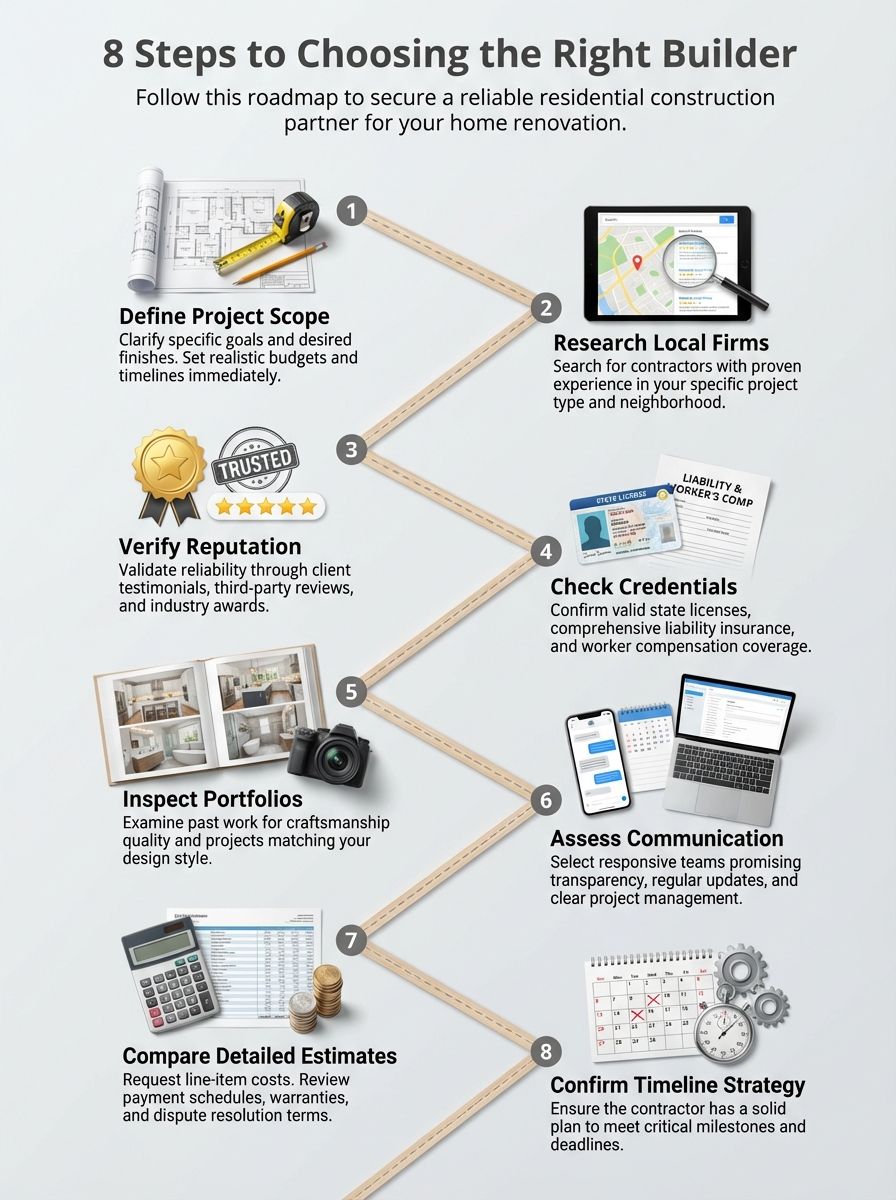
Define Your Project Requirements

If you want a smooth renovation, you need a scope that’s specific enough to price, schedule, and permit correctly.
Your builder, remodeler, or contractor can only manage your budget and timeline if you define what “done” means, in writing.
Watch a quick walkthrough on defining scope before you request bids
What is the scope and goal of my construction project?
In NYC, “scope” is more than finishes and inspiration photos. It’s also what you’re changing behind the walls, which often decides whether you need filings, permits, special inspections, or a design professional involved.
Start with a short, buildable scope statement, then expand it into a checklist you can hand to every residential construction company you interview.
- Spaces: list every room and any shared building areas affected (kitchen, bath, hallway, terrace, basement, attic).
- Systems: call out any plumbing, electrical, gas, HVAC, sprinklers, or venting changes.
- Walls and structure: note any wall removals, beam work, or floor leveling.
- Building constraints: co-op or condo rules, work hours, elevator reservations, noise limits, debris routes, and protection requirements.
- Finish level: materials and performance expectations (tile quality, cabinet hardware, waterproofing approach, sound control).
Then write your goal in plain English. Examples: “A durable family kitchen that’s easy to clean,” “A second bathroom added legally,” or “A basement that stays dry and meets code.” That wording makes contractor selection easier because it forces real recommendations, not generic sales talk.
If you’re renovating in a landmarked building or historic district, add a note early. The NYC Landmarks Preservation Commission often reviews exterior changes in historic districts, and certain interior work can also trigger review.
At HomeRenovation4U, led by me, Alex Fedin, we translate those goals into a scope that can be priced, scheduled, and inspected correctly.
How do I determine my budget and timeline?
Plan early, and let numbers drive decisions.
Budget and timeline planning in the NYC metro area works best when you separate three buckets: base scope (the work you want), required scope (code or building requirements), and unknown scope (hidden conditions).
The NYC Department of Buildings notes that many kitchen and bathroom renovations need permits, and “most kitchen and bathroom renovations” commonly fall under an Alteration Type 2 filing when multiple trades are involved or you change plumbing, gas, or electrical layouts. That should shape your schedule because filings, approvals, and inspections take real time.
Set your initial budget using a written scope and line-item estimates. Then add a contingency that matches the risk profile of your building. Older apartments, brownstones, and any project that opens walls should carry a stronger contingency than surface-only work.
- Lower-risk refresh: painting, light carpentry, or cabinet swaps with no trade changes.
- Mid-risk renovation: kitchens and baths with new outlets, moved fixtures, or new ventilation.
- Higher-risk renovation: structural work, load-bearing changes, multi-trade reroutes, or moisture remediation.
For timeline planning, ask each contractor to provide a milestone schedule, not just a start and end date. A schedule that lists approvals, long-lead ordering, rough-ins, inspections, and punch list tells you the team actually knows how NYC projects run.
Research Residential Construction Companies
The fastest way to waste money in NYC is to hire a contractor you “like” before you confirm their license status, track record in your building type, and ability to run permits and inspections cleanly.
Do your research with a repeatable process so you can compare firms fairly.
See an overview of how to evaluate and compare contractors
How do I find reputable local construction companies?
Start by building a shortlist of firms that regularly work in your borough and your building type (single-family, two-family, condo, or co-op). Then validate them through public records and direct questions.
- License lookup: confirm a current Home Improvement Contractor license through NYC’s consumer protection licensing search tools.
- Complaint checks: ask for guidance on complaint history through city resources such as 311, then compare what you learn to the company’s own story.
- Building history tools: use NYC building data portals like BIS and the DOB NOW public portal to understand filings, permits, complaints, and violations tied to a property.
- Trade affiliations: look for meaningful memberships or credentials, such as NARI certifications for remodelers or NKBA credentials for kitchen and bath design expertise.
One practical filter: if a company can’t clearly explain how they handle permits and inspections in NYC, remove them from your list. You want a firm that treats compliance as part of project management, not as an afterthought.
Which companies have experience with projects like mine?
“Experience” should mean your exact risk profile, not just a pretty photo gallery. In the NYC Metropolitan Area, the building itself changes the project.
Use this quick matching guide while you interview each residential construction company.
| Your project type | What you want the company to have done before | Why it matters in NYC |
|---|---|---|
| Kitchen or bath renovation with layout changes | Alteration filings, multi-trade coordination, inspection closeouts | These projects often trigger DOB filings and trade permits, and mistakes can stall inspections. |
| Co-op or condo renovation | Alteration agreement compliance, neighbor protection, building scheduling | Board rules can dictate work hours, elevator use, noise limits, and insurance paperwork. |
| Older home or pre-war apartment | Lead-safe work planning, hidden-condition problem solving | Older buildings hide surprises, and lead-safe practices can become a real requirement, not a “nice-to-have.” |
If the contractor’s “similar project” is in a totally different building type, treat their timeline and pricing as a rough guess. You need a team that’s already learned the NYC-specific lessons.
Where can I read reliable reviews and testimonials?
Reviews help, but only when you read them like a contractor reads them. Look for specifics: schedule accuracy, cleanliness, change order fairness, and how the team handled inspections.
For your final two candidates, go beyond star ratings and ask for direct references. A practical rule I use is to request three to five recent references from projects completed in roughly the last 12 to 18 months, then ask those homeowners what went wrong and how the contractor responded.
- Ask the reference: “Did the final price match the estimate, and if not, why?”
- Ask the reference: “How did they document change orders and approvals?”
- Ask the reference: “Did they pass inspections without drama?”
- Ask the reference: “Would you hire them again in the same building?”
Then cross-check what you hear against public information. If someone claims they “always pull permits,” you should see evidence of that approach in how they talk about filings, inspections, and closeouts.
Verify Credentials and Certifications
Credentials are not decoration. In NYC, they are part of how you protect your budget, your neighbors, and your ability to close out permits and sell your property later.
Watch a short video on verifying contractor credentials before you sign
Is the company properly licensed and insured?
Start with licensing. NYC requires a Home Improvement Contractor license for many types of residential renovation work, and the city has also made it clear that some “no permit required” work still needs a licensed Home Improvement Contractor.
Then confirm insurance with documents, not a verbal “yes.” For NYC renovations, ask for copies of current certificates and make sure the business name matches the contract.
- General liability insurance: protects you if property damage or third-party injury happens.
- Workers’ compensation: protects you if a worker gets hurt on your site.
- Disability and Paid Family Leave coverage (NY): required for many businesses seeking permits and licenses, and New York State lists specific acceptable proof forms for coverage.
- Licensed trades: confirm who will pull electrical and plumbing permits if your scope requires them.
A simple red flag: if someone asks you to “pull the permit as the owner” so they can “save time,” stop and get clarity. In my experience, that move often shifts risk onto you.
What industry accreditations and memberships should I look for?
Certifications are only useful if they connect to how the work is executed. For NYC homeowners, I focus on credentials that change day-to-day jobsite behavior.
For example, the US Environmental Protection Agency requires Renovation, Repair and Painting certification for firms doing certain work in homes built before 1978, and firm certification runs on a five-year cycle. If your building falls into that category, this credential directly affects how the crew contains dust and documents compliance.
- EPA RRP certification: a must-ask for pre-1978 homes and apartments where painted surfaces will be disturbed.
- LEED or WELL experience: useful if you’re prioritizing indoor air quality and material choices, especially during gut renovations.
- NKBA and NARI credentials: signals specialized kitchen and bath planning knowledge and remodel-focused business standards.
- Local trade participation: often correlates with continuing education and up-to-date code awareness.
If you’re in a historic district or landmarked property, add a compliance check for Landmarks Preservation Commission review. A contractor who has worked through that process will plan your schedule differently, and more accurately.
Evaluate Their Portfolio
A strong portfolio answers three questions: can they do work like yours, can they finish cleanly, and can they explain how they got there.
Don’t settle for pretty photos. You’re hiring for craftsmanship and project management, not for a highlight reel.
How can I review a company’s previous projects?
Ask for a short list of projects that match your building type and constraints, then review each one with a “proof” mindset. In NYC, proof often looks like filings, approvals, and clean closeouts.
- Ask for a similar-scope case study: scope, schedule, change orders, and final cost range.
- Ask for details behind the photos: waterproofing method, substrate prep, ventilation, and electrical planning.
- Ask about inspections: which inspections were required and how the team planned for them.
- Confirm building coordination: co-op or condo rules, protection plans, and neighbor management.
If your project is in a multiple dwelling, understand that some alteration work can require special and progress inspections. NYC building guidance also notes that the owner typically engages a registered Special Inspection Agency, and the contractor cannot hire the special inspector. That separation is a quality control step, not a hassle.
What indicates high-quality craftsmanship in their work?
Craftsmanship shows up in the parts you touch every day, and in the parts you will never see after walls close. I look for both.
In kitchens and baths, tile is a great “tell.” The Tile Council of North America maintains ANSI A108 installation standards, including workmanship requirements. You do not need to memorize standards to benefit from them, you just need to ask the right question: “What standard are you installing to, and how do you verify it?”
- Fit and finish: straight grout lines, consistent reveals, doors and drawers that align, clean caulk transitions.
- Water management: shower slopes, waterproofing continuity, and clean penetrations around valves and niches.
- Substrate prep: flat walls and floors before tile, stone, or cabinetry goes in.
- Mechanical planning: ventilation that’s sized and routed correctly, and electrical that’s planned before cabinets land.
If a contractor gets defensive about these basics, that’s a signal. A confident builder will explain their process and show how they check their own work.
Communication and Customer Service
In NYC renovations, communication is part of your schedule. If you can’t get clear answers before you sign, you won’t get them when the walls are open and decisions matter.
Judge communication like you’d judge workmanship, with observable behaviors.
How responsive and transparent is the company?
Set expectations in writing before the project starts. If a contractor can’t commit to a communication cadence, you should assume you’ll be chasing them later.
NYC consumer rules include requirements around cancelling home appointments, including giving notice before the end of the business day before the appointment day. Use that as a baseline standard for professionalism, even at the estimate stage.
- Update rhythm: weekly check-in meeting plus quick written updates when decisions are needed.
- Decision log: a simple list of finish selections, approvals, and change orders.
- Single point of contact: one person accountable for answers and scheduling.
- Change order discipline: no work proceeds on changes until you approve the price and time impact in writing.
Transparency also means telling you “no” when something is risky or unrealistic. A reputable contractor will flag schedule risks like long-lead materials and inspection timing early.
Why is clear communication important during construction?
Clear communication prevents rework, and in NYC rework often triggers building delays, neighbor complaints, and inspection problems.
It also protects your budget because most cost blowups start as small, undocumented changes that snowball.
| Communication habit | What it prevents |
|---|---|
| Written daily or weekly status updates | “I thought you meant…” misunderstandings and missed decisions |
| Written change orders with cost and time impact | Surprise invoices and schedule drift |
| Scheduled walkthroughs at milestones | Late punch lists and rushed final fixes |
My training at Kharkiv National University of Architecture & Construction pushed structure and accountability, and that mindset has served NYC homeowners well. The work goes smoother when every decision has an owner and a timestamp.
Compare Estimates and Contracts
Estimates and contracts are where you separate a professional construction service from a risky guess.
Ask for details that make it possible to compare apples to apples, then read the contract like it’s part of the build.
How do I request and compare detailed estimates?
Get at least three written estimates, and give each contractor the same scope document. If you change the scope between bidders, you’ll get numbers that can’t be compared.
This Old House notes a helpful renovation bid reality: materials often represent about 40% of the total cost, with overhead and profit margins commonly in the 15% to 20% range. That’s why a one-line “labor and materials” number tells you almost nothing.
- Line items: demolition, framing, plumbing, electrical, finishes, protection, cleanup, and fees.
- Allowances: list the exact allowance amounts for cabinets, tile, fixtures, and appliances.
- Exclusions: call out what’s not included so you can price it separately.
- Schedule: a milestone plan tied to approvals, inspections, and long-lead orders.
If one bid is dramatically lower, don’t “hope” it’s a deal. Treat it as a question that needs an answer: cheaper materials, missing scope, or aggressive assumptions usually show up later as change orders.
What contract terms should I review for fairness and clarity?
Your contract should make the job measurable. In New York State, home improvement contract requirements can apply once the contract value crosses a threshold, and the required elements commonly include a written agreement, start and completion dates, a description of work and materials, and a clear progress payment schedule tied to completion events.
Here’s the checklist I want NYC homeowners to use before signing.
- Scope of work: detailed, attached, and signed.
- Payment schedule: progress payments tied to milestones, not vague dates.
- Change orders: written, signed, priced, and scheduled before work starts.
- Permits and filings: who files, who pays, and what closeout deliverables you receive.
- Warranty and punch list: what’s covered, how long, and how fixes are requested.
- Dispute resolution: steps to resolve issues before anyone talks about court.
If a contractor won’t put it in writing, you should assume they won’t honor it under pressure.
One more NYC-specific protection worth knowing: the NYC Department of Consumer and Worker Protection offers a Home Improvement Contractor Trust Fund process for eligible consumers when a DCWP-licensed contractor owes money or doesn’t complete work. DCWP lists recovery limits that can reach up to $40,000 under the standard process, and it also lists a separate claim process with its own maximum that increased in 2025. This is one reason I tell homeowners to avoid unlicensed work, even if the price feels tempting.
Ask About Project Management and Timelines
Project management is where good intentions either turn into a smooth build, or turn into chaos.
Ask how the contractor plans, tracks, and closes out a NYC renovation, step by step.
What is the company’s construction management process?
A strong process starts before demolition. Pre-construction planning should include scope confirmation, building requirements, permit strategy, long-lead ordering, and a schedule that accounts for inspections.
For many NYC kitchen and bathroom renovations, the NYC Department of Buildings points out that you may need a New York State licensed Professional Engineer or Registered Architect to file, which should be part of your contractor’s plan.
- Pre-construction: field verify measurements, confirm building rules, finalize drawings, confirm permit path.
- Procurement: order long-lead items early (custom cabinets, specialty tile, windows, certain appliances).
- Rough-ins: plumbing, electrical, framing, and any required inspections.
- Finish phase: cabinets, tile, paint, trim, fixtures, and final touch-ups.
- Closeout: final walkthrough, punch list, sign-offs, and a clean handover package.
If your project triggers special inspections, make sure everyone is clear on who hires the Special Inspection Agency and how discrepancies get handled. That clarity prevents stalled permits and repeat visits.
Can the company reliably meet project deadlines?
Deadline reliability comes from planning, not confidence. Ask for the schedule, then ask how they protect it.
- Critical path: which tasks must be completed on time so everything else stays on track?
- Subcontractor coverage: who’s on the calendar for plumbing, electrical, tile, and finish carpentry?
- Decision deadlines: when do you need to choose fixtures, tile, and paint to avoid delays?
- Inspection plan: how do they schedule and prepare for inspections and re-inspections?
In my experience, the most overlooked schedule killer in NYC is building coordination, elevator bookings, protection requirements, and limited work hours. A contractor who has done real co-op and condo work will address those constraints upfront.
Closing Words
If you want a smoother renovation in the NYC Metropolitan Area, stick to the fundamentals: define your scope, vet licenses and insurance, review real project history, and compare detailed estimates and contracts.
Those steps are the core of How To Choose The Right Residential Construction Company For Your Project, and they protect your budget, timeline, communication, and craftsmanship.
If you want a second set of eyes on your scope or bids, contact HomeRenovation4U and we’ll talk through the smartest next step for your home.
FAQs
1. How do we choose the right residential construction company for our project?
We pick a licensed general contractor who shows a state contractor license, proof of insurance, and a clear portfolio. Ask for references, examples that match our budget and timeline, and records of building permits.
2. What should we check in their experience and work history?
Check their portfolio, Google reviews, and references, and make sure they know local codes, have handled similar projects, and offer clear warranties.
3. How do we compare costs, timelines, and contracts?
Request detailed bids, and compare what each bid covers, including who handles permits and inspections. Favor a fixed-price contract with clear payment terms, so we avoid surprise costs. Set a timeline with milestones, and agree how we will get progress updates.
4. How do we ensure good communication and long-term support?
We look for a company that shares a communication plan, offers post-project support, and builds lasting partnerships; contact us to discuss your project and get a clear bid.
References
- https://www.mdpi.com/2075-5309/13/5/1154
- https://www.researchgate.net/publication/370300110_Construction_Contracts_Quality_Assessment_from_the_Point_of_View_of_Contractor_and_Customer (2023-04-27)