
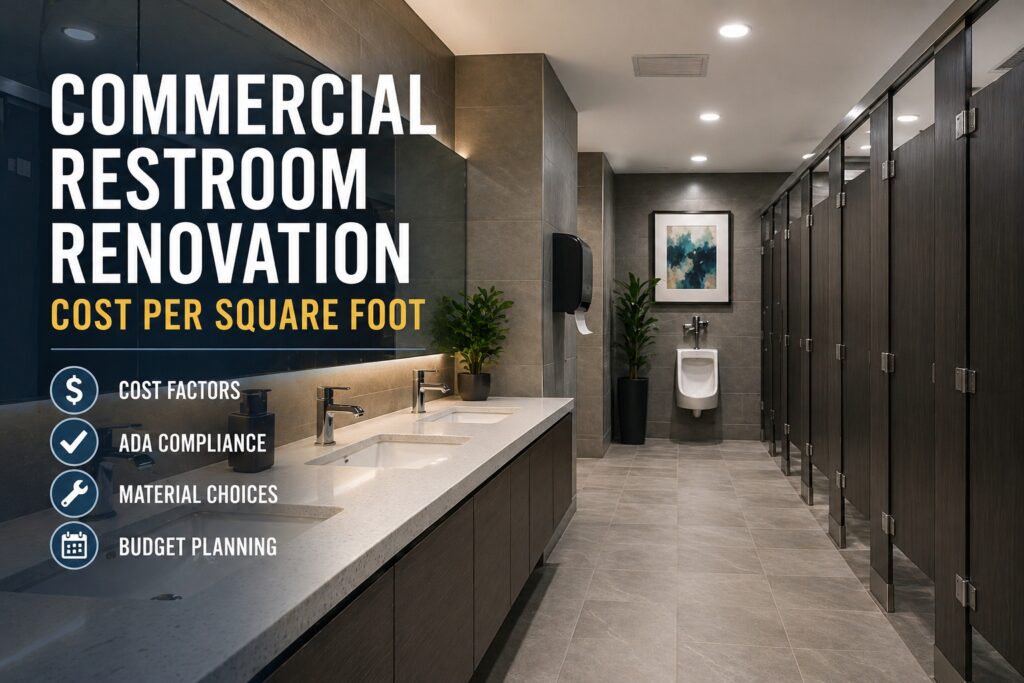
Commercial restroom renovation cost per square foot can help you build an early budget, but the number only means something when the scope is clear. A light restroom refresh with paint, fixtures, lighting, and accessories is one project. A full renovation with plumbing changes, new drains, ADA layout work, ventilation, waterproofing, tile, partitions, and permits is a very different project.
In the NYC metro area, commercial restroom renovations often fall in a broad range of about $70 to $300 per square foot. Smaller cosmetic updates may stay closer to the lower end. Full commercial restroom renovations with multiple fixtures, durable materials, accessibility upgrades, licensed trades, and ventilation work can move toward the higher end or beyond it.
The biggest mistake is budgeting for visible finishes first. Owners often focus on tile, toilets, faucets, mirrors, and lighting, then get surprised by rough plumbing, electrical work, exhaust, wall backing, ADA clearances, permits, demolition, waterproofing, and hidden water damage.
This guide breaks down the real cost drivers, explains why commercial restroom pricing varies so widely, and shows how to control the budget without creating a restroom that fails under daily use.
What to Know Before Budgeting a Commercial Restroom Renovation
- Commercial restroom renovation cost per square foot usually depends more on scope than size. Moving plumbing, changing fixture count, adding ADA upgrades, or improving ventilation can change the budget quickly.
- A basic refresh may stay around $70 to $150 per square foot. This usually applies when the layout stays the same and work focuses on finishes, fixtures, lighting, paint, and accessories.
- Full renovation can reach $200 to $300+ per square foot. This is common when the project includes demolition, plumbing changes, tile, waterproofing, partitions, ventilation, and accessibility work.
- Keeping toilets, sinks, drains, and major electrical points in place usually saves the most money. Layout changes often trigger the biggest cost jump.
- ADA requirements can reshape the room. Accessible clearances, stall size, grab-bar backing, door swings, sink height, and turning space need to be planned before framing.
- Durable materials cost more upfront but reduce maintenance. Porcelain tile, epoxy grout, commercial partitions, WaterSense fixtures, and moisture-resistant wall finishes usually perform better in high-traffic restrooms.
What Factors Influence Commercial Restroom Renovation Cost per Square Foot?
Square footage matters, but restroom renovation is priced by scope first and area second. The fastest way to misread a quote is to compare a paint-and-fixture refresh with a gut renovation that moves drains, adds exhaust, replaces partitions, and changes accessibility clearances.
A restroom is a small room with a high concentration of trades. Plumbing, electrical work, ventilation, tile, waterproofing, partitions, fixtures, accessories, doors, wall backing, and inspections all have to work together in a limited space.
How Does Restroom Size Affect Cost?
Restroom size changes the total cost, but layout density decides whether the price per square foot feels reasonable or painful. A small single-user restroom may have a high cost per square foot because the project still needs setup, protection, demolition, plumbing, electrical, tile work, and cleanup. A larger multi-stall restroom may have better unit pricing, but the final contract value can still be much higher.
Larger restrooms need more tile, more flooring, more partition material, more lighting, more accessories, more cleaning, and more labor hours. They may also require more exhaust capacity, more fixtures, and more accessibility planning.
The best unit pricing usually appears when the fixture layout is efficient and the plumbing stays close to existing lines. If the project adds longer drain runs, new wet walls, extra stalls, or major accessibility changes, the cost per square foot climbs.
What Is the Difference Between Partial and Full Renovation Costs?
The cleanest dividing line is this: a partial renovation updates what people see, while a full renovation changes how the room functions. A partial refresh may include paint, lighting, mirrors, accessories, select fixture replacement, floor repair, and minor plumbing or electrical corrections. A full renovation may include demolition, tile replacement, new partitions, plumbing changes, electrical upgrades, ventilation, waterproofing, ADA changes, and inspections.
| Renovation Type | Typical Scope | Common Cost Range | Best Fit |
|---|---|---|---|
| Light refresh | Paint, accessories, mirrors, lighting, minor repairs, fixture swaps. | $70 to $150 per sq ft | Rooms with a sound layout and limited code issues. |
| Mid-level renovation | New flooring, tile repairs, partitions, improved fixtures, lighting, selected plumbing or electrical work. | $125 to $250 per sq ft | Outdated rooms that still keep the main layout. |
| Full renovation | Demolition, new tile, plumbing changes, ventilation, partitions, ADA work, electrical upgrades, waterproofing. | $200 to $300+ per sq ft | Old, damaged, non-compliant, or heavily used restrooms. |
If you can keep toilets, sinks, drains, and major electrical points in place, you usually save the most money. The moment you move wet walls or add new fixture locations, the project becomes slower, more trade-heavy, and more permit-sensitive.
How Do Material Types and Quality Affect the Budget?
Material choices can move the budget more than owners expect. Commercial restrooms take abuse: water, cleaning chemicals, heavy traffic, public use, and constant maintenance. Cheap finishes can lower the first number but create faster failure and higher maintenance later.
- Porcelain tile: a strong choice for wet floors, mop-heavy maintenance, and high-use restrooms.
- Large-format tile: creates a cleaner look with fewer grout lines, but often needs flatter walls and floors, which can raise prep labor.
- Epoxy grout: costs more and requires skill, but resists stains and frequent cleaning better than standard cement grout.
- HDPE or phenolic partitions: more expensive than powder-coated steel, but much better in damp, heavy-use, or high-cleaning environments.
- Quartz or solid-surface counters: often easier to maintain than marble or porous stone in commercial restrooms.
- Moisture-resistant wall panels: useful behind sinks and in high-splash zones where paint would fail quickly.
The practical move is to spend on the surfaces that staff clean every day: floors, grout, wall protection, partitions, counters, and fixtures. That is where durable mid-range materials usually outperform both bargain products and overly decorative upgrades.
Why Do Labor Costs Vary So Much?
Labor costs vary because restroom renovation stacks multiple specialties into a tight footprint. Plumbers, electricians, tile installers, carpenters, painters, ventilation contractors, demolition crews, and inspectors may all touch the same small room.
Skilled trade work drives the price. Drain changes, fixture relocation, GFCI protection, lighting controls, exhaust routing, tile layout, wall backing, waterproofing, and accessible fixture placement all require coordination. A commercial restroom is not just a decorated box. It is a systems-heavy room.
| Trade or Task | Why It Affects Cost |
|---|---|
| Plumbing | Toilets, sinks, drains, shutoffs, urinals, valves, and fixture relocation can reshape the budget. |
| Electrical | Lighting, outlets, hand dryers, sensors, mirrors, controls, and code-compliant wiring require licensed coordination. |
| Tile and flooring | Substrate prep, waterproofing, layout, slope, and grout quality all affect labor hours. |
| Ventilation | Exhaust, duct routing, roof or exterior termination, and controls are often underestimated. |
| Demolition | Older tile, mud beds, concrete, damaged walls, and limited access can make demo slower than expected. |
How Does Location Affect Pricing?
Location changes labor availability, permit process, delivery logistics, inspection timing, and debris handling. In the NYC metro area, owners usually pay more for licensed trade coordination, dense-site logistics, protection of occupied areas, and access restrictions.
Restroom renovation in a Staten Island retail space, restaurant, office, medical suite, or mixed-use building may involve limited parking, narrow delivery windows, building management rules, after-hours work, and strict cleanup routines. Those realities affect the estimate.
Local experience matters. A contractor who already understands New York commercial buildings, occupied-site work, and trade coordination can often save more than a slightly lower hourly rate from a crew that underestimates the process.
Commercial Restroom Renovation Cost Breakdown by Components
A good estimate should show where the budget goes. If a quote only gives one lump sum, it becomes hard to compare bids and easy to miss exclusions. The major cost buckets usually include demolition, plumbing, electrical, flooring, wall finishes, partitions, countertops, ventilation, accessibility, permits, accessories, and cleanup.
Flooring and Tile Installation
Flooring and tile can range widely depending on material, substrate condition, layout, waterproofing, and installation complexity. Basic tile may look affordable by the box, but commercial installation requires preparation, layout, transitions, slip resistance, and cleanable grout lines.
| Floor or Tile Type | Typical Use | Budget Impact |
|---|---|---|
| Basic ceramic tile | Lower-traffic restrooms and budget-focused updates. | Lower to mid-range. |
| Porcelain tile | High-use commercial floors and wet-cleaned surfaces. | Mid-range and often best value. |
| Large-format tile | Modern walls and cleaner visual lines. | Can raise labor because flatter surfaces are needed. |
| Mosaic tile | Accent walls, slopes, or small areas. | Higher labor due to layout and grout work. |
| Natural stone | Premium restrooms and hospitality settings. | Higher material and maintenance cost. |
For many commercial owners, the smart middle ground is durable porcelain on floors, simpler wall tile in wet or splash areas, and moisture-resistant paint or panels in dry zones. This keeps the restroom durable without turning every surface into a premium tile installation.
Plumbing Fixtures: Toilets, Sinks, Faucets, and Urinals
Fixture pricing depends on brand, durability, flush type, controls, finish, and whether the fixtures are commercial-grade. Public and employee restrooms should use products that are easy to maintain and replace, not delicate fixtures designed for low-use residential bathrooms.
| Fixture | Budget Consideration | What to Ask For |
|---|---|---|
| Toilets | Commercial durability, flush performance, water use, and installation type. | Reliable parts, efficient flush, and easy service access. |
| Urinals | Flush valve, water use, maintenance, and partition layout. | Efficient models and proper spacing. |
| Lavatory sinks | Wall-hung, countertop, integrated, or multi-user trough style. | Cleanable surfaces and accessible height where required. |
| Faucets | Manual, metered, sensor, finish, and maintenance requirements. | Commercial-grade valves and water-saving flow rates. |
| Flush valves | Manual or sensor-operated, exposed or concealed. | Serviceable parts and proven commercial hardware. |
Reusing sound supply and drain locations can save real money. Reusing worn-out public fixtures usually does not, because the labor to work around failing parts can erase the short-term savings.
Lighting and Electrical Systems
Lighting affects safety, cleaning, user comfort, and how finished the restroom feels. Electrical work may also include hand dryers, GFCI protection, mirror lighting, occupancy sensors, emergency lighting, access control, and low-voltage devices.
- Basic lighting replacement: lower cost when existing wiring and fixture locations are usable.
- LED upgrade: usually a smart move for long-term operating cost and visibility.
- Occupancy sensors: useful in commercial restrooms that are not used continuously.
- Mirror and vanity lighting: improves user experience and cleaning visibility.
- Hand dryers: may require electrical review and dedicated circuits.
Electrical planning should happen before walls and ceilings close. Adding lights, outlets, sensors, or dryers late can require rework that should have been avoided in design.
Ventilation and Exhaust
Ventilation is one of the most important restroom systems and one of the easiest to underbudget. Poor exhaust creates odor problems, moisture issues, comfort complaints, and faster finish deterioration.
Ventilation cost depends on existing duct routes, ceiling access, fan capacity, code requirements, controls, exterior discharge path, and whether the building can support the required airflow. In older commercial spaces, the exhaust route can be more expensive than the fan itself.
- Confirm whether the existing exhaust works properly.
- Review fixture count and restroom use before sizing ventilation.
- Plan duct routing before ceilings are closed.
- Use controls that match restroom traffic patterns.
- Do not treat ventilation as a cosmetic item.
Countertops, Vanities, and Sink Areas
Countertops and vanities can quietly shift the entire price tier of a restroom renovation. Prefabricated units keep spending down. Custom casework, stone tops, wall-hung sinks, integrated sinks, and premium hardware push labor and material costs up.
In commercial restrooms, quartz and solid-surface materials often make more practical sense than marble because they are easier to maintain. Around sinks, the key issue is cleaning and water exposure, not just appearance.
| Vanity or Counter Choice | Budget Impact | Best Use |
|---|---|---|
| Prefab vanity | Lower | Small staff restrooms or budget-focused renovations. |
| Quartz counter | Mid-range | Durable commercial restroom counters. |
| Solid-surface integrated sink | Mid to high | Easy-clean commercial and medical-style restrooms. |
| Natural stone | Higher | Premium hospitality or executive spaces with planned maintenance. |
| Custom millwork | Higher | Brand-sensitive spaces where appearance matters strongly. |
Wall Finishes: Paint, Tile, Panels, and Wallcovering
Wall finish pricing depends on cleaning demands as much as appearance. Paint is the lowest-cost starting point, but it is not always the best lifecycle value in high-use or splash-prone rooms.
- Paint: lowest entry cost; best for dry walls and lighter-use restrooms.
- Commercial wallcovering: stronger visual effect but needs careful seam and moisture planning.
- FRP panels: durable and cleanable in high-use or wet-cleaned spaces.
- Tile wainscot: durable around sinks and high-traffic wall areas.
- Decorative moisture-resistant panels: higher upfront cost but useful where walls get frequent cleaning.
If the restroom sees frequent mopping, public use, or sink splash, wall protection around the hardest-hit areas can be smarter than repainting every year.
Partitions, Doors, Accessories, and Hardware
Partitions and accessories can add more than expected. Stall partitions, privacy strips, door hardware, toilet paper dispensers, grab bars, mirrors, soap dispensers, paper towel dispensers, hand dryers, hooks, shelves, and baby-changing stations all require coordination and installation.
| Item | Why It Matters |
|---|---|
| Toilet partitions | Material choice affects cost, durability, and moisture resistance. |
| Grab bars | Need proper backing and correct placement. |
| Mirrors | Affect finish quality and may require wall preparation. |
| Dispensers | Need consistent placement and maintenance access. |
| Hand dryers | Can require electrical planning and noise consideration. |
| Baby-changing station | May require wall backing and clear floor space. |
These items should be included in the estimate. If they are left as owner-supplied extras, the budget may look lower than it really is.
Accessibility and ADA Compliance Costs
ADA upgrades rarely act like simple add-ons. They often reshape the room. Clearances, turning space, stall width, door swings, sink approach, mirror height, toilet placement, grab bars, and accessible routes all affect the layout.
Costs rise because the renovation may need wider stalls, revised partitions, door changes, new wall backing, fixture relocation, adjusted sink height, and new plumbing or tile work. The worst time to discover an accessibility problem is after framing, tile, or partition installation.
- Review accessible stall size before ordering partitions.
- Confirm door swings and maneuvering clearances.
- Add backing for grab bars before walls close.
- Coordinate sink height, pipe protection, and knee clearance.
- Check mirror, dispenser, and accessory mounting heights.
- Do not assume existing conditions are compliant.
ADA planning is cheapest on paper. It becomes expensive after tile, partitions, and plumbing are already installed.
Restrooms vs. Changing Rooms: Why the Cost per Square Foot Differs
Commercial restroom renovation usually costs more per square foot than dry changing-room work because restrooms contain more plumbing, waterproofing, ventilation, fixtures, and code-sensitive clearances. Changing rooms can still be expensive, especially when they include showers and premium lockers, but a basic dry changing area may avoid much of the wet-trade work that drives restroom costs.
| Space Type | Main Cost Drivers | Why the Budget Changes |
|---|---|---|
| Commercial restroom | Plumbing, drains, exhaust, waterproofing, ADA clearances, fixtures, partitions. | More trade coordination and more code-sensitive work. |
| Dry changing room | Lockers, benches, flooring, lighting, mirrors, partitions, paint. | Usually fewer plumbing and exhaust requirements. |
| Changing room with showers | Showers, drains, waterproofing, ventilation, lockers, benches, privacy, flooring. | Can approach restroom costs because wet systems are added. |
The lesson is simple: a changing room budget is often driven by lockers, benches, and layout, while a restroom budget is usually driven by hidden systems, fixtures, and compliance.
Average Cost by Restroom Size
Commercial restroom renovation cost per square foot changes by room size. Small restrooms often run higher per square foot because fixed costs are spread across less area. Medium restrooms usually give the most predictable pricing. Large restrooms can have better unit pricing but much larger total costs.
| Restroom Size | Common Range | What Drives the Number |
|---|---|---|
| Small single-user restroom | $150 to $350+ per sq ft | High fixed costs, tight labor conditions, limited layout flexibility. |
| Medium commercial restroom | $125 to $300 per sq ft | Balanced footprint, manageable fixture count, better labor efficiency. |
| Large multi-stall restroom | $100 to $250+ per sq ft | Better efficiency, but higher totals for tile, partitions, fixtures, and labor. |
| Premium or high-complexity restroom | $250 to $400+ per sq ft | ADA changes, premium finishes, new plumbing, heavy ventilation, custom details. |
Small Restrooms
Small restrooms often look expensive on a square-foot basis because every project still needs setup, protection, demolition, trade coordination, cleanup, and finish work. A single-user restroom may be small, but it still needs plumbing, electrical, ventilation, fixtures, flooring, wall finishes, and accessories.
If the room only needs a cosmetic refresh, the budget can stay more manageable. If the project requires ADA layout correction, new plumbing, tile replacement, or ventilation upgrades, the cost per square foot can rise quickly.
Medium Restrooms
Medium-sized restrooms often give the best balance between cost and efficiency. They are large enough for trades to work more efficiently, but not so large that every finish line item becomes oversized.
This size category is where owners often get the best budget control if they keep the layout intact and focus on durable mid-range materials. The biggest budget risk is moving plumbing or discovering hidden damage after demolition.
Large Restrooms
Large restrooms may have better square-foot efficiency, but the total project cost can become significant. More stalls, more sinks, more floor area, more lighting zones, more partitions, more accessories, and more ventilation all add cost.
Large restrooms also carry more scheduling and phasing concerns. In active commercial buildings, the contractor may need to keep some restroom access available while work happens in phases.
Additional Costs to Consider
Permits, inspections, demolition, waste removal, water damage, smart systems, and hidden structural issues often sit outside the visible finishes owners focus on first. These are the cost categories that create budget drift when they are not planned early.
Permits and Inspections
Permit planning affects both timeline and legal exposure. Restroom renovations involving plumbing, electrical work, ventilation, walls, accessibility, or changes to layout may require filings, licensed trade work, inspections, and closeout documentation.
- Plumbing work: fixture relocation, drain changes, valves, and water lines can trigger licensed trade requirements.
- Electrical work: lighting, hand dryers, outlets, sensors, and emergency systems need proper electrical coordination.
- Ventilation: exhaust work may require mechanical review and code coordination.
- Accessibility: ADA-related layout changes should be reviewed before construction.
- Inspections: rough and final inspections can affect schedule sequencing.
The best move is to confirm the permit path before demolition starts. That protects the schedule more than almost any finish decision.
Demolition and Waste Removal
Demolition and hauling are easy to underestimate because the cost disappears once the restroom looks new. Owners still pay for labor, protection, dust control, debris movement, disposal, and cleanup.
Older restrooms can be especially expensive to demolish. Thick mortar beds, old tile assemblies, concrete-backed walls, rusted fixtures, and hidden water damage can make demolition slower than expected.
- Ask what demolition includes.
- Clarify who handles debris removal.
- Confirm protection of adjacent spaces.
- Expect older tile systems to require more labor.
- Leave room in the budget for conditions found behind the walls.
Water Damage, Mold, and Structural Problems
Water damage can change the budget quickly. A small stain may be minor, or it may point to a larger problem behind the wall. Failed waterproofing, leaking valves, damaged subfloor, soft framing, and mold-related cleanup can all appear during demolition.
If moisture is hiding behind the wall, time is working against your budget.
If the contractor finds soft flooring, staining, failed waterproofing, mold concerns, or damaged framing, pause and price the repair before finish work continues. Covering a moisture problem with new tile or paint is not renovation. It is a delay tactic.
Smart Technology and Sensor Upgrades
Smart upgrades can be useful, but they should solve real operating problems. In commercial restrooms, the best technology usually reduces water use, energy use, complaints, or maintenance labor.
- Occupancy-sensor lighting: reduces waste in rooms used intermittently.
- Sensor faucets: improve hygiene and control water use.
- Leak sensors: useful in high-risk areas or multi-tenant buildings.
- Smart flush valves: can support maintenance tracking in larger facilities.
- Efficient ventilation controls: improve comfort and reduce unnecessary runtime.
Do not overbuy gadgets before fixing basics. Plumbing, ventilation, waterproofing, lighting, and durable finishes should come first.
How to Reduce Commercial Restroom Renovation Costs
You can cut cost without cutting quality, but the strategy has to be deliberate. The best savings usually come from layout discipline, durable mid-range specifications, smart phasing, and clear project management.
Keep the Layout Where Possible
Keeping toilets, sinks, drains, and wet walls in place is often the fastest way to control cost. Moving plumbing can trigger demolition, slab work, drain slope issues, venting problems, new tile, new inspections, and longer schedule.
If the existing layout functions well and can meet accessibility needs, reuse it. Spend the money on fixtures, partitions, lighting, ventilation, wall protection, and finishes instead of moving systems that do not need to move.
Choose Cost-Effective Materials by Zone
The goal is not to buy the cheapest finish. The goal is to match each material to the abuse it will see.
- Use porcelain tile or commercial safety flooring where water and cleaning are frequent.
- Use epoxy grout in wet or heavy-cleaning zones.
- Use moisture-resistant panels around sink splash areas.
- Use HDPE or phenolic partitions where humidity or traffic is high.
- Use quality commercial-grade fixtures instead of decorative fragile fixtures.
- Use standard product lines when possible to reduce lead time and replacement headaches.
Prioritize Essential Upgrades First
Prioritizing is how you keep a restroom renovation from becoming a wish list with no budget logic. Start with the items that protect function, safety, and code compliance.
- Fix leaks, drainage, and ventilation first. They protect every finish that comes after.
- Keep the layout if possible. Moving plumbing is one of the fastest ways to grow the budget.
- Fund accessibility needs early. Do not treat them like optional extras.
- Choose durable mid-range materials. They often beat both cheap finishes and expensive fragile materials.
- Carry a contingency. A 10% to 20% reserve is still a smart rule for renovation work in older buildings.
Work With an Experienced Contractor
Experienced contractors save money by seeing expensive mistakes before they happen. That includes permit strategy, trade sequencing, waterproofing details, ventilation planning, fixture coordination, and realistic lead times.
A cheap number from a team that misses plumbing, electrical, ADA, ventilation, or inspection details can become the most expensive estimate on your desk. The right contractor helps you compare full scope, not just the headline price.
Plan for Long-Term Durability
Long-term value comes from tracking what the restroom costs after renovation, not only what it costs to build. Maintenance, cleaning, water use, lighting, repairs, complaints, and downtime all matter.
| Upgrade | Upfront Impact | Why It Pays Back |
|---|---|---|
| LED lighting | Low to moderate | Cuts energy use and replacement frequency. |
| Water-saving fixtures | Moderate | Reduces water use in high-traffic rooms. |
| Epoxy grout in wet zones | Moderate | Helps resist staining and frequent deep-clean replacement. |
| Moisture-resistant wall panels | Moderate to high | Reduces repainting and wall damage in splash areas. |
| Commercial partitions | Moderate to high | Last longer in high-use public restrooms. |
If you want the renovation to age well, choose parts that your maintenance team will thank you for. In busy restrooms, the easiest surfaces to clean are often the smartest surfaces to buy.
Final Cost Takeaway
Commercial restroom renovation cost per square foot is driven by scope, not just size. The biggest budget drivers are plumbing changes, ventilation, accessibility work, demolition, tile, partitions, permits, and material durability.
A basic refresh may stay near the lower end of the range, while a full commercial restroom renovation with new plumbing, ADA changes, tile, partitions, ventilation, and hidden-condition repairs can move toward $200 to $300+ per square foot.
The safest way to control cost is to define the scope clearly, keep the layout where possible, price hidden systems first, choose durable mid-range materials, and carry a realistic contingency. HomeRenovation4U can help review the space, define the scope, and build a practical restroom renovation plan before construction starts.
Frequently Asked Questions
How much does a commercial restroom renovation cost per square foot?
Commercial restroom renovation often ranges from about $70 to $300 per square foot. A light refresh may stay closer to the lower end, while full renovations with plumbing changes, ADA upgrades, tile, partitions, ventilation, and permits can move toward the higher end or beyond it.
What drives commercial restroom renovation costs the most?
The biggest cost drivers are plumbing, fixture count, drain locations, ventilation, accessibility requirements, tile, partitions, demolition, wall conditions, permits, and whether the existing layout can be reused.
Is it cheaper to keep the same restroom layout?
Yes. Keeping toilets, sinks, drains, and wet walls in the same place is usually one of the best ways to control cost. Moving plumbing can trigger demolition, new rough-in work, inspections, tile replacement, and longer timelines.
Do commercial restroom renovations require permits?
Many projects do, especially when they involve plumbing, electrical work, ventilation, walls, accessibility changes, or major fixture replacement. The permit path depends on the building, location, and exact scope.
What materials are best for high-traffic commercial restrooms?
Durable materials usually perform best, including porcelain tile, epoxy grout in wet zones, commercial-grade fixtures, HDPE or phenolic partitions, quartz or solid-surface counters, and moisture-resistant wall panels around splash areas.
How can owners reduce restroom renovation costs without cutting quality?
Owners can reduce costs by keeping the layout, choosing durable mid-range materials, separating must-have upgrades from decorative extras, ordering standard product lines, fixing plumbing and ventilation first, and comparing contractor bids by the same written scope.