
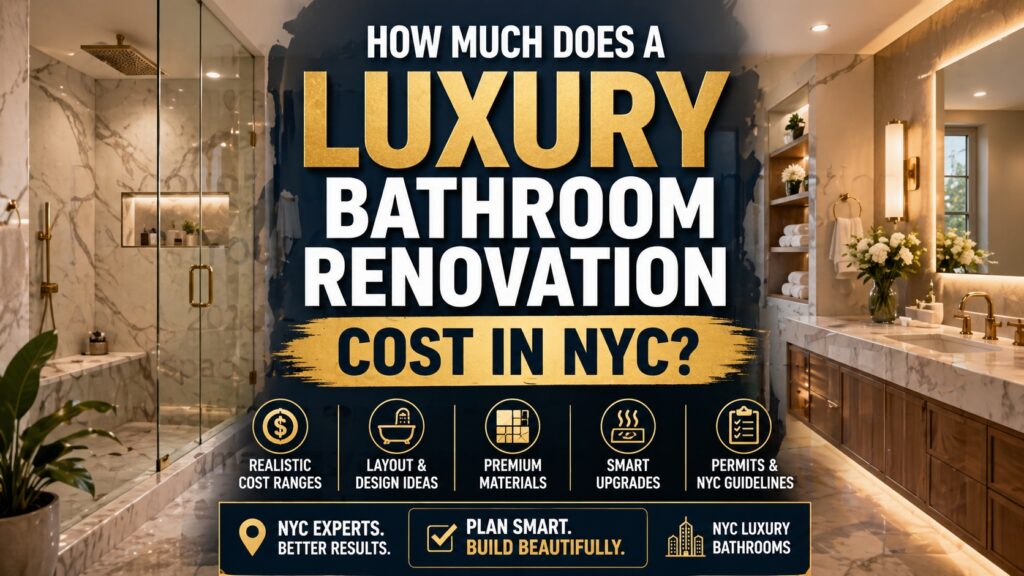
A luxury bathroom renovation in NYC should do more than make a small room look expensive. The best projects improve layout, storage, comfort, lighting, ventilation, and finish quality at the same time. In a city apartment, townhouse, brownstone, or condo, real luxury comes from a bathroom that feels calm, works smoothly every morning, and holds up to daily use.
Many NYC bathrooms look acceptable on paper, then create friction every day: tight clearances, poor storage, dim lighting, weak ventilation, dated tile, awkward doors, and materials that are hard to clean. A smart luxury bathroom plan fixes those problems before choosing marble, brass fixtures, or a freestanding tub.
Recent NYC bathroom cost guides often place high-end bathroom renovations around $25,000 to $75,000+, with totals climbing quickly when the project includes plumbing relocation, slab stone, custom cabinetry, heated floors, premium shower systems, or DOB filings. The best way to control the budget is to decide early what kind of luxury matters most: daily comfort, resale value, spa atmosphere, easier maintenance, or a full custom rebuild.
What to Know Before Planning a Luxury Bathroom Renovation
- High-end NYC bathroom renovations often range from $25,000 to $75,000+. Larger bathrooms, gut work, premium stone, custom vanities, and plumbing moves can push the number higher.
- Layout matters before finishes. A bathroom with marble and poor storage still feels frustrating. Clearances, door swings, shower entry, vanity depth, and storage should come first.
- Permits and building rules can affect the timeline. Many NYC bathroom renovations need DOB filings, licensed trades, or co-op and condo approvals when plumbing, electrical, walls, or layout change.
- Porcelain is often the practical luxury choice. Large-format porcelain creates a clean high-end look with less maintenance than many natural stones.
- Natural stone can be beautiful but needs care. Marble, travertine, quartzite, limestone, slate, and Tadelakt finishes can elevate the room, but they require correct installation and realistic upkeep.
- The best comfort upgrades are not always decorative. Walk-in showers, heated floors, custom vanities, quiet ventilation, layered lighting, and better waterproofing often matter more than visual extras.
Key Features of a Luxury Bathroom Renovation in NYC
A true luxury bathroom does more than impress visitors. It feels calmer, cleans faster, stores more, and works better in a compact footprint. That is the difference between a bathroom that photographs well and one that actually improves daily life.
Many generic design guides list trendy finishes without explaining what protects comfort and value: quiet ventilation, strong waterproofing, proper lighting, usable storage, fixture clearances, and a layout that does not make the room feel crowded.
What Makes a Bathroom Feel Spa-Inspired?
Spa-inspired design starts with restraint. Warm whites, soft grays, muted greens, pale stone tones, wood accents, and simple lines help the room feel settled instead of busy. The point is not to add more decorative objects. The point is to reduce visual noise.
Then comfort is layered where it counts: a larger shower, a deep soaking tub if the room supports it, dimmable lighting, hidden storage, soft towels, a heated floor, and finishes that make cleaning easier. A spa-style bathroom should feel relaxing because the plan is calm, not because the room is overloaded with luxury symbols.
- Use one dominant finish family and one accent, so the room feels composed.
- Keep countertops open with concealed storage and recessed medicine cabinets.
- Use warm, flattering light rather than one harsh ceiling fixture.
- Add natural materials, such as wood or stone, in controlled doses.
- Choose ventilation that protects the finishes and keeps the room fresher after showers.
Create calm every day with fewer visual distractions and better comfort at the points you use most.
Which High-End Materials Work Best?
Marble and travertine still define the classic luxury look. They bring depth, veining, softness, and visual character that printed surfaces rarely match. They work especially well on vanity tops, tub decks, feature walls, and carefully selected shower details.
Porcelain is often the practical luxury choice for NYC homes. Large-format porcelain can imitate stone, concrete, plaster, or limestone while reducing grout lines and maintenance. It is especially useful in bathrooms that are used every day, where water resistance and easy cleaning matter.
| Material | Why Homeowners Choose It | Best Use | What to Plan For |
|---|---|---|---|
| Marble | Timeless veining and strong luxury appeal | Vanities, statement walls, shower details | Needs sealing and gentler care. |
| Travertine | Warm, soft, spa-like texture | Feature walls, flooring, quiet luxury palettes | Needs sealing and professional installation. |
| Large-format porcelain | Clean look with fewer grout lines | Floors, shower walls, full surrounds | Requires a flat substrate and skilled layout. |
| Tadelakt | Seamless handcrafted finish | Powder rooms, feature walls, select wet areas | Needs an experienced artisan and upkeep. |
| Quartz or quartzite | Durable vanity surface with premium appearance | Vanity tops, thresholds, ledges, accents | Fabrication and edge details affect cost. |
If you want a more architectural look, combine one rich natural material with a lower-maintenance field material. For example, a marble vanity or travertine feature wall can pair well with large-format porcelain in the shower.
How Can Smart Technology Be Integrated?
Smart technology belongs in a luxury bathroom when it removes friction. A touchless faucet can keep the vanity cleaner. Radiant heat warms tile underfoot. A humidity-sensing fan protects paint, grout, and millwork. A lighted mirror improves grooming. A leak detector can prevent serious damage under the vanity or near the toilet.
The best smart upgrades are planned before walls close. Power for mirrors, bidet seats, heated floors, towel warmers, low-voltage controls, and sensors should be coordinated with the electrical plan early. Adding them later is usually messier and more expensive.
- Lighted mirrors: improve grooming light and make the vanity wall feel finished.
- Heated floors: add daily comfort and make stone or porcelain feel warmer.
- Touchless faucets: reduce fingerprints and help shared bathrooms stay cleaner.
- Humidity-sensor fans: keep moisture under control after showers.
- Bidet seats or smart toilets: add comfort but need electrical planning.
- Leak sensors: small upgrade, large potential savings.
Smart technology should make the room easier to use. If it adds apps, wiring, and complexity without solving a real problem, it is not luxury. It is clutter with a power cord.
Planning the Layout for a Luxury NYC Bathroom
Luxury starts with layout. A bathroom can use premium materials and still feel awkward if the door swing blocks movement, the vanity is too deep, the shower entry is tight, or storage steals the only clear wall.
NYC bathrooms are often clearance-driven. There may not be one simple minimum size that solves the problem. Fixture clearances, ventilation, plumbing locations, accessibility requirements, board rules, and the existing building conditions usually decide what is realistic.
How Do You Maximize Space in a NYC Apartment Bathroom?
Many NYC bathrooms are compact, and small rooms can carry a higher cost per square foot because the work is tighter and less forgiving. The best approach is to make every inch perform without crowding the room.
- Use a floating vanity to expose more floor and lighten the room visually.
- Choose a pocket door or out-swing door where conditions allow.
- Use frameless glass to make the shower feel less bulky.
- Run the same floor tile into the shower so the room reads as one continuous space.
- Use large-format tile to reduce grout lines and visual interruption.
- Keep plumbing close to existing locations when budget control matters.
Measure twice, model once, and let clearances decide the plan before finishes do.
Small bathrooms need discipline. A freestanding tub, oversized vanity, or large decorative fixture can ruin the room if it steals too much circulation. In many compact NYC bathrooms, a better shower, cleaner vanity, and stronger lighting create more luxury than forcing in a tub that does not fit.
What Storage Solutions Feel Truly High-End?
The best storage disappears into the architecture. Recessed medicine cabinets, full-extension vanity drawers, shower niches, linen towers, wall-mounted cabinets, and built-in shelves do more for luxury than decorative baskets on every open surface.
Because NYC bathrooms are clearance-driven, made-to-fit cabinetry often outperforms stock units. A vanity built to the exact wall width can recover valuable inches that standard sizes waste with filler strips and awkward gaps.
| Storage Move | Why It Works in NYC |
|---|---|
| Recessed medicine cabinet | Adds storage without taking floor area. |
| Full-depth vanity drawers | Hold more than shelves and keep daily items easy to reach. |
| Built-in shower niche | Keeps bottles off the floor and off ledges. |
| Wall-mounted cabinet | Preserves sightlines and makes the room feel lighter. |
| Custom linen storage | Uses narrow walls and odd corners more efficiently. |
Keep the visual weight low. Closed storage, cleaner counters, and a well-lit mirror will make a modest-size bath feel more expensive than overfilling the room with accessories.
How Do You Create a Seamless Flow?
Seamless flow comes from removing visual stops. Full-height slabs, large-format porcelain, frameless glass, and repeated finishes reduce interruption. Matching the floor tile into the shower can help the room feel longer and calmer.
Fixture placement matters just as much. The vanity, toilet, shower entry, towel storage, and door swing should not fight each other. If you have to turn sideways to enter the shower or cannot open a drawer fully, the plan needs work.
- Keep the vanity shallow enough to protect circulation.
- Use glass instead of heavy shower framing where possible.
- Repeat one metal finish for faucets, hardware, and lighting.
- Use layered lighting so the room feels balanced from every angle.
- Place towel bars, robe hooks, and outlets where daily use actually happens.
Premium Materials for a Sophisticated Bathroom
The right materials keep a bathroom feeling luxurious long after installation. In wet NYC homes, the best material is usually the one that gives the desired look without creating upkeep the owner will resent later.
Which Natural Stone Options Work Best?
Marble, travertine, quartzite, limestone, slate, and soapstone can all work beautifully in luxury bathrooms. The difference is not just appearance. It is porosity, maintenance, slip resistance, sealing, fabrication, and how the material reacts to water, soap, cosmetics, and cleaning products.
- Marble: the most classic luxury effect; ideal for vanities, feature walls, and selected shower details.
- Travertine: warmer and softer than bright white stone; strong for spa-style palettes.
- Quartzite: bolder natural patterning; often chosen for statement vanities and slabs.
- Limestone: quiet, elegant, and soft-looking; best where maintenance expectations are realistic.
- Slate and soapstone: suit moodier bathrooms with darker metals and a quieter palette.
I usually recommend using natural stone where it delivers the most impact: vanity tops, bench tops, niche trim, feature walls, thresholds, or one memorable surface. Covering every wet surface in delicate stone can be beautiful, but it also raises maintenance and installation demands.
Why Choose Porcelain and Ceramic Tile?
Porcelain and ceramic tile bring durability, water resistance, design flexibility, and easier maintenance. For many homeowners, that mix makes them the smartest luxury choice, especially in a primary bathroom that sees daily use.
Porcelain stands out in wet areas because it is dense and low-absorption. It works well on shower floors, shower walls, heated bathroom floors, and large continuous surfaces. Ceramic can be useful for feature walls, powder rooms, backsplashes, and areas where design variety matters more than heavy wet exposure.
| Tile Type | Best Reason to Use It | Best Location |
|---|---|---|
| Porcelain | Low absorption and strong durability | Floors, shower walls, heated floors |
| Ceramic | Great design variety and better budget control | Feature walls, backsplashes, powder rooms |
| Mosaic tile | Detail, texture, and traction | Shower floors, niches, accents |
| Large-format porcelain | Fewer grout lines and a slab-like look | Full shower surrounds, floors, feature walls |
Do not cut corners behind the tile. Waterproofing, substrate prep, slope, and layout are what protect the room. Expensive tile over weak prep is not a luxury bathroom. It is a future repair.
What Is Tadelakt and When Is It Worth Using?
Tadelakt is a traditional Moroccan lime plaster that creates a smooth, seamless, water-resistant finish. It softens a bathroom visually because it removes the grid of grout lines almost entirely.
This finish is ideal when you want artistry instead of factory uniformity. It can look especially strong in powder rooms, curved shower walls, moody guest baths, and spaces paired with stone sinks or aged metal fixtures.
The tradeoff is labor and upkeep. Tadelakt needs an experienced installer and a homeowner who understands that the finish is more artisanal than porcelain. Use it where its softness and uniqueness are worth the maintenance.
Luxury Fixtures and Fittings
Fixtures are where luxury becomes tangible. You touch them, hear them, clean them, and use them every day. This is where quality often pays back fastest.
Are Freestanding Bathtubs Worth It?
A freestanding tub creates a focal point immediately. In a roomy primary bathroom, it can make the space feel like a hotel suite rather than a utility room. But it needs breathing room to look right.
In smaller NYC bathrooms, a walk-in shower often delivers more luxury than a tub that crowds the plan. If the tub blocks circulation, steals storage, or makes cleaning difficult, the room may be better served by a larger shower and better vanity.
- Use a freestanding tub when there is enough floor space around it.
- Pair it with a separate shower if daily convenience matters.
- Place it against a focal wall, window, or statement finish.
- Skip it if it compromises circulation in a compact bathroom.
How Do Rainfall and Dual Showerheads Improve Comfort?
Rainfall and dual-shower setups deliver one of the clearest comfort upgrades in a bathroom remodel. The best combination for many NYC homes is a rainfall head for immersion and a handheld on a slide bar for flexibility, cleaning, and accessibility.
If you want multiple outlets, body sprays, or a larger shower system, review water pressure and plumbing capacity before finalizing the fixture package. A beautiful shower system that the plumbing cannot support will disappoint every day.
- Add a thermostatic valve for steadier temperature control.
- Use a handheld shower for daily cleaning and accessibility.
- Plan niche placement and bench location with spray direction in mind.
- Keep glass simple so the shower feels open instead of busy.
- Confirm wall blocking and valve access before closing the wall.
What Makes Custom Vanities and LED Mirrors Premium?
Custom vanities feel luxurious because they solve storage and proportion at the same time. Stock units often leave dead space at the sides or force awkward filler strips. A made-to-fit vanity can align with the room, plumbing, mirror, lighting, and storage needs.
Lighted mirrors raise both function and appearance. Good mirror lighting helps with shaving, makeup, grooming, and skin care. It also sharpens the vanity wall and makes the whole room feel more finished.
| Upgrade | Why It Feels Premium |
|---|---|
| Floating custom vanity | Makes the room feel larger and adds cleaner storage. |
| Drawer organizers | Keeps daily items accessible without countertop clutter. |
| LED mirror | Improves grooming light and sharpens the vanity wall. |
| Integrated medicine cabinet | Adds hidden storage without extra bulk. |
| Stone or quartz vanity top | Creates daily tactile quality and visual weight. |
Smart Bathroom Technology That Actually Helps
Smart technology should make the bathroom easier, cleaner, and more comfortable. If it adds complexity without solving a real problem, it is not worth the cost.
How Do Touchless Faucets Work in Luxury Bathrooms?
Touchless faucets use a sensor to start and stop water when your hand moves within range. They reduce fingerprints, cut unnecessary running water, and help shared bathrooms stay cleaner.
They are most useful in bathrooms where cleanliness matters, the vanity is used often, or the owner wants a more hotel-like feel. In a private primary bathroom, a high-quality single-handle faucet may be just as practical. Choose based on actual use, not novelty.
What Are the Advantages of Heated Floors?
Heated floors are one of the few upgrades homeowners keep mentioning after the job is done. The benefit is immediate and daily. Tile and stone feel better underfoot, and the bathroom feels warmer before the shower starts.
Plan the system after the vanity, toilet, tub, and shower layout is fixed. Heating should be coordinated with permanent cabinets, plumbing fixtures, and floor tile layout.
- Electric systems make sense for many single-bath renovations.
- Porcelain and natural stone pair well with radiant floor heat.
- A programmable thermostat makes the upgrade feel effortless.
- Floor warming should be planned before tile installation, not after.
How Do Smart Lighting and Mirrors Improve the Room?
Smart lighting works best in layers. Use bright, even light at the vanity, softer ambient light around the room, and dimming control so the room can shift from morning function to evening calm.
Mirrors with integrated lighting, anti-fog features, and nightlight settings can be valuable in windowless or compact bathrooms. The key is to avoid gimmicks and choose features that improve daily use.
- Use vanity lighting that illuminates the face, not just the room.
- Add dimming so the bathroom does not feel harsh at night.
- Use anti-fog mirrors when the room gets heavy shower use.
- Coordinate switches and controls so the room is simple to operate.
Designing a Unique Luxury Powder Room
A powder room is where you can be bolder. Since the footprint is smaller and the material quantity is lower, you can often use richer stone, handmade tile, custom plaster, or a statement sink without spending primary-bath money.
Many powder room renovations cost less than full bathrooms because there is no shower or tub, but premium finishes, custom vanities, lighting, and wall treatments can still move the budget quickly.
How Can a Statement Sink or Vanity Transform the Room?
A statement sink works because a powder room is seen almost all at once. A carved stone basin, fluted wood vanity, dramatic slab backsplash, or wall-mounted sink becomes the centerpiece immediately.
Floating vanities keep sightlines open, while custom cabinetry can steal back storage from shallow walls and odd corners. This is also a good place for bolder materials, such as green marble, dark bronze, deep plaster, or dramatic tile, because the smaller scale keeps the effect controlled.
In a powder room, one great surface usually beats five competing ones.
What Tile Ideas Work for Luxury Powder Rooms?
Handmade tile, zellige, checkerboard stone, mosaic floors, and full-height feature walls can all work in a powder room. The key is to let one element lead.
- Run tile full height behind a floating vanity.
- Use a checkerboard or mosaic floor for contrast.
- Add a stone cap or slab backsplash for a finished look.
- Keep metal finishes consistent so the tile stays in focus.
- Use dramatic lighting to turn the small room into an intentional moment.
Powder rooms can handle more personality than primary bathrooms because they are used for shorter periods and are easier to update later.
Related Luxury Renovation Projects in NYC
If a luxury bathroom renovation is part of a larger home upgrade, it is usually smarter to plan related rooms together. Electrical work, plumbing, stone fabrication, custom cabinetry, lighting controls, tile delivery, and finish scheduling often overlap.
Kitchen Remodeling and Bathroom Renovation Together
Kitchen remodeling and luxury bathroom renovation share many planning principles: strong layout, durable materials, careful lighting, custom storage, and clean project coordination. Planning both spaces together can save time because stone selection, electrical upgrades, millwork, and finish deliveries can be coordinated under one schedule.
This approach is especially useful in apartments, townhouses, brownstones, and multi-family buildings where access, deliveries, permits, and contractor scheduling are already complicated.
Cost Considerations for NYC Luxury Bathroom Renovations
Budgeting a luxury bathroom in NYC gets easier when you separate core construction from decorative extras. Waterproofing, plumbing, electrical, tile work, ventilation, filings, and building rules decide whether the project feels smooth or stressful.
How Do You Budget for High-End Bathroom Finishes?
Spend first on the items that are expensive to change later: waterproofing, shower construction, ventilation, electrical, plumbing, stone fabrication, and custom millwork. Decorative layers can improve over time, but weak infrastructure is expensive to reopen.
| Budget Category | Why It Deserves Priority |
|---|---|
| Waterproofing and substrate | Prevents the most expensive failures. |
| Plumbing and electrical | Hard to change after finishes go in. |
| Shower system | Delivers daily comfort and resale appeal. |
| Vanity and storage | Improves function every day in a small footprint. |
| Statement finish | Adds personality once the fundamentals are protected. |
- Reserve 10% to 15% as contingency for non-gut renovation.
- Use 15% to 20% if you are opening old walls or moving plumbing.
- Order enough tile and stone up front to reduce delay risk.
- Lock the plumbing layout early if budget control matters.
- Do not let decorative upgrades consume the money needed for waterproofing and ventilation.
How Can You Balance Cost and Quality?
The simplest way to control cost without cheapening the room is to mix one or two luxury focal points with practical field materials. For example, a marble vanity top or slab feature wall can deliver the high-end effect while large-format porcelain handles the wet walls and floor with less upkeep.
Some work is cosmetic. Other work is regulated, structural, or system-related. Painting, cabinet replacement, and surface updates are very different from moving plumbing, adding electrical, changing walls, or rebuilding a shower. The budget should reflect that difference.
One practical move that protects cost is keeping the toilet, shower drain, and main wet wall close to existing locations. In older NYC buildings, moving supply and waste lines usually raises labor cost, approval complexity, and schedule risk at the same time.
How Luxury Bathroom Renovation Adds Value
The right bathroom renovation improves daily life first, then resale. Buyers notice clean layouts, reliable finishes, modern showers, good lighting, and storage that makes a small city bathroom feel thought through.
What Real Estate Benefits Come From Bathroom Upgrades?
A well-renovated bathroom signals that the home has been maintained. Wet rooms are where buyers expect mold, leaks, cracked tile, poor ventilation, and outdated electrical to show up first. When the bathroom looks clean, dry, organized, and modern, the whole home feels better cared for.
- Walk-in showers make the room feel larger and more current.
- Better lighting makes finishes look cleaner and more expensive.
- Hidden storage helps small bathrooms photograph and show better.
- Good ventilation protects the room from peeling paint, mildew, and stale odor.
- Durable materials reduce buyer anxiety about future repairs.
How Do Bathrooms Create a Lasting Impression?
Buyers and guests respond to bathrooms that feel easy. A room with a frameless shower, strong task lighting, concealed storage, and no visible moisture problems makes the rest of the home feel more polished.
For most luxury projects, the strongest sequence is simple:
- Fix waterproofing, ventilation, plumbing, and electrical first.
- Plan the shower, vanity, storage, and lighting experience next.
- Use stone, tile, mirrors, hardware, and accessories to make the room memorable.
That order protects daily comfort now and market appeal later.
Final Planning Notes
A well-planned luxury bathroom renovation in NYC turns a cramped or dated room into a calmer, better-performing part of the home. The best projects start with layout, waterproofing, ventilation, storage, and code-sensitive planning before moving into stone, tile, lighting, and smart features.
Choose materials that fit your maintenance style. Use premium finishes where they create the most impact. Invest in comfort upgrades you will actually feel, such as heated floors, better shower controls, quiet ventilation, and layered lighting.
HomeRenovation4U can help plan and build a luxury bathroom renovation with fewer surprises, clearer scope, and better coordination between design, permits, waterproofing, trades, and finish work.
Frequently Asked Questions
How much does a luxury bathroom renovation cost in NYC?
High-end NYC bathroom renovations often range from about $25,000 to $75,000 or more. Larger bathrooms, gut renovation, custom cabinetry, slab stone, heated floors, plumbing relocation, and premium fixtures can push the cost higher.
How long does a luxury bathroom renovation take?
Many luxury bathroom renovations take several weeks once construction starts, but the full timeline depends on design, approvals, material lead times, plumbing changes, permits, inspections, and building rules.
What upgrades make a bathroom feel more luxurious?
The upgrades with the strongest daily impact are usually a walk-in shower, heated floors, custom vanity storage, layered lighting, quiet ventilation, quality fixtures, frameless glass, and durable premium materials.
Is natural stone better than porcelain for a luxury bathroom?
Natural stone offers unique character and depth, but it usually needs more care. Large-format porcelain is often easier to maintain and works well in wet areas while still giving a high-end look.
Do luxury bathroom renovations in NYC need permits?
Many do, especially when plumbing, electrical, walls, ventilation, or layout changes are involved. Co-op and condo buildings may also require board approval, insurance documents, and alteration agreements.
What is the best way to control the budget?
The best way to control the budget is to keep plumbing close to existing locations, finalize materials early, avoid unnecessary layout changes, protect waterproofing and ventilation money, and compare contractor bids by detailed scope rather than total price alone.