
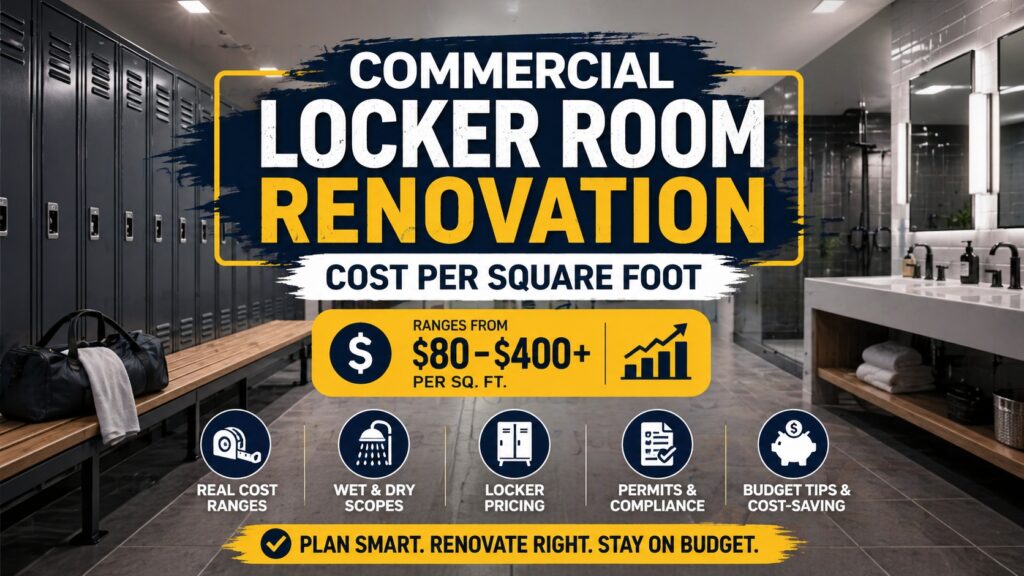
If you are trying to understand commercial locker room renovation cost per square foot in the NYC metro area, the hardest part is not finding a number. The hard part is knowing what that number includes. A locker room with new paint and lockers is one project. A locker room with showers, floor drains, waterproofing, ADA upgrades, ventilation, lighting controls, and new plumbing is a completely different budget.
For many NYC-area projects, commercial locker room renovation often falls between about $80 and $300 per square foot. Dry-area refreshes usually sit toward the lower end, while wet, system-heavy gut renovations can climb well above that. High-end work with major plumbing, HVAC, accessibility upgrades, custom lockers, or premium finishes can reach $250 to $400+ per square foot.
The biggest mistake is budgeting only for the visible finishes. Owners often think first about tile, paint, benches, and lockers, then get surprised by plumbing, ventilation, permit filings, debris hauling, code compliance, accessibility, and utility relocation. Those hidden or semi-hidden line items are often what decide the final cost.
This guide breaks down the real cost drivers, practical pricing bands, hidden expenses, and smart ways to control budget before signing a commercial renovation contract.
What to Know Before Budgeting a Locker Room Renovation
- Most NYC-area locker room renovations range from about $80 to $300 per square foot. Dry cosmetic work is cheaper; wet-area gut work costs much more.
- Plumbing, drainage, ventilation, and code work drive the biggest jumps. Showers, floor drains, exhaust, ADA layouts, and lighting controls matter more than surface finishes.
- A 500-square-foot mid-scope locker room or restroom renovation can land around $60,000 to $100,000. That range becomes higher when showers, new tile, waterproofing, electrical upgrades, and custom storage are involved.
- Locker pricing varies sharply by material. Standard metal lockers often start around $150 to $350 per opening, while wood, laminate, HDPE, or phenolic lockers can run much higher.
- NYC-specific rules affect the budget. Permit pathways, licensed trades, certified debris hauling, ADA planning, and energy-code lighting controls can all change the final number.
- The cheapest bid is rarely the lowest real cost. Durable wet-zone materials, efficient fixtures, LED lighting, and smarter layout planning usually protect the budget better than bargain finishes.
Key Factors That Influence Locker Room Renovation Cost
Every renovation budget is shaped by size, materials, design complexity, labor, and how much work touches plumbing, electrical, or HVAC systems. Locker rooms are especially sensitive because wet-zone work makes those drivers more expensive than they appear in a basic estimate.
To compare bids correctly, owners need to separate dry areas from wet areas, cosmetic upgrades from system work, and locker procurement from construction. A contractor pricing only paint, floor finish, and lockers is not pricing the same project as a contractor including waterproofing, drain work, shower valves, fan upgrades, and ADA clearances.
How Does Size Affect Cost per Square Foot?
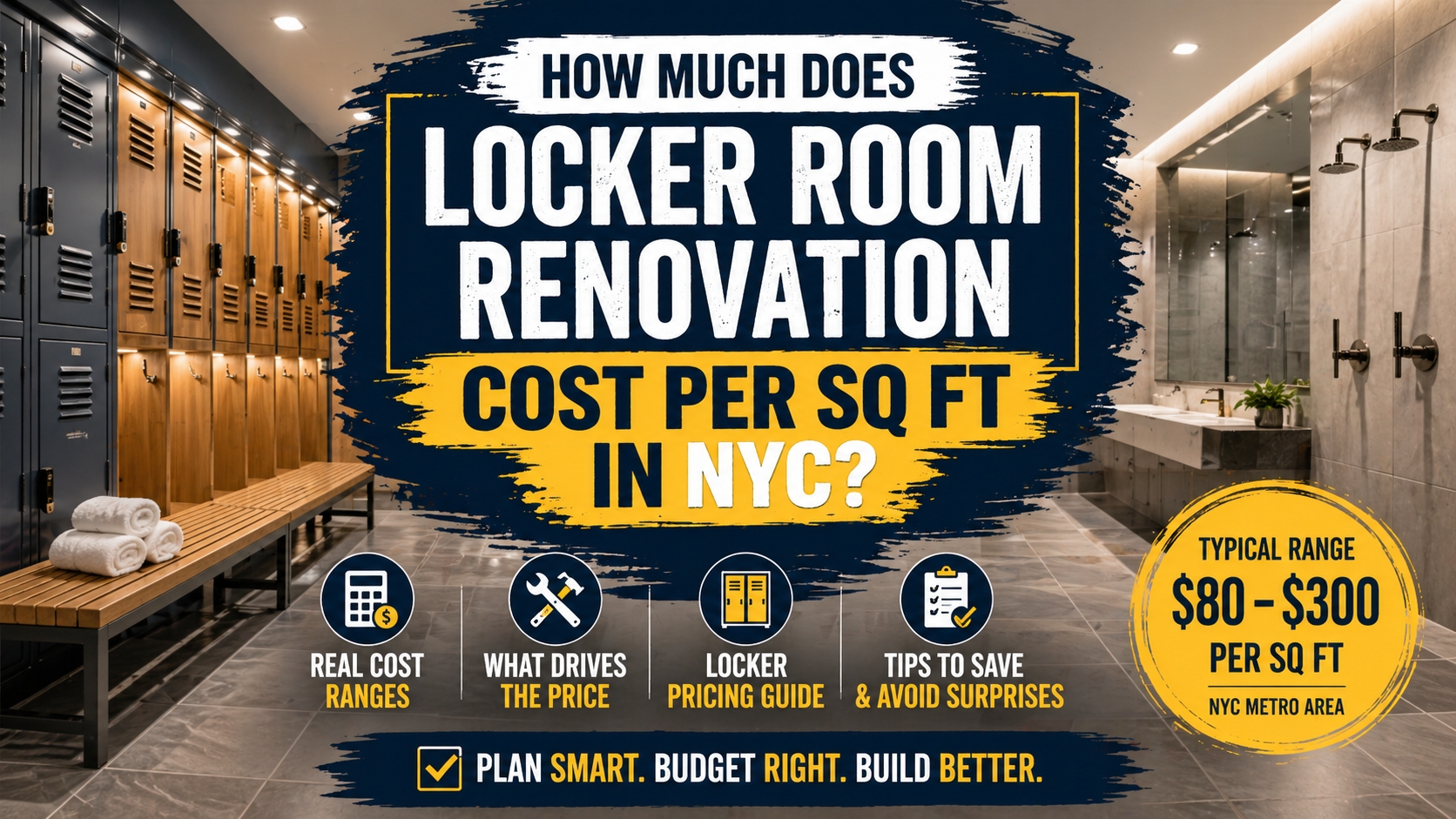
Larger spaces often cost less per square foot because fixed expenses are spread over more area. Smaller locker rooms usually feel expensive because they still require site protection, mobilization, demolition, permits, supervision, trade coordination, and final cleaning.
That effect is stronger in New York because labor, logistics, building access, insurance, and hauling are all expensive. A small locker room with showers and floor drains can easily cost more per square foot than a much larger dry changing area.
- Small projects: usually carry the highest unit cost because setup and coordination costs do not shrink much.
- Mid-size projects: often provide the best balance between total spend and cost efficiency.
- Large projects: can lower the unit rate, but the total check still rises because there are more lockers, more fixtures, more tile, and more labor hours.
- Bulk locker orders: can reduce unit cost when the layout is settled early and lockers are ordered in full banks.
The key is scope discipline. A 500-square-foot locker room with showers, floor drains, and accessibility work is not comparable to a 500-square-foot dry staff changing area with new paint and lockers.
What Do Materials and Finishes Do to the Budget?
Material choices can move a locker room from a basic refresh into a premium renovation quickly. In wet locker rooms, this is not only about appearance. It is about service life, cleaning, impact resistance, humidity, and long-term maintenance.
Powder-coated steel lockers work well in dry or lightly damp spaces. In heavier moisture zones, phenolic, HDPE, plastic composite, and other moisture-tolerant systems cost more up front but hold up better against humidity, cleaning chemicals, and heavy traffic. That is why they are common in gyms, pools, schools, rehab centers, and health facilities.
Fixtures matter too. Efficient showerheads, toilets, faucets, lighting, and controls can reduce operating costs in facilities that see constant use. The right material package should be judged by installed cost and life-cycle cost, not only by day-one price.
How Does Design Complexity Change the Price?
Simple cosmetic work is one budget class. Moving showers, adding saunas, changing floor drains, widening accessible routes, building new partitions, or rerouting ductwork is another. The more systems the design touches, the more trades, inspections, and coordination the project needs.
Good design keeps the budget honest. Complicated design without early cost control can move a locker room into a different price class.
- Layout changes: raise cost because plumbing, electrical, HVAC, flooring, and wall work begin overlapping.
- Older buildings: often reveal electrical, plumbing, or structural problems after demolition.
- Accessibility upgrades: are easier and cheaper when designed from day one.
- Amenity add-ons: steam rooms, towel counters, digital locks, premium benches, and custom millwork create more line items.
- Wet-area expansion: usually adds waterproofing, slope, drainage, ventilation, and inspection requirements.
ADA planning is a good example. Accessible lockers, benches, clearances, routes, mirrors, showers, and changing areas need to be coordinated before materials are ordered. If those decisions come late, owners can pay for redesign, reordering, and field changes.
What Are Typical Labor and Contractor Costs?
Labor is where NYC projects separate themselves from generic national pricing. Skilled trades, site logistics, insurance, permit work, and tight schedules all affect the number. General contractor oversight is also a real cost because locker room renovations require several trades working in sequence.
| Cost Component | Typical Range or Example | Why It Matters |
|---|---|---|
| General contractor oversight | Often built into lump-sum pricing or around 10% to 20% of trade cost | Covers scheduling, supervision, permit coordination, insurance paperwork, and sequencing. |
| Demolition labor | Often around $4 to $8 per square foot | Old tile, wet walls, mud beds, tight access, and hazardous materials can push cost higher. |
| Plumbing labor | Varies by scope and licensed trade requirements | Showers, drains, valves, venting, and fixture relocation can stack labor quickly. |
| Electrical labor | Depends on circuits, controls, panel capacity, and lighting scope | Lighting, GFCI protection, emergency lighting, sensors, and controls need careful planning. |
| Post-construction cleaning | Often around $0.15 to $0.80 per square foot | Detailed cleaning after tile, drywall, grout, dust, and adhesive work is a real closeout item. |
| Locker procurement and installation | Metal lockers often $150 to $350 per opening; premium lockers much higher | Material, lock type, end panels, benches, delivery, and installation all affect price. |
| Electronic lock add-ons | Often around $50 to $150 per opening | Useful in membership facilities where lost keys and rekeying become recurring costs. |
Commercial Locker Room and Restroom Renovation Cost per Square Foot
Locker rooms and restrooms should often be budgeted together because both depend on plumbing, waterproofing, ventilation, fixture placement, and code compliance. The cost per square foot means very little unless you know how much wet work is included.
A restroom or locker room with only paint, accessories, lighting swaps, and minor fixture replacement is one budget. A full gut with shower banks, new floor drains, waterproofing, tile, partitions, ventilation, accessibility upgrades, and new controls is a much more expensive project.
What Is the Average Cost per Square Foot for Commercial Restroom Renovation?
Commercial restrooms usually cost more per square foot than many other interior spaces because the footprint is small, the trade density is high, and code requirements are strict. In the NYC metro area, restroom and locker room work often sits near the upper end of general interior remodeling costs.
| Project Type | Typical NYC Budget Band | What That Usually Includes |
|---|---|---|
| Cosmetic refresh | $80 to $120 per square foot | Paint, accessories, lighting swaps, limited fixture replacement, and no major layout changes. |
| Mid-scope wet-area update | $120 to $200 per square foot | New tile, waterproofing repairs, updated partitions, better lighting, modest plumbing work, and finish upgrades. |
| Full gut renovation | $200 to $350+ per square foot | Complete demolition, new waterproofing, drain work, fixture relocation, ventilation upgrades, accessibility changes, and premium finishes. |
| 500-square-foot example | About $60,000 to $100,000 for many mid-scope jobs | A realistic planning range for owners who want more than a surface refresh. |
Older historical benchmarks can be useful for context, but they are not enough for 2026 planning. Labor, code requirements, lighting controls, accessibility expectations, and building logistics have moved too much to rely on outdated cost assumptions.
Breakdown of Locker Room Renovation Costs
A locker room budget makes more sense when it is broken into flooring, plumbing, electrical, HVAC, storage, lockers, benches, mirrors, fixtures, and closeout work. That is how owners can see where the money goes and which scope decisions matter most.
What Flooring Options Are Available and What Do They Cost?
Locker room flooring should be chosen by wet exposure, traffic, slip resistance, maintenance, and cleaning demands. The numbers below represent common installed flooring system ranges, not the full room renovation cost.
| Flooring Type | Installed Cost per Square Foot | Best Use | Why Owners Choose It |
|---|---|---|---|
| Commercial sheet vinyl or LVT | $8 to $16 | Dry changing areas and light-moisture zones | Lower upfront cost, easier replacement, and fast installation. |
| Epoxy or seamless resin | $7 to $14 | Wet, high-traffic locker rooms | Seamless surface, easy cleaning, and strong water resistance. |
| Porcelain tile | $15 to $30 | Showers, wet corridors, and premium locker rooms | Strong wear performance and good slip-rated options. |
| Rubber flooring | $10 to $20 | Athletic changing areas and impact-heavy zones | Comfort underfoot, sound control, and good slip resistance. |
| Sealed or polished concrete | $8 to $18 | Public facilities and back-of-house locker areas | Durable and low maintenance, but wet slip planning matters. |
| Budget sheet flooring | $5 to $9 | Storage or low-demand dry areas | Low first cost, but short life in active locker rooms. |
Ask for slip data and cleaning guidance before approving a flooring system. A floor that looks inexpensive on bid day can become expensive if it loses traction under soap, water, and constant mopping.
How Much Do Plumbing and Drainage Systems Affect the Budget?
Plumbing is often the biggest cost driver in a locker room renovation. Showers, trench drains, floor slopes, waterproofing, hot-water distribution, venting, and fixture relocation all add cost quickly.
- Keeping fixtures in place: usually the most cost-controlled path because it protects existing wet walls and drain locations.
- Moving drains or shower banks: can mean slab work, new venting, more inspections, and tile repairs.
- Older NYC buildings: may need pipe replacement once corroded or undersized lines are exposed.
- ADA showers and clearances: require careful layout and waterproofing details.
- Water-efficient fixtures: can reduce operating cost in high-use facilities.
The difference between a modest update and a high-end renovation is often whether you are replacing fixtures in place or rebuilding the wet infrastructure.
What Are the Costs for Electrical Work and Lighting Upgrades?
Electrical scope may look simple at first, then grow when walls open. Older buildings may have limited panel capacity, outdated branch wiring, poor fixture placement, or missing controls. Locker rooms also need safe lighting, emergency lighting where required, moisture-aware fixture choices, GFCI protection, and code-compliant controls.
Lighting upgrades are not only cosmetic. Occupancy sensors, LED fixtures, emergency lighting, mirror lighting, and controls can all affect compliance and operating cost. In older spaces, a 10% to 15% electrical contingency is safer than assuming the existing system will accept new loads without changes.
If you are comparing bids, ask whether the price includes new circuits, controls, GFCI protection, panel work, and emergency lighting, or only fixture swaps. That answer often explains the spread between quotes.
How Do HVAC and Ventilation Upgrades Affect Renovation Cost?
HVAC upgrades can become a major budget item because locker rooms need more than heating and cooling. They need humidity control, odor control, and reliable exhaust. This is especially important in wet locker rooms with showers, high traffic, damp towels, and limited natural ventilation.
HVAC cost is usually driven by duct routing, shaft access, fan capacity, controls, and coordination with ceilings and walls. When showers are spread out, duct runs become longer and harder to coordinate. When wet areas are grouped intelligently, ventilation usually becomes more efficient and more affordable.
- Minor fan and diffuser updates may fit inside a mid-range renovation.
- New dedicated exhaust, makeup air, or major duct rerouting can push the project into a higher budget band.
- Humidity control helps protect lockers, benches, paint, mirrors, and adhesives.
- Ventilation should be designed with the shower layout, not added after finish plans are complete.
What Is the Cost of Storage and Locker Installation?
Locker pricing is easier to compare when material, lock type, ventilation, end panels, accessories, delivery, and installation are listed separately. The cheapest locker is not always the cheapest long-term choice, especially in wet or high-abuse facilities.
| Locker Type | Typical Price per Opening | Best Fit |
|---|---|---|
| Standard metal | $150 to $350 | Dry locker rooms, employee changing rooms, schools, and budget-conscious gym projects. |
| HDPE or plastic composite | $250 to $600 | Wet zones, pools, and facilities that need moisture resistance. |
| Phenolic | $300 to $800 | Premium wet-use environments with heavy traffic and long life-cycle goals. |
| Wood or laminate-finish lockers | $500 to $1,200+ | High-end gyms, clubs, and design-driven amenities. |
| Electronic lock add-on | $50 to $150 | Membership spaces where lost keys and rekeying become recurring problems. |
Do not order lockers too early. Field measurements, ADA review, bench placement, wet-wall locations, and final wall layouts should be settled first. Owners lose money when lockers are ordered, then the wall layout changes.
How Much Do Benches, Mirrors, and Accessories Add?
Benches, mirrors, hooks, shelves, grab bars, dispensers, and accessory packages can look minor on a proposal, but they add up quickly because each item needs backing, anchoring, field layout, and finish labor.
- Commercial benches: vary widely by material, length, supports, and anchoring method.
- Large mirrors: often budget around $20 to $50 per square foot installed, with oversize wall mirrors costing more.
- Accessory packages: hooks, shelves, towel bars, paper holders, soap dispensers, and grab bars add cost through both product and labor.
- ADA-related items: should be planned early to avoid rework around clearances and wall backing.
Price these items as a group, not as afterthoughts. That gives a more accurate renovation budget and a cleaner closeout.
Hidden Costs to Consider
Hidden costs are what turn a comfortable estimate into a stressful one. In locker room renovations, the usual culprits are permits, demolition and hauling, utility relocations, damaged existing systems, access restrictions, and final cleaning.
What Permits and Inspection Fees Should Be Expected?
Permit cost depends on scope, but the real risk is assuming the project is too small to need filing. In NYC, plumbing work that alters, rearranges, relocates, or removes piping must be handled by a Licensed Master Plumber and filed through the proper DOB process.
Minor work may qualify for a lower-friction permit path, but moved showers, new drains, changed plumbing layouts, expanded wet areas, or major electrical and ventilation work can push the job into heavier documentation. Permit costs themselves may not be the largest line item, but design, filing, professional coordination, inspection scheduling, and delays can all affect the final budget.
How Much Does Demolition and Waste Removal Cost?
Commercial demolition often starts around $4 to $8 per square foot, but debris hauling can be just as important in New York. Old tile, mud beds, wet walls, lockers, benches, partitions, and fixtures are heavy. Getting them out of a building can take more labor than owners expect.
- Old tile and mud beds: increase labor and hauling weight.
- Asbestos or hazardous materials: require separate testing, handling, and disposal.
- Elevator buildings: often require tighter removal windows and common-area protection.
- Certified hauling: professional construction debris needs proper disposal, not normal trash handling.
Detailed demolition scopes help owners compare bids and reduce change orders. “Demo included” is not detailed enough for a locker room with old tile, plumbing, fixtures, and built-in storage.
What Are the Expenses for Utility Relocations?
Utility relocation is difficult to price perfectly before demolition because walls and floors may hide old field fixes, unexpected routes, corroded lines, shared cavities, and undocumented changes. Locker rooms are especially vulnerable because moving one shower bank can affect water lines, drains, vents, electrical, controls, and ventilation.
The cheapest way to control this line item is good space planning. Keep new plumbing close to existing risers and wet walls whenever possible. That single decision can save more money than switching tile brands.
How Much Does Post-Construction Cleaning Add?
Post-construction cleaning is usually a separate scope, and it should be. Fine dust, grout haze, overspray, adhesive residue, mirror film, and vent debris all take real labor to remove properly.
Current market pricing for post-construction cleaning often falls around $0.15 to $0.80 per square foot, with many straightforward projects clustering near the middle. Debris removal, vent cleaning, stainless detailing, glass cleaning, and locker interiors can push the number higher.
Cleaning should be described in the bid as a real closeout item, not buried in a vague allowance.
Cost-Saving Strategies for Locker Room Renovations
You do not save money on a locker room by stripping out the important parts. You save money by putting the budget where water, wear, safety, and code pressure are highest, then simplifying the rest.
How Can Durable Materials Save Money?
Durable materials are one of the best long-term savings moves in a wet or high-traffic facility. The goal is to spend less on repairs and replacement, not only less on day one.
- Use phenolic, HDPE, or moisture-tolerant locker materials in wet zones, and reserve painted steel for dry areas.
- Choose WaterSense fixtures where appropriate to reduce water use.
- Specify LED fixtures and controls for spaces that run long hours.
- Use slip-rated, easy-clean flooring where water and soap are constant.
- Avoid bargain flooring in heavy-use wet areas because replacement and downtime cost more than better material would have.
The best budget materials are rarely the cheapest products. They are the ones that survive humidity, cleaning chemicals, and constant traffic without forcing another repair cycle.
What Layout Choices Minimize Waste and Cost?
Good layout work cuts waste before construction starts. This matters in locker rooms because plumbing, ventilation, storage, circulation, and accessibility all overlap.
- Keep showers, toilet rooms, and sinks near existing wet walls whenever possible.
- Group lockers by use type so the whole room is not overbuilt for one user group.
- Protect ADA clearances early for lockers, benches, showers, and circulation.
- Use field measurements before finalizing lockers, benches, or millwork.
- Cluster exhaust-heavy areas to shorten duct runs and reduce coordination.
How Does Bundling Services with One Contractor Help?
Bundling helps when it reduces coordination gaps. In a locker room renovation, that usually means one team coordinating demolition, plumbing, electrical, HVAC, waterproofing, finishes, storage, cleaning, and closeout.
- Shared scheduling reduces idle time between trades.
- One coordinated site walk catches conflicts earlier.
- Bundled procurement can improve pricing on lockers, benches, fixtures, and accessories.
- Punch list and cleaning are smoother when one team manages the turnover schedule.
- Owners get fewer gaps between “not my scope” and “not in the quote.”
Bundling should not mean vague pricing. It should mean clearer coordination, better sequencing, and fewer missed responsibilities.
Regional Cost Variations in the NYC Metro Area
Regional pricing is not only about wages. In the NYC metro area, access, insurance, code requirements, building management, debris hauling, staging, and permit pathways all explain why similar locker room upgrades can price differently from one property to the next.
How Do Urban and Suburban Costs Compare?
Urban projects in New York City usually carry higher total construction costs because parking, material delivery, elevator rules, debris routes, insurance requirements, and building oversight all add time. A project in a dense commercial building may require more protection and scheduling than a similar scope in a suburban facility with easier loading access.
Suburban jobs may be more efficient when access is simpler and hauling is easier. Materials may cost about the same, but labor productivity can improve when crews are not working around the same building restrictions.
How Do Local Labor Rates and Building Codes Affect Pricing?
Local labor rates shape the baseline. Local codes determine how much work is required before the room can legally open. In NYC, plumbing filings, energy-code lighting controls, accessibility rules, inspection scheduling, and debris handling all affect both price and timeline.
Historic buildings, multifamily amenity spaces, schools, health facilities, and tightly managed commercial properties can add another layer of approvals. That does not always mean a huge material premium, but it often means more planning, documentation, and time on the calendar.
Why Professional Renovation Services Matter
Professional renovation services save money in locker rooms for one main reason: they reduce expensive mistakes before waterproofing, tile, lockers, benches, fixtures, and equipment are already installed.
How Do Professionals Handle Compliance?
Compliance is a design and construction issue, not a punch-list item. Professionals fold the rules into the layout from the start, including accessible lockers, bench dimensions, clear routes, shower requirements, grab bar locations, mirror placement, lighting controls, and licensed trade work.
When compliance is handled early, owners avoid failed inspections, rework, delayed openings, and the worst kind of expense: reopening finished wet areas to fix something that should have been coordinated before installation.
What Are the Advantages of Efficient Project Management?
Efficient project management turns a complicated renovation into a predictable one. That matters in condo amenities, gyms, schools, employee facilities, health facilities, and any locker room that cannot stay offline for long.
- Clear scheduling: keeps demolition, rough-ins, inspections, finishes, and closeout in the right order.
- Better communication: reduces change orders caused by missed details.
- Field verification: catches layout problems before lockers, mirrors, benches, or glass arrive.
- Budget tracking: keeps allowances, owner decisions, and scope changes visible.
- Faster closeout: gets the room back into service sooner.
How Can Professional Planning Create Long-Term Savings?
Long-term savings come from making the right decisions before the room is closed up. That includes replacing weak piping while walls are open, sizing ventilation correctly, choosing materials by wear level, planning maintenance access, and coordinating storage with traffic patterns.
A locker room that uses durable wet-zone materials, efficient lighting, properly planned HVAC, and realistic storage layouts usually costs less to operate and less to repair. The most valuable savings often come from avoiding the second renovation, the one owners did not plan on doing two or three years later because the first job improved the finish and ignored the systems underneath.
Final Takeaway Before You Request Bids
Commercial locker room renovation cost per square foot is a useful starting point, but it only helps when it is tied to real scope. Plumbing, HVAC, accessibility, materials, building access, permits, and debris handling can change the final number more than the finish package.
For property owners and facility managers in the NYC metro area, the best estimate is not the one with the lowest first number. It is the one that clearly explains what is included, what is excluded, how wet areas are handled, how code requirements are addressed, and what risks could affect the final price.
HomeRenovation4U can review the site, define the scope, and help build a realistic renovation budget before hidden costs show up in the middle of construction.
Frequently Asked Questions
How much does commercial locker room renovation cost per square foot?
In the NYC metro area, commercial locker room renovation often ranges from about $80 to $300 per square foot. Dry cosmetic work sits toward the lower end, while wet-area renovations with showers, waterproofing, plumbing, ventilation, and code work cost more.
What is the biggest cost driver in a locker room renovation?
Plumbing, drainage, waterproofing, ventilation, and accessibility upgrades usually drive the biggest cost increases. Surface finishes matter, but system-heavy wet work is what moves the budget fastest.
How much does a 500-square-foot locker room renovation cost?
A 500-square-foot mid-scope locker room or restroom renovation in the NYC metro area can often land around $60,000 to $100,000. Full gut work, custom lockers, major plumbing changes, or premium finishes can push the cost higher.
Are lockers priced separately from the renovation?
They should be. Standard metal lockers often start around $150 to $350 per opening, while HDPE, phenolic, wood, or laminate lockers cost more. Lock type, end panels, benches, delivery, and installation should be listed clearly in the estimate.
How can owners reduce locker room renovation costs?
Owners can reduce costs by keeping plumbing close to existing wet walls, choosing durable materials by zone, ordering lockers after field measurements, avoiding unnecessary layout changes, and comparing contractor bids by the same scope.
Does a commercial locker room renovation require permits?
Many projects do, especially when plumbing, electrical, ventilation, accessibility, or layout changes are involved. In NYC, licensed trades and proper filings may be required, so the permit path should be clarified before construction starts.