
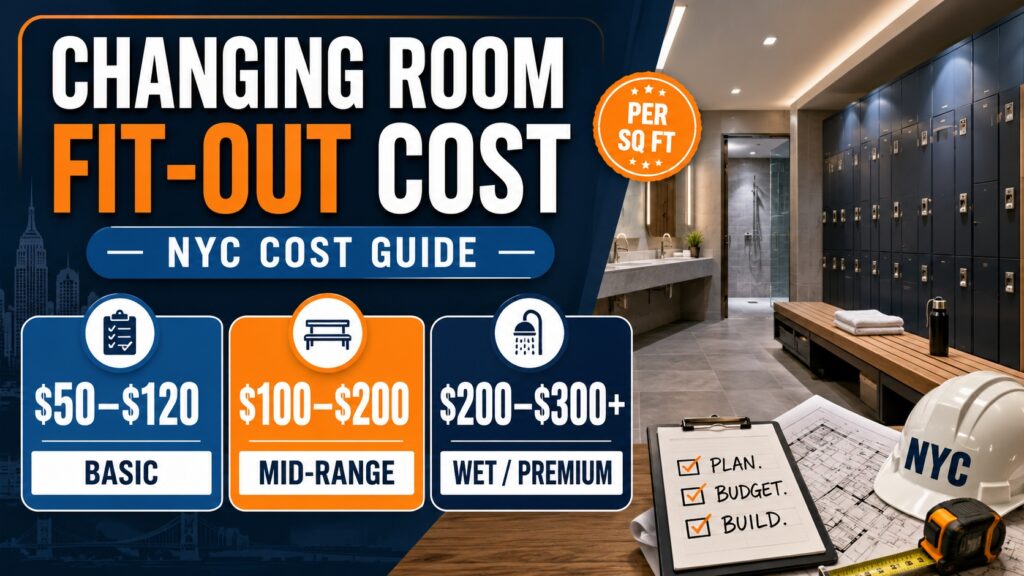
Commercial changing room fit-out cost per square foot depends on one thing more than anything else: what the room actually has to do. A dry employee changing area with lockers and benches is one budget. A wet changing room with showers, drains, waterproofing, accessibility clearances, ventilation, plumbing, lighting controls, and premium lockers is a completely different project.
In the NYC metro area, a basic commercial changing room fit out can start around $50 to $120 per square foot. Mid-range work often moves into the $100 to $200 per square foot range. More complex changing rooms with showers, custom lockers, durable wet-area materials, ADA upgrades, and heavy mechanical, electrical, and plumbing work can reach $200 to $300+ per square foot.
The biggest mistake is comparing two square-foot numbers without comparing scope. One contractor may be pricing paint, flooring, lockers, and minor lighting. Another may be including plumbing, drains, waterproofing, exhaust, permits, accessibility, electrical work, and full closeout. Those are not the same job.
This guide breaks down the real cost drivers, the line items that most often create budget surprises, and the decisions that help owners control commercial changing room fit out costs before construction starts.
What to Know Before Budgeting a Changing Room Fit Out
- Basic changing room upgrades often start around $50 to $120 per square foot. This usually applies to simpler dry-area work with limited plumbing or layout change.
- Wet-area changing rooms can reach $200 to $300+ per square foot. Showers, floor drains, waterproofing, ventilation, premium lockers, and ADA work push the budget higher.
- NYC metro pricing starts from a higher baseline. Commercial fit-out work in the Tri-State region often prices above national averages before wet-room complexity is added.
- Soft costs are real. Design, engineering, filing, permitting, review, and inspection planning can commonly require 10% to 20% of total project value.
- MEP systems drive the budget. Plumbing, electrical, HVAC, exhaust, and fire protection usually matter more than paint or decorative finishes.
- Compliance should be planned before framing. ADA clearances, door swings, bench placement, accessible showers, and fixture approach space can reshape the room.
Key Factors That Influence Commercial Changing Room Fit Out Cost
Location, size, material quality, existing conditions, and regulatory requirements all affect changing room pricing. But wet rooms add another layer. Plumbing counts. Drainage counts. Ventilation counts. Waterproofing counts. Every one of those choices changes the square-foot cost.
That is why a changing room with showers can price closer to a small spa or locker room renovation than to a simple back-of-house refresh.
How Does Location Affect Changing Room Fit Out Costs?
Location affects labor rates, delivery logistics, permit friction, inspections, and how efficiently trades can work. In New York City, crews may deal with freight elevators, limited loading windows, building protection, after-hours restrictions, tight staging areas, and more expensive licensed trade coordination.
- Urban access costs more: freight elevators, lobby protection, limited parking, delivery windows, and building rules all add labor hours.
- Permit handling costs more: NYC filing steps, inspections, and licensed trade requirements can affect both budget and schedule.
- Replacement work is usually cheaper than first-generation work: existing drains, risers, exhaust paths, and electrical distribution can save money when they are usable.
- High-use facilities cost more: gyms, spas, wellness centers, and commercial amenities need durable finishes and better moisture control than low-use staff rooms.
The practical point is simple: do not compare NYC metro changing room pricing to generic national averages without adjusting for access, labor, permit requirements, and wet-area scope.
What Role Do Size and Layout Play?
Size matters, but layout often matters more. A compact room with several showers, toilet stalls, benches, lockers, ADA clearances, and floor drains can cost more per square foot than a larger dry changing area with a cleaner plan.
The most overlooked cost driver is system reuse. If the new layout follows the bones of the existing space, owners can often save money by reusing workable plumbing paths, sprinkler locations, electrical distribution, and exhaust routes. If the new layout fights the existing systems, the budget rises quickly.
Plan the layout first, then price the finishes. That order prevents expensive redraws, rework, and change orders.
- Keep showers and drains near existing wet walls when possible.
- Separate wet and dry zones to reduce flooring and maintenance costs.
- Place lockers where they will not interfere with accessible routes or bench clearances.
- Confirm door swings before rough plumbing and framing.
- Coordinate exhaust and ceiling space before finalizing the layout.
How Do Material Quality and Type Affect Cost?
Material choices decide whether the job stays in a basic range or moves into premium territory. In changing rooms, the biggest pricing jumps usually come from moisture-resistant materials, not decorative paint colors.
Porcelain tile, epoxy grout, phenolic lockers, HDPE partitions, solid-surface counters, safety flooring, and wet-rated wall systems cost more upfront. In heavy-use commercial changing rooms, they often make sense because cheaper materials can fail quickly under water, humidity, cleaning chemicals, and constant traffic.
| Material Choice | Budget Effect | Best Use |
|---|---|---|
| Powder-coated steel lockers | Lower upfront cost | Dry locker rows, staff changing areas, budget-focused projects. |
| HDPE or plastic composite lockers | Mid-range | Moisture-prone locker rooms, gyms, pool areas, and high-use facilities. |
| Phenolic lockers and partitions | Higher upfront cost | Wet zones, spas, wellness centers, executive locker rooms, and premium facilities. |
| Basic resilient flooring | Lower upfront cost | Dry changing zones and support areas with limited standing water. |
| Porcelain tile with epoxy grout | Mid to high cost | Showers, wet corridors, and heavy-use areas that need durability. |
| Rubber or safety flooring | Mid-range | Wet or athletic spaces where slip resistance and comfort matter. |
Why Is Compliance So Important?
Compliance is where many low bids fall apart. Changing rooms often involve plumbing, drains, electrical work, ventilation, accessibility, and sometimes fire protection changes. Those items are not optional details. They can decide whether the room can open and function legally.
Accessibility can reshape the layout. Turning space, door swings, bench position, accessible lockers, shower controls, grab bars, and fixture approach clearances need to be coordinated early. If the layout is corrected after rough-in or tile work, the cost impact is much higher.
- Budget for filing and review time: permit delay can hold trades off site and stretch the schedule.
- Check plumbing requirements early: altered piping usually requires licensed trade coordination and proper filing.
- Verify accessibility before framing: fixing layout on paper is cheap; fixing it after tile is expensive.
- Review older building conditions: existing wiring, ventilation, drain lines, and shutoff locations may need upgrades.
Commercial Changing Room Fit Out Cost Breakdown
A useful changing room estimate should break the project into clear categories: design, permitting, demolition, labor, flooring, walls, partitions, lockers, plumbing, electrical, HVAC, ventilation, accessories, and closeout. A single lump sum makes it harder to compare bids and easier to miss scope gaps.
What Are Typical Design and Planning Fees?
For many NYC metro projects, owners should reserve 10% to 20% of project value for soft costs. This can include architectural design, engineering, permit coordination, project management, accessibility review, inspections, and documentation.
| Soft Cost Item | Typical Planning Range | Why It Matters |
|---|---|---|
| Architectural design | Often 6% to 12% of construction cost | Coordinates layout, code, clearances, drawings, and finish schedules. |
| MEP engineering | Often 2% to 6% of construction cost | Critical for plumbing, exhaust, electrical load, lighting, and fixture coordination. |
| Interior design / FF&E planning | Often 3% to 8% of project cost | Coordinates lockers, benches, mirrors, counters, finishes, and user experience. |
| Permitting and compliance | Often 1% to 5% of project cost | Covers filing support, permit fees, inspections, and code-related reviews. |
| Project management | Often 5% to 10% of total project cost | Helps manage trades, deliveries, inspections, change orders, and punch list. |
| Consultants / special inspections | Variable | May apply for accessibility, environmental testing, structural review, or special conditions. |
Soft costs are not paperwork fluff. In wet rooms, good planning prevents expensive field changes. Drain placement, shower clearances, exhaust routing, ADA clearances, and locker dimensions should be solved before construction starts.
How Much Do Construction and Labor Usually Cost?
Construction and labor make up the largest part of most changing room fit outs. The reason is simple: changing rooms are trade-heavy spaces. They require demolition, carpentry, tile work, plumbing, electrical, waterproofing, HVAC, ventilation, accessories, and final finish work in a small footprint.
| Cost Component | Typical Range or Impact | Notes |
|---|---|---|
| Basic commercial build-out | $50 to $120 per sq ft | Best for dry or limited-scope changing areas. |
| Mid-range changing room | $100 to $200 per sq ft | Often includes better finishes, partitions, lighting, lockers, and limited wet work. |
| High-end wet-area fit out | $200 to $300+ per sq ft | Includes showers, premium tile, custom lockers, ventilation, plumbing, and accessibility upgrades. |
| Specialized wet trades | Can create a premium | Tight rooms, drains, waterproofing, and licensed work add labor hours. |
| Compressed schedule | Variable increase | Overtime, phased work, and fast-track delivery can raise total cost. |
| Contingency | 10% to 20% | Important in existing buildings with hidden conditions. |
Owners should budget with a range, not a single number, until the layout, fixture count, finish level, permit path, and building conditions are confirmed.
What Is the Average Cost of Flooring Installation?
Flooring in a changing room is not just a design choice. It is a drainage, slip-resistance, cleaning, waterproofing, and maintenance decision. A cheap floor in the wrong location can become expensive once the room is wet every day.
| Flooring Type | Typical Installed Cost | Best Use |
|---|---|---|
| Budget vinyl / sheet flooring | $5 to $15 per sq ft | Dry changing areas and support spaces. |
| Commercial LVT / luxury vinyl plank | $8 to $25 per sq ft | Dry or limited-moisture areas with moderate traffic. |
| Ceramic / porcelain tile | $12 to $40 per sq ft | Wet rooms, shower areas, and durable commercial changing rooms. |
| Rubber / safety flooring | $10 to $30 per sq ft | Wet zones, athletic spaces, and areas needing slip resistance. |
| Natural stone or specialty tile | $25 to $75+ per sq ft | Premium spas, wellness centers, and executive facilities. |
- Use smaller-format tile near drains when better slope control is needed.
- Separate wet and dry zones when possible to reduce cost and maintenance.
- Do not let appearance override drainage and slip resistance.
- Budget for substrate prep, waterproofing, drain slope, and transitions.
How Much Do Wall Finishes and Partitions Add?
Wall finishes and partitions are often underestimated because the rooms are small. In practice, these line items grow once you add moisture-resistant backing, tile substrate, waterproof membranes, partition hardware, stall doors, trim, and cleaning durability.
- Basic painted walls: lower cost; best for dry vestibules and staff-only areas.
- Moisture-resistant drywall: better for humid zones but not a shower waterproofing system.
- Tiled shower walls: higher labor and material cost, but better for direct wet exposure.
- Solid-surface or wall panels: fewer seams and easier cleaning, but product cost can rise.
- Phenolic or HDPE partitions: higher upfront cost, stronger performance in damp commercial use.
A dry locker bay and a shower wing should not use the same wall strategy. The more water a surface sees, the more the material specification matters.
What Are the Costs for Lighting and Electrical Systems?
Electrical systems do more than light the room. They support exhaust controls, hand dryers, occupancy sensors, smart locks, mirrors, water-heating accessories, GFCI protection, access control, emergency lighting, and future upgrades.
In a changing room, electrical work is rarely cosmetic. Older rooms may need panel review, branch circuits, wet-location fixtures, lighting controls, and safe fixture placement. Those items can shift the budget more than the fixtures themselves.
- LED lighting: reduces operating cost and improves visibility.
- Occupancy sensors: useful in rooms with uneven traffic throughout the day.
- Wet-location fixtures: important near showers and damp zones.
- Mirror and vanity lighting: affects user comfort and premium feel.
- Smart locks or access systems: may require low-voltage planning and coordination.
Electrical planning should happen before ceilings and walls close, not after lockers and mirrors are ordered.
How Much Should You Expect for Plumbing and Water Fixtures?
Plumbing is one of the biggest reasons changing rooms cost more than ordinary commercial interiors. Showers, floor drains, point drains, trench drains, hot water, shutoffs, valves, venting, and fixture relocation all add cost quickly.
| Plumbing Choice | Budget Impact | Why It Matters |
|---|---|---|
| Reuse existing shower and drain locations | Lower | Usually the best way to control plumbing labor. |
| Add new showers | Higher | Requires more supply, drainage, waterproofing, and coordination. |
| Move drains or wet walls | High | Can trigger slab work, slope changes, venting, and permit complexity. |
| Premium valves and touchless fixtures | Moderate to high | Improves user experience and can reduce maintenance complaints. |
| Efficient fixtures | Moderate upfront cost | Can reduce water use in high-traffic facilities. |
If the room includes showers, plumbing should be one of the first categories reviewed. A finished design that ignores drain locations is not a budget. It is a future change order.
What Are HVAC and Ventilation Expenses?
Changing rooms need better moisture and odor control than typical office areas. Showers, damp towels, high user turnover, and enclosed rooms create moisture that must be removed properly.
Ventilation cost depends on fan capacity, duct routing, ceiling space, controls, makeup air, access, and whether existing HVAC can support the new use. A small room can still be expensive if the exhaust path is difficult or the ceiling is crowded.
- Basic exhaust upgrades: useful for smaller rooms with limited wet use.
- Dedicated exhaust systems: often needed for shower-heavy changing rooms.
- Humidity control: important for spas, wellness centers, pools, and premium facilities.
- Controls: timers, sensors, or building management integration can improve performance.
- Duct routing: one of the hidden cost drivers in existing buildings.
Ventilation should be designed with the shower and locker layout, not added after finishes are selected.
Additional Costs to Consider
Changing room fit out budgets often grow through add-ons that look small at first: lockers, benches, mirrors, smart systems, ADA upgrades, energy-efficient fixtures, accessories, and inspection-related corrections. In NYC metro projects, these can easily add meaningful cost beyond the basic construction number.
How Much Do Custom Lockers, Benches, and Furniture Cost?
Lockers and benches are one of the first places where owners can overspend without meaning to. The right material depends on moisture exposure, user volume, appearance goals, and replacement cycle.
| Locker Material | Relative Cost | Best Use |
|---|---|---|
| Powder-coated steel | Lower | Dry locker rows, staff areas, budget-focused projects. |
| Plastic or HDPE | Mid-range | High-moisture rooms where corrosion resistance matters. |
| Phenolic | Mid to high | Showers, spas, wellness clubs, and high-use wet environments. |
| Wood or wood-look millwork | High | Executive clubs and premium locker rooms. |
Benches, mirrors, hooks, shelves, vanity counters, and accessories also need wall backing, layout coordination, installation labor, and finish detailing. They should be included in the estimate, not left as vague owner-supplied extras.
What Is the Cost of Smart Systems and Sensors?
Smart upgrades are useful when they solve a real operating problem. In changing rooms, that usually means occupancy control, lighting control, smart locker management, access control, leak monitoring, humidity monitoring, or better maintenance visibility.
- Occupancy sensors: reduce lighting waste in rooms with uneven use.
- Smart locker locks: reduce lost-key problems in gyms and membership facilities.
- Touchless fixtures: improve hygiene and reduce visible wear.
- Leak sensors: useful near showers, vanities, and mechanical areas.
- Building controls: help larger facilities manage lighting, ventilation, and energy use.
Do not overbuy technology. A small facility may benefit more from simple sensors and durable fixtures than from a full smart-building platform.
How Does ADA Compliance Affect the Budget?
ADA compliance raises cost because it changes geometry. Clearances, turning space, bench placement, door swings, shower controls, grab bars, accessible lockers, and fixture approach areas all affect layout and construction.
Accessible showers and benches may enlarge the footprint. Door and partition placement may need to change. Older buildings may require demolition just to create enough maneuvering space.
- Review ADA requirements before finalizing the layout.
- Coordinate accessible benches, lockers, showers, and routes together.
- Do not wait until tile layout to discover clearance problems.
- Include grab-bar backing and wall reinforcement before walls close.
What Are the Benefits and Costs of Energy-Efficient Upgrades?
Energy-efficient upgrades are easier to justify in changing rooms because the rooms often run lights, fans, hot water, and controls for long periods. The best first moves are usually LED lighting, occupancy sensors, efficient fixtures, and smart ventilation controls.
- LED lighting: lowers electricity use and replacement labor.
- Occupancy sensors: reduce waste in rooms that are not used continuously.
- Efficient water fixtures: reduce operating cost in high-use shower rooms.
- Better controls: prevent exhaust and lighting systems from running harder than needed.
- Load reduction: can reduce pressure on HVAC equipment over time.
The smartest time to add energy upgrades is during the fit out, while ceilings, walls, plumbing, and electrical systems are already open.
Cost Variation by Type of Changing Room
The type of facility changes the finish package, plumbing load, locker specification, privacy requirements, durability needs, and user expectations. A staff changing room, a gym locker room, and a luxury wellness center should not be priced the same way.
Gym and Fitness Changing Rooms
Gym and fitness changing rooms usually sit in the middle of the market. A basic upgrade can stay near the $50 to $120 per square foot range, but many projects move higher because they need durable flooring, multiple showers, strong ventilation, and lockers that can handle daily abuse.
Peak traffic matters. If the room serves classes, morning rush, evening turnover, and high member volume, durability should matter more than decorative savings.
Spa and Wellness Changing Rooms
Spa and wellness changing rooms tend to cost more because the finish level is part of the service experience. Premium tile, warmer lighting, humidity control, larger vanities, quieter ventilation, privacy features, custom benches, and better materials all raise the budget.
This is where budgets often move into the $200 to $300+ per square foot range, especially when the project includes showers, heated floors, custom lockers, specialty lighting, or moisture-resistant millwork.
Office Building Changing Rooms
Office building changing rooms often serve commuters, cyclists, staff wellness programs, and tenant amenities. These rooms may price below spa-level spaces but above simple restroom work because they still need showers, lockers, ventilation, durable flooring, and code compliance.
| Changing Room Type | Typical Range | Main Cost Drivers |
|---|---|---|
| Gym / fitness | $50 to $200+ per sq ft | Durable flooring, showers, lockers, ventilation, wet-area maintenance. |
| Spa / wellness | $200 to $300+ per sq ft | Premium finishes, humidity control, privacy, custom millwork, upgraded lighting. |
| Office building | $60 to $180+ per sq ft | Commuter showers, standard lockers, modest finishes, access and code compliance. |
| Staff-only changing area | $50 to $120+ per sq ft | Basic lockers, benches, flooring, paint, lighting, and limited plumbing. |
Regional Cost Context for NYC Metro Projects
Regional benchmarks help keep changing room pricing realistic. If general commercial fit-out costs in the Tri-State region already sit above national averages, a wet changing room with showers and drains should not be budgeted like a simple office refresh.
The useful takeaway for NYC metro owners is direct: your baseline is already elevated before wet-area complexity enters the conversation. Once plumbing, exhaust, waterproofing, accessibility, and durable materials are included, the square-foot number can move quickly.
| Benchmark | How to Use It |
|---|---|
| General commercial fit-out average | Useful as a baseline for non-wet commercial interiors. |
| Tri-State / NYC metro premium | Better starting point for local planning than low-cost regional averages. |
| Wet-room adjustment | Add cost for plumbing, drains, ventilation, waterproofing, and compliance. |
| Premium facility adjustment | Add cost for custom lockers, stone, specialty lighting, privacy, and higher finish levels. |
If a contractor quotes a wet changing room below local market reality, ask what is excluded. The missing items are often ventilation, waterproofing, permit handling, accessibility, electrical upgrades, or plumbing relocation.
How to Optimize Changing Room Fit Out Costs
The goal is not to make the room cheap. The goal is to spend where durability, safety, water control, and compliance matter, and save where finish choices are mostly decorative.
Choose Cost-Effective Materials by Zone
Cost-effective materials are the ones that match the room’s moisture load and traffic level. Cheap materials in the wrong place are usually the most expensive choice later.
- Use standard commercial-grade lockers in dry rows and save premium phenolic or HDPE systems for wet rows near showers.
- Choose flooring based on water exposure, slip resistance, and cleaning needs, not just appearance.
- Use standard fixture families for lights, valves, and accessories so replacements stay easy.
- Limit custom millwork to the areas users notice most.
- Use durable wall systems in wet zones and simpler finishes in dry support zones.
- Price lifecycle cost, not only installed cost.
Plan for Future Scalability
The smartest fit outs leave room for the next phase. If the facility may need more lockers, another shower, better controls, or more user capacity later, plan the rough infrastructure now.
- Lock the core layout early so future additions do not require a full rebuild.
- Leave plumbing and electrical capacity where later fixture growth is likely.
- Use modular locker banks and partitions when possible.
- Consider wireless controls for lighting and sensors if later upgrades are likely.
- Keep service access clear behind key walls and ceilings.
- Review the room with operations staff before final sign-off.
Work With an Experienced Contractor
Experienced contractors save money because they catch scope gaps before work starts. This is especially true in changing rooms, where attractive finishes cannot rescue a bad drain plan, weak ventilation, or missed accessibility clearance.
A strong contractor will also tell you where to keep the layout simple. In many projects, the biggest savings come from reusing workable plumbing paths, keeping wet zones grouped, coordinating ADA clearances early, and resisting late finish upgrades that force redesign.
Good contractors do more than build. They help you avoid paying twice for the same room.
Final Cost Takeaway
Commercial changing room fit out cost per square foot is driven less by paint and more by plumbing, ventilation, accessibility, layout discipline, and material durability. A basic dry changing area may stay near $50 to $120 per square foot, while wet, premium, or system-heavy rooms can move into the $200 to $300+ range.
The safest way to budget is to define the room type, lock the layout, confirm fixture count, review existing plumbing and ventilation, separate wet and dry zones, and compare bids by the same scope.
HomeRenovation4U can review your commercial changing room, define the real scope, and help build a practical renovation budget before hidden costs appear during construction.
Frequently Asked Questions
How much does a commercial changing room fit out cost per square foot?
In the NYC metro area, a basic commercial changing room fit out can start around $50 to $120 per square foot. Mid-range projects often fall around $100 to $200 per square foot, while wet-area or premium rooms with showers, custom lockers, plumbing, ventilation, and accessibility upgrades can reach $200 to $300+ per square foot.
What drives changing room fit out costs the most?
The biggest cost drivers are plumbing, drains, waterproofing, ventilation, electrical work, accessibility requirements, locker systems, flooring, wall finishes, and how much the layout changes from the existing space.
Why do wet changing rooms cost more than dry changing areas?
Wet changing rooms cost more because they need showers, floor drains, waterproofing, slip-resistant flooring, exhaust, humidity control, licensed plumbing work, and more durable materials. Dry changing areas usually need fewer systems and less intensive construction.
How much should I budget for soft costs?
For many NYC metro projects, owners should reserve about 10% to 20% of project value for soft costs such as design, engineering, permits, filing support, project management, inspections, and compliance review.
How can owners reduce changing room fit out costs?
Owners can reduce costs by keeping plumbing close to existing wet walls, separating wet and dry zones, choosing materials by moisture exposure, avoiding unnecessary layout changes, ordering lockers after field verification, and comparing bids by the same written scope.
Does a commercial changing room fit out require permits?
Many projects do, especially when plumbing, electrical work, ventilation, accessibility, wall changes, or shower installation are involved. Requirements depend on the building, location, and exact scope, so the permit path should be reviewed before construction starts.