
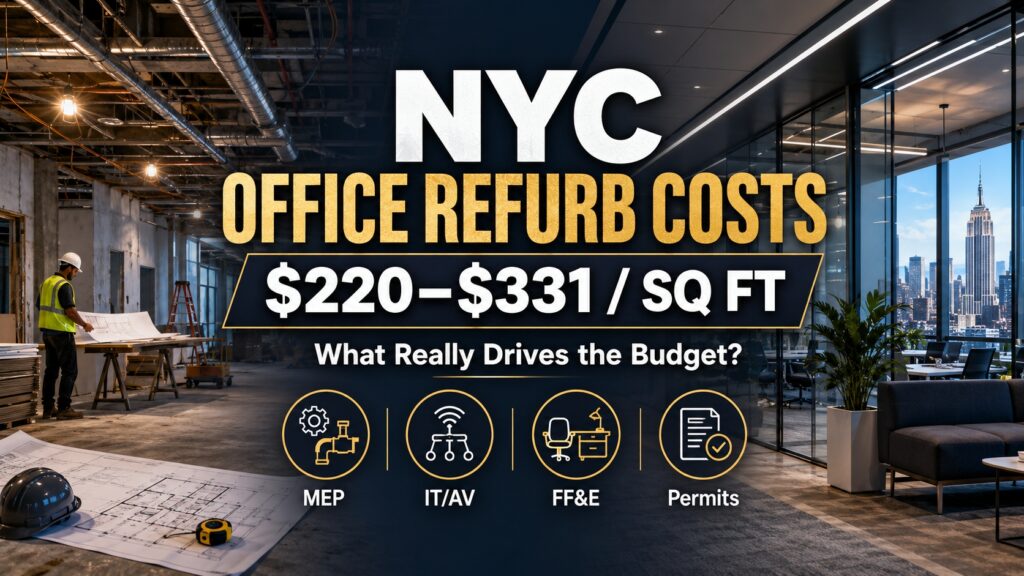
Office refurbishment costs in New York City are rarely about paint, drywall, flooring, and furniture alone. The real price usually moves with building age, permits, mechanical systems, electrical capacity, fire protection, IT, AV, furniture, delivery logistics, and how much the existing space fights the new plan.
For current NYC planning, one useful benchmark is around $220.62 per square foot in hard costs for a serious office fit-out, with an all-in budget near $330.92 per square foot once soft costs, IT, AV, furniture, and contingency are added. Those numbers are not a fixed quote, but they explain why office renovation budgets climb so quickly when owners include the full scope instead of only the visible finishes.
The biggest mistake is budgeting for what people can see first. Owners often focus on flooring, paint colors, conference tables, and workstations, then get surprised by HVAC, electrical, permits, lighting controls, asbestos review, freight access, landlord requirements, and technology infrastructure. In NYC, those hidden and semi-hidden line items can decide the budget before finish selections even matter.
This guide breaks down the cost categories that actually drive office refurbishment pricing, where NYC owners usually get surprised, and how to control spend before construction begins.
What to Know Before Pricing an Office Refurbishment
- NYC office fit-outs can reach roughly $220.62 per square foot in hard costs. A more complete all-in budget can reach about $330.92 per square foot after soft costs, furniture, IT, AV, and contingency are included.
- Mechanical, plumbing, fire protection, and electrical are usually the biggest cost drivers. In current NYC benchmarks, those systems can total around $96.44 per square foot, or nearly 44% of hard costs.
- Older buildings carry more risk. Pre-1987 and pre-1989 NYC buildings often require asbestos review, system investigation, and extra inspection planning before work can proceed safely.
- Furniture and technology are not minor add-ons. Furniture can account for about 22% of hard cost, while IT and AV together can add about 16% in a modern hybrid workplace.
- Contingency matters. For straightforward work, hold 10% to 15%. For older NYC buildings, major layout changes, incomplete as-builts, or heavy MEP work, 15% to 20% is safer.
- The cheapest bid is not always the best price. A low quote that leaves out permits, MEP coordination, IT, AV, furniture, or logistics can become the most expensive option after change orders.
What Factors Affect Office Refurbishment Costs?
Dependable office renovation pricing starts with the variables that change the job before the first wall comes down. Clear specifications, a defined scope, and realistic cost estimation make it easier to compare bids, control construction costs, and avoid expensive change orders later.
In NYC, the main cost factors are building age, location, access, project scale, layout complexity, permit path, MEP scope, furniture, technology, and whether the work is happening in an occupied or tightly managed building.
How Does Building Age and Condition Influence Cost?
Older buildings almost always carry more budget risk. A team may open a ceiling expecting a lighting swap and find undersized wiring, abandoned ductwork, old pipe insulation, undocumented penetrations, or systems that no longer match the drawings.
This matters in NYC because older properties can trigger asbestos review, hazardous-material planning, special inspections, and broader code checks. Before a permit is issued, owners may need to determine whether asbestos is present in affected work areas. In pre-1987 and many pre-1989 buildings, materials such as pipe insulation, floor tile, plaster, ceiling materials, and adhesives may need closer review before demolition.
- Hidden structural work: cracked slab patches, old partitions, and undocumented framing changes can force redesign.
- MEP replacement: outdated HVAC, panels, wiring, and plumbing risers may not support modern office loads.
- Hazardous-material compliance: asbestos investigation, abatement, and air monitoring can add cost and time.
- Code upgrades: work affecting exits, fire protection, accessibility, or ventilation can expand the required scope.
- Unknown field conditions: incomplete as-builts make early pricing less reliable until selective openings confirm reality.
That is why the visible budget and the risk budget should be separate. In a newer building, a 10% contingency may hold. In an older NYC property, 15% to 20% is often healthier, especially before demolition confirms existing conditions.
How Do Location and Logistics Affect Pricing?
Location changes labor, logistics, permits, and how fast trades can work. In a suburban building, a crew may unload beside the entrance and work a full day. In Manhattan or dense parts of NYC, that same crew may lose time to freight elevators, parking restrictions, loading windows, lobby protection, building security, and after-hours rules.
| Factor | Direct Cost Impact | NYC Note |
|---|---|---|
| Local labor rates | Higher wages for licensed trades raise electrical, HVAC, plumbing, and finish installation costs. | Skilled labor demand and stricter inspections keep NYC bids above many markets. |
| Building logistics | Restricted access slows deliveries, debris removal, and staging. | High-rise work often needs freight reservations, floor protection, and off-site storage. |
| Permits and filings | More filings mean more consultant time, agency review, and coordination fees. | DOB filings, special inspections, and electrical permits can expand soft costs. |
| Work-hour limits | Limited working hours can stretch the schedule and raise supervision costs. | After-hours work may require additional approvals and higher labor cost. |
| Material supply | Lead times and freight charges affect lighting, glass, switchgear, furniture, and millwork. | Custom and imported items can create both price and schedule pressure. |
When comparing bids, ask whether logistics are included. Freight elevator coordination, floor protection, after-hours deliveries, debris routes, loading dock rules, and off-site storage should not be vague assumptions.
How Do Scope and Scale Change the Budget?
Scope decides whether the project is a light refresh or a true rebuild. Repainting and replacing carpet may stay manageable. Moving offices, restrooms, conference rooms, ceiling systems, power distribution, and HVAC zones changes the budget profile completely.
- Light refresh: paint, flooring, lighting replacement, minor repairs, and selective furniture updates.
- Mid-level refurbishment: new partitions, ceiling work, upgraded HVAC zones, better lighting, moderate AV, and selected millwork.
- Full fit-out: new layout, full MEP coordination, furniture, IT, AV, security, access control, branded finishes, and final workplace setup.
Project scale also affects unit cost. Larger projects can spread design, management, mobilization, and permit costs across more square footage. Smaller offices may carry a higher cost per square foot because the same basic setup costs apply to less area.
Layout is another major lever. Office typology choices, such as open plan, more enclosed rooms, hybrid collaboration zones, focus rooms, or client-facing reception areas, can shift the budget before finish levels even change.
What Is the Difference Between Cat A and Cat B Fit-Outs?
In office leasing conversations, owners and tenants may hear the terms Cat A and Cat B. Even when a project uses simpler language like landlord work and tenant build-out, the distinction matters because it shows who is paying for base systems and who is paying for the finished workplace.
| Aspect | Cat A Fit-Out | Cat B Fit-Out |
|---|---|---|
| Definition | Basic landlord-ready space with essential building services and clean finish. | Tenant-ready office customized for operations, branding, and staff use. |
| Typical inclusions | Ceilings, lighting, HVAC distribution, core flooring, fire protection, and basic power. | Meeting rooms, offices, pantries, workstations, AV, security, furniture, and decorative finishes. |
| Primary purpose | Make the space leasable. | Make the space usable. |
| Cost profile | Lower because it stops at base infrastructure and finish. | Higher because it adds layout, furniture, technology, and brand-specific elements. |
| Lease impact | Often tied to landlord delivery terms. | Usually tied to tenant improvement allowance, approvals, and restoration clauses. |
If the lease includes a tenant improvement allowance, ask what it actually covers. Does it only cover base-building prep, or does it help pay for offices, conference rooms, AV, millwork, furniture, and IT? That answer changes the cash needed up front.
Office Refurbishment Cost Categories Explained
The cleanest way to control office refurbishment costs is to split the project into predictable buckets: soft costs, builders’ work, MEP systems, furniture, technology, and contingency. That prevents one oversized trade package from hiding inside a vague lump sum.
What Are Typical Design and Planning Expenses?
Soft costs are the planning, design, filing, management, and professional-service expenses that make the project buildable. In many current NYC office benchmarks, soft costs can be modeled around 10% of hard costs, but complex projects may require more.
Planning costs rise when the job needs architectural drawings, engineering, DOB filings, special inspections, phased occupancy planning, emissions-related upgrades, or landlord review. They also rise when the building has poor records and the team must verify existing conditions before pricing can settle down.
- Architectural design: space planning, code review, reflected ceiling plans, finish schedules, and details.
- Engineering: mechanical, electrical, plumbing, fire protection, and load verification.
- Permit coordination: DOB filings, responses to objections, sign-off planning, and agency coordination.
- Project management: scheduling, procurement tracking, meeting coordination, budget control, and closeout.
- Special inspections: required when the scope touches certain structural, fire, or code-sensitive systems.
The best money spent here is often on clarity. A clean drawing set and full finish schedule make bids easier to compare and reduce gray areas that later become change orders.
What Costs Are Involved in Construction and Structural Changes?
Builders’ work is one of the largest categories in an office refurbishment. It includes demolition, partitions, doors, ceilings, flooring, painting, carpentry, millwork, wall protection, and finish installation.
Structural changes raise the budget faster than most finish decisions. Cutting a slab, reinforcing a floor, moving stairs, changing restroom locations, or altering egress can trigger engineering, permit revisions, special inspections, and schedule extensions at the same time.
If a change affects structure, egress, restrooms, or major mechanical routing, treat it as a budget event, not a minor design tweak.
- Demolition: selective demo is labor-heavy in occupied or access-restricted buildings.
- Partitions and doors: private offices, phone rooms, and conference rooms add labor, hardware, glass, and acoustic details.
- Ceilings and finishes: acoustical ceiling work, specialty lighting, and millwork raise both material and coordination costs.
- Structural corrections: floor leveling, reinforcement, and undocumented existing work create painful surprises.
- Fire-rated or acoustic assemblies: conference rooms, equipment rooms, and corridors may require more expensive assemblies than basic partitions.
How Much Do Electrical and Mechanical Upgrades Cost?
Mechanical and electrical work can decide whether an office refurbishment stays on budget. In current NYC planning, mechanical, plumbing, and fire protection can sit around $50.19 per square foot, while electrical can sit around $46.25 per square foot. Together, that is about $96.44 per square foot, or nearly 44% of hard cost before furniture and technology are added.
This is why existing capacity should be verified early. If the panel is full, the HVAC system is undersized, the condenser is old, the fire alarm needs modification, or the restroom count does not support the new layout, infrastructure will cost more than finish upgrades.
| Item | Planning Benchmark | Why It Drives Cost |
|---|---|---|
| Mechanical, plumbing, fire protection | About $50.19 per square foot | HVAC equipment, duct changes, sprinkler modifications, restroom work, and code compliance. |
| Electrical | About $46.25 per square foot | Panel upgrades, circuits, lighting, emergency systems, AV power, and data room support. |
| Combined MEP burden | About $96.44 per square foot | Often the biggest reason a quote climbs after design development. |
| System contingency | 10% to 20% | Protects against hidden deficiencies, lead times, and correction work. |
Ask whether the quote includes lighting controls, emergency lighting, panel work, branch circuits, low-voltage pathways, fire alarm changes, sprinkler modifications, HVAC zoning, and restroom plumbing. If those items are vague, the budget is not stable.
What Should You Expect for Furniture, Fixtures, and Equipment?
Furniture is not an afterthought in a real office refurbishment. In current NYC fit-out models, furniture can account for about 22% of hard cost, or roughly $48.54 per square foot.
That number becomes easier to understand once the full package is included: workstations, task chairs, conference tables, lounge furniture, filing, storage, pantry pieces, reception millwork, delivery, assembly, and installation. In a client-facing office, furniture can shape the space as much as walls do.
- Workstations: modular benching lowers the per-seat footprint and supports hybrid scheduling.
- Task seating: commercial-grade ergonomic seating costs more upfront but affects comfort every day.
- Meeting spaces: tables with integrated power can prevent awkward floor-box retrofits later.
- Reception and lounge areas: usually carry higher design expectations and more custom pieces.
- Reuse strategy: keeping quality storage, conference pieces, or chairs can free cash for better lighting or AV.
Price furniture early. If the layout assumes sit-stand desks, focus booths, six-person conference tables, and lounge seating, those costs should be in the budget before the construction contract is signed.
How Does Technology Integration Affect Costs?
Technology is now a core construction category, not a final shopping list. In modern office refurbishment, IT and AV can together represent about 16% of hard cost.
This includes structured cabling, Wi-Fi coordination, room scheduling, meeting-room AV, displays, microphones, speakers, access control, security, data rooms, low-voltage pathways, and support for hybrid work. These systems must be coordinated with the reflected ceiling plan, lighting, furniture, conference room layouts, and power distribution.
| Technology Choice | Why Owners Use It | Budget Effect |
|---|---|---|
| Video conference rooms | Better hybrid meetings and fewer compatibility issues. | Raises AV spend but reduces rework and support problems. |
| Access control and security | Controls employee, visitor, and vendor access. | Adds low-voltage, hardware, and coordination cost. |
| Occupancy sensors and room analytics | Shows which rooms and desks people actually use. | Improves future space decisions and helps avoid overbuilding. |
| Smart lighting and HVAC controls | Reduces waste and improves comfort. | Adds controls cost but can lower operating cost. |
One simple rule: have the technology team review the reflected ceiling plan before it is final. That one coordination step can prevent expensive ceiling reopenings for microphones, sensors, cameras, speakers, and access-control wiring.
How Energy Costs Influence Refurbishment Budgets
Energy costs shape office refurbishment budgets in two ways. They raise the price of equipment and energy-intensive materials today, and they push owners to spend more on efficiency so the finished space costs less to operate later.
What Energy-Efficient Systems and Sustainability Upgrades Matter?
In NYC, energy upgrades are larger than a utility-bill conversation. Building emissions, operating cost, and long-term property value are connected. The most useful upgrades are usually not flashy. They are LED lighting, occupancy sensors, better HVAC controls, heat-pump strategies where feasible, improved insulation at key problem areas, and submetering that shows real office energy use.
- LED lighting and controls: reduce energy use and cut lamp replacement labor.
- Smart thermostats and BMS controls: keep meeting rooms and open areas from being over-conditioned.
- High-efficiency HVAC: costs more upfront but protects the budget against future operating spikes.
- Occupancy-based scheduling: helps hybrid offices stop heating and cooling empty rooms all day.
- Submetering: gives owners better data for future cost control and tenant discussions.
If the project already involves ceilings, lights, HVAC controls, or electrical work, it is usually more efficient to fold energy upgrades into the same construction cycle rather than reopen finished areas later.
How Do ESG and Green Certifications Affect Cost?
ESG upgrades can raise the first-round budget, but in NYC they can also help avoid expensive compliance pressure later. For larger buildings, emissions requirements and efficiency planning increasingly affect renovation strategy.
For certification-minded projects, LEED Interior Design and Construction remains a relevant framework for tenant interior fit-outs. It can help align the project team around indoor air quality, lighting, materials, energy performance, and documentation from the start.
Early sustainability planning is cheaper than late sustainability correction. Once ceilings close and finishes are installed, green upgrades stop being elegant and start being expensive.
The practical decision is not whether every office needs a certification plaque. The practical question is whether the refurbishment is being designed for the next year or the next decade.
How Technology Is Shaping Modern Office Refurbishment
Technology is reshaping office refurbishment because the workplace now has to support hybrid meetings, space analytics, access control, flexible seating, stronger Wi-Fi, and higher electrical demand from day one. If the office is supposed to work for the next five to ten years, the infrastructure has to be ready now.
What Is AI Readiness and Automation in Office Refurbishment?
AI readiness sounds abstract, but in construction it usually means practical future-proofing: enough power, data capacity, sensor coverage, equipment space, and building-system integration to support automation and better decision-making later.
That can include occupancy sensors, room-booking data, energy dashboards, automated lighting scenes, HVAC controls that respond to real usage, and better reporting from building systems. The key is planning the backbone before finishes are installed.
- Reserve extra electrical capacity for future meeting rooms, security devices, and dense plug loads.
- Install scalable cabling pathways so walls and ceilings do not need to be reopened later.
- Coordinate sensors with lighting and HVAC so systems share useful data instead of operating in silos.
- Plan a real IT closet with cooling, access, ventilation, and maintenance clearance.
- Keep ceiling access in mind for future sensors, microphones, displays, and network upgrades.
The simplest version of AI readiness is avoiding a second renovation when the office needs more automation later.
How Do Smart Office Solutions and IoT Integration Work?
Smart office systems connect the physical space to software. Sensors detect occupancy, room panels show availability, building controls respond to actual use, and analytics show which areas deserve more investment or less square footage.
For meeting spaces, many teams now standardize on certified video-conferencing hardware because it reduces deployment problems and support headaches. For building controls, integrated platforms can bring HVAC, lighting, scheduling, and monitoring into one operating view.
The practical win is better decisions. Owners stop guessing how often conference rooms are used, which departments need dedicated desks, or whether an oversized open area is earning its rent.
How to Manage Office Refurbishment Costs Effectively
Office refurbishment costs are controlled before construction starts, during procurement, and every week the job is live. Good cost management is not one big trick. It is a series of decisions that keep the scope clear and surprises limited.
How Do You Set a Realistic Refurbishment Budget?
Start with a local benchmark, then build the budget by category instead of relying on one flat per-square-foot guess. That gives you a number you can defend when bids come in.
- Use $220.62 per square foot as a current NYC hard-cost planning benchmark for a serious office fit-out, then adjust for quality, layout complexity, and building condition.
- Use an all-in working budget near $330.92 per square foot if the project includes furniture, AV, IT, soft costs, and contingency.
- Carry soft costs near 10% of hard cost, then raise that allowance for engineering, filing revisions, phased occupancy, or complex approvals.
- Budget furniture at roughly 22% of hard cost and IT plus AV at roughly 16% for a fully functional hybrid workplace.
- Hold a 10% to 15% contingency for cleaner jobs and 15% to 20% for older buildings, major layout changes, or incomplete as-builts.
- If the office is in a high-rise, add a logistics line for freight reservations, protection, after-hours work, and limited material staging.
A quick example helps. At the all-in NYC benchmark, a 2,500-square-foot office can land near $827,300. That is why owners need to separate wish-list items from must-have infrastructure before signing the first contract.
Why Hire an Experienced Office Refurbishment Contractor?
Experience matters because NYC office work is part construction project and part compliance project. A team that has handled both knows how to price the real scope instead of chasing a low number that falls apart after filing, demolition, or landlord review.
- Permit knowledge: commercial alterations, electrical permits, and inspections need coordination from the start.
- Building-rule awareness: freight windows, insurance certificates, and landlord approvals affect schedule and labor.
- Practical value engineering: a good contractor knows where a lower-cost finish is safe and where a cheaper system creates future failure.
- Trade coordination: the biggest savings often come from sequencing, not from cutting quality.
- Clear scope control: vague quotes usually become expensive change orders.
One clear red flag is a quote that looks cheap because major permit, coordination, MEP, or technology items are vague. A stronger company may look more expensive on paper at first, then become cheaper by the end of the job.
How Should Costs Be Tracked During the Project?
Once the job starts, cost control becomes a weekly discipline. Problems should be visible while they are still small enough to fix with procurement changes, not after finishes are installed.
- Track committed cost and actual cost separately. A signed purchase order is already money spoken for.
- Review change orders in writing. If a change affects layout, power, or schedule, price it before work proceeds.
- Break out MEP, finishes, furniture, and technology. Lumping them together hides which category is drifting.
- Hold a weekly owner meeting. Review budget, schedule, submittals, approvals, and long-lead items.
- Watch lead times closely. Switchgear, specialty lighting, glass, and custom millwork can force rushed substitutions if they slip.
- Reforecast contingency. As unknowns are resolved, decide what can be released and what must stay reserved.
Scope creep usually starts with one sentence: “While we’re at it, can we also…” Treat that sentence with respect, because it changes both cost and schedule.
Future Trends Affecting Office Refurbishment Costs
Future office costs will be shaped by hybrid work patterns, sustainability pressure, smart systems, and the push for more adaptable interiors. Owners who plan for those shifts now usually spend less on rework later.
How Are Hybrid Workspaces Changing Cost?
Hybrid work has changed what a fully used office looks like. The problem is not always empty space. Often, it is uneven use across the week: crowded peak days, quiet off-days, and rooms that do not match actual work patterns.
That is why modern refurbishments now favor fewer permanently assigned desks and more shared meeting rooms, project tables, focus booths, touchdown areas, and hospitality-style collaboration zones. Owners are paying for flexibility, not just density.
| Hybrid Design Move | What It Does | Cost Effect |
|---|---|---|
| Desk sharing | Reduces fixed workstations. | Can lower furniture count but may increase locker and booking-system costs. |
| More collaboration rooms | Supports midweek attendance and team meetings. | Raises partition, AV, acoustic, and lighting spend. |
| Focus rooms and phone booths | Supports private calls and concentrated work. | Adds acoustic, ventilation, electrical, and furniture cost. |
| Hospitality-style zones | Makes the office more useful for clients and staff. | Can raise FF&E and finish budgets. |
Flexible design works best when actual use is measured first. If the team comes in mainly for meetings and client work, spend more on room quality and less on rows of seldom-used desks.
How Do Sustainable and Modular Choices Affect Cost?
Sustainable and modular choices can raise the first price, but they often improve the long view of the investment. That matters in NYC, where operating cost, emissions rules, and labor-heavy site work all put pressure on older office layouts.
Modular construction inside an office usually means demountable partitions, prefabricated millwork, repeatable room kits, or systems that shorten installation time and reduce site disruption. Those choices can be especially useful in occupied buildings where schedule discipline matters as much as material price.
- Modular partitions: faster installation and easier future reconfiguration.
- Prefabricated millwork: tighter factory quality control and less on-site labor.
- Efficient MEP upgrades: higher initial cost but lower operating expense and better compliance positioning.
- Reused furniture: lower waste and better budget control when existing assets are strong.
- Flexible infrastructure: makes future layout changes less destructive and less expensive.
Owners are no longer paying only for the next move-in date. They are paying for how easy the office will be to adapt, operate, and keep compliant over the next several years.
Final Cost Takeaway
Understanding office refurbishment costs means looking past the headline quote and into the line items that actually move the budget. In NYC, that usually means building condition, MEP upgrades, logistics, permits, soft costs, furniture, technology, and contingency.
A realistic budget should separate hard costs, soft costs, furniture, AV, IT, and risk. That is the only way to compare bids fairly and avoid surprise costs after construction starts.
HomeRenovation4U can help review the space, define the scope, and build a clearer office refurbishment budget before hidden conditions, landlord rules, or system upgrades start driving the price.
Frequently Asked Questions
How much does office refurbishment cost in NYC?
A serious NYC office fit-out can use about $220.62 per square foot as a hard-cost planning benchmark. An all-in budget with soft costs, IT, AV, furniture, and contingency can reach about $330.92 per square foot, depending on scope and building condition.
What drives office refurbishment costs the most?
The biggest cost drivers are usually mechanical systems, electrical work, plumbing, fire protection, building age, permits, logistics, furniture, IT, AV, and how much the layout changes.
What is the difference between hard costs and soft costs?
Hard costs are direct construction costs such as demolition, partitions, finishes, mechanical work, electrical work, plumbing, and fire protection. Soft costs include design, engineering, permits, project management, inspections, insurance, and other professional services.
How much contingency should an office refurbishment budget include?
For straightforward office work, a 10% to 15% contingency is often reasonable. For older NYC buildings, incomplete as-builts, major MEP work, or layout changes, 15% to 20% is safer.
Why do older NYC offices cost more to refurbish?
Older offices can hide outdated wiring, undersized HVAC, abandoned ductwork, asbestos-containing materials, old plumbing, poor documentation, and code issues. These conditions often appear after demolition and can add cost.
How can owners avoid office refurbishment cost overruns?
Owners can reduce overruns by defining scope early, verifying existing conditions, locking key finishes, pricing MEP and technology clearly, carrying contingency, tracking change orders weekly, and comparing contractor bids by the same scope.